
Why Understanding Worker Types Matters
Proper classification of workers is foundational to a fair, compliant workplace. Understanding these distinctions helps prevent costly misclassification, ensures employees receive correct benefits, and protects both employers and workers from legal disputes.
When everyone understands the framework, full-time, part-time, or casual. It reduces confusion, builds trust, and creates a foundation for compliance with the Employment Act 1955 and guidance from the Department of Labour (JTK).
Legal risk
Misclassification can lead to disputes, back-pay obligations, penalties, and non-compliance issues with Malaysian labor authorities.
Comply with Regulations
Meet EA1955 requirements and JTK guidelines consistently. Provide appropriate entitlements based on employment type
Protect All Parties
Safeguard both employer and employee interests through clarity
Legal Framework: The Two Main Pillars
Malaysian employment law rests on two key pieces of legislation that define worker rights and classifications. Understanding how these laws interact is essential for proper implementation.

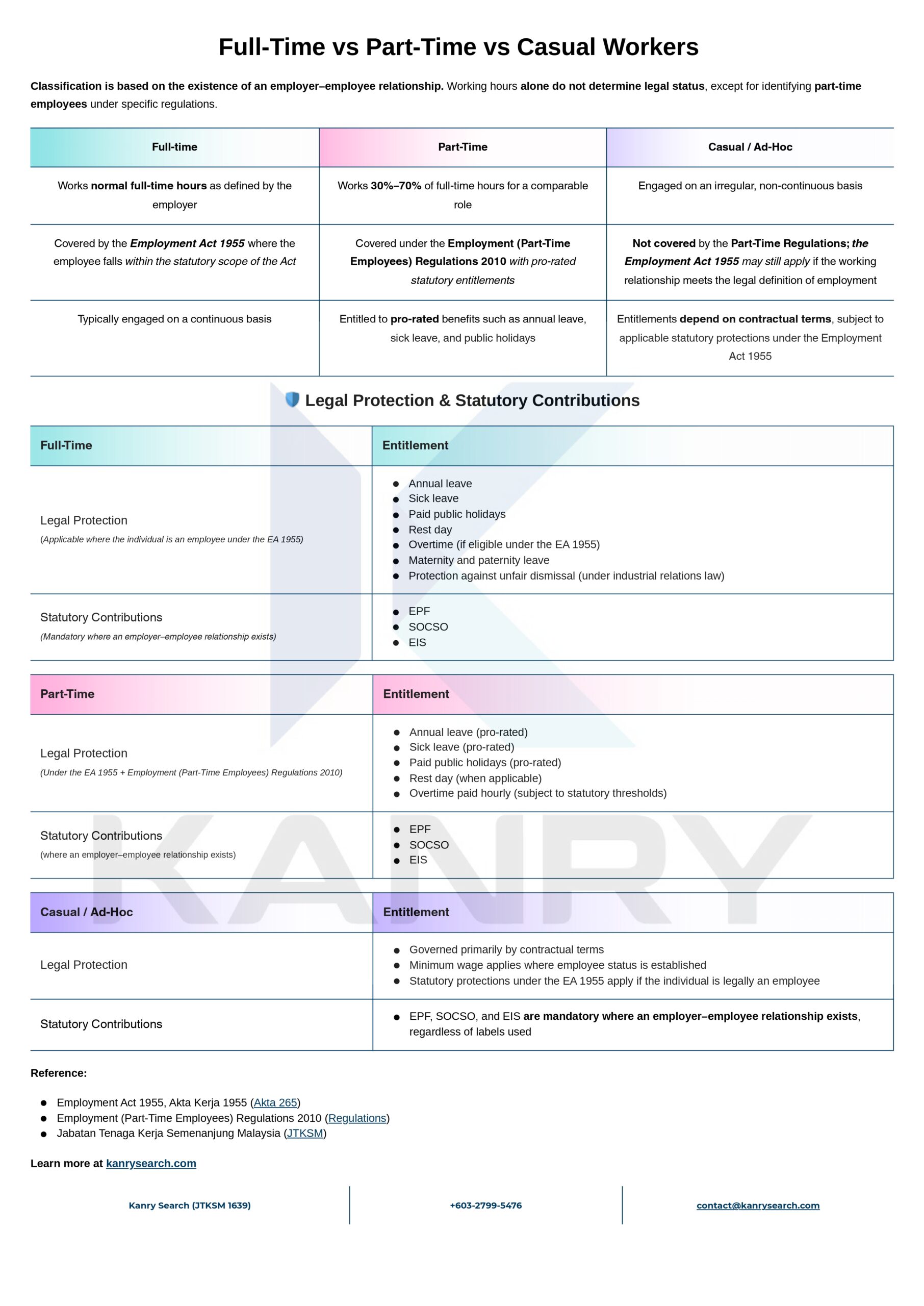
| Full-Time Workers | Part-Time Workers | Casual Workers |
| Full-time employees may be covered under EA1955, subject to the statutory scope | Covered under EA1955 + PT Regulations 2010 | Contract terms + general EA1955 (if applicable) |
JTKSM / MOHR
They provide authoritative guidance, handle complaints, and ensure compliance with labor laws across Malaysia.
Jabatan Tenaga Kerja Semenanjung Malaysia (Department of Labour Peninsular Malaysia) under the Ministry of Human Resources serves as the official enforcement and interpretation body for employment legislation.
Full-Time Employees
Full-time employment represents the standard employment relationship in Malaysia, providing workers with comprehensive statutory protections under the Employment Act 1955. Understanding what qualifies as full-time employment is crucial for proper classification.

Complete Legal Protection
Annual Leave

Full entitlement based on years of service
Sick & Hospitalisation Leave

Complete coverage as per EA1955 standards
Public Holidays

All gazetted public holidays with pay
- Additional Protections
- Weekly rest day entitlement
- Overtime pay for eligible categories
- Maternity protection (98 days)
- Paternity leave provisions
- Protection against unfair dismissal
- Statutory Contributions
- EPF — Employees Provident Fund for retirement
- SOCSO — Social Security Organisation coverage
- EIS — Employment Insurance System protection
Part-Time Employees
Part-time employees occupy a legally defined middle ground. Under the Part-Time Employees Regulations 2010, they’re entitled to the same benefits as full-time workers, but calculated proportionally to their hours worked.
A part-time employee works between 30% and 70% of the normal hours of a comparable full-time employee in the same establishment. This creates a clear boundary that determines coverage.Key Legal Protections for Part-Time Workers

Casual & Ad-Hoc Employees — Contractual Terms, Subject to Employment Law
Casual and ad-hoc workers generally perform work on an irregular, occasional, or “as-needed” basis. Under the Employment (Part-Time Employees) Regulations 2010, work that is irregular and does not exceed 30% of the normal weekly hours of a full-time employee is excluded from the part-time regulatory protections.
However, a contract label such as “casual” does not automatically remove statutory rights. If the overall working relationship, including factors such as control, personal service, wages, and integration into the business, meets the legal definition of an employee under the Employment Act 1955, the protections of that Act may still apply.
Unlike part-time employees who are covered by the Part-Time Employees Regulations 2010 and entitled to pro-rated statutory benefits, casual workers’ rights and benefits are governed by their employment contract, subject to any applicable statutory protections under the Employment Act 1955 and other labour laws.

Important Note: While casual workers don’t receive part-time statutory benefits, they’re not without protections.
Contract terms, basic EA1955 provisions (where applicable), and general employment principles still provide a framework for their working relationship.
Understanding the Differences
Each category has distinct characteristics defined by hours worked and legal coverage.

The boundaries between these categories are informed by actual hours worked relative to full-time standards and the nature of the working relationship, not by job titles or labels.
Common Myths vs. Legal Reality
Misinformation about employment categories spreads rapidly through social media, workplace gossip, and well-meaning but inaccurate advice. Let’s dismantle the most persistent myths with what Malaysian law actually says.

Why Accuracy Protects Everyone
Proper worker classification isn’t just about legal compliance. It’s about creating fair, transparent workplaces where both employers and employees understand their rights and obligations. When classification is accurate, everyone benefits.
For Employers
- Avoid costly disputes and potential legal challenges
- Apply benefits correctly and consistently across the workforce
- Prevent JTK enforcement issues and penalties
- Build trust and credibility with your employees
- Streamline HR processes with clear classification rules
For Employees
- Know your legal entitlements based on your status
- Understand your classification and what it means
- Avoid being misinformed about your rights
- Know what to expect in your employment contract
- Advocate for proper treatment with confidence
Hiring Is Easy. Getting It Right Is Harder.
If you’re:
- Reviewing worker classifications and contract structures
- Balancing operational demands with Employment Act compliance
- Scaling teams across multiple locations or business units
- Exploring flexible or project-based manpower models
Kanry Search supports your teams with clear, regulation-aware guidance and execution, so decisions hold up under scrutiny, not just pressure.
📩 Start a conversation with Kanry Search to build a workforce strategy that is compliant, resilient, and aligned with business goals.
📎 Source
📄 Employment Act 1955 (Act 265)
📄 Employment (Part-Time Employees) Regulations 2010