
When employees ask HR why their monthly PCB deduction has changed, the answer may involve more than a salary increase or bonus.
Employees can also request that certain eligible tax deductions and rebates be considered in their Monthly Tax Deduction (MTD), known in Malaysia as Potongan Cukai Bulanan (PCB).
This is where Borang TP1 becomes relevant.
For Malaysian employers, understanding TP1 is important because incorrectly processing employee claims can affect PCB calculations, payroll records and year-end tax reporting.
This guide explains what Borang TP1 is, who can use it, how to complete the 2026 form, the deductions employees may claim, and the internal checks employers should establish before processing a claim.
What Is Borang TP1 in Malaysia?
Borang TP1 is the Individual Tax Deduction and Rebate Claim Form for Monthly Tax Deduction Purposes, issued by Lembaga Hasil Dalam Negeri Malaysia (LHDN/HASiL).
It allows employees to declare eligible deductions and rebates that they wish their employer to consider when calculating PCB.
The official form is titled Borang PCB/TP1 (1/2026).
TP1 does not automatically entitle an employee to a tax refund. Instead, the information may affect the amount of income tax deducted through payroll, subject to the applicable rules and calculation method.
Employers should use the current-year form and explanatory notes.
Official documents:
- Download Borang TP1 2026 — Bahasa Malaysia
- Download TP1 2026 — English
- TP1 2026 Explanatory Notes — English
Is Borang TP1 Mandatory for Every Employee?
No. TP1 is a claim form used when an employee wishes to declare eligible deductions or rebates for PCB purposes.
An employee who does not make a TP1 claim is not automatically non-compliant simply because they have not submitted the form.
However, where an employee does submit TP1, the employer should ensure that the claim is handled according to LHDN’s requirements.
Who is responsible?
| Party | Responsibility |
|---|---|
| Employee | Declare accurate eligible claims and retain supporting documents |
| HR | Distribute the correct form and coordinate submission |
| Payroll | Review and process the applicable information in PCB calculations |
| Management | Establish approval controls, record retention and escalation procedures |
The employee is responsible for the accuracy of the declaration, while the employer remains responsible for its applicable PCB obligations.
Borang TP1 vs TP3 vs EA Form: What Employers Should Know
Although these forms all relate to employment taxation, they have different purposes.
| Form | Main purpose | Typical timing |
|---|---|---|
| TP1 | Employee claims eligible deductions and rebates for PCB | When the employee wishes to make an applicable claim |
| TP3 | Declares previous-employment information within the current year | During onboarding or when required for a new employee’s PCB calculation |
| EA Form | Reports annual employment remuneration and relevant tax information | Issued annually by the employer |
For example, an employee who joins in October 2026 may need TP3 to report January–September remuneration from a previous employer.
The same employee may separately submit TP1 to claim qualifying deductions for PCB purposes.
TP1 and TP3 are not interchangeable.
For a detailed explanation of previous-employment reporting, refer to Kanry Search’s Blog #6: Borang TP3 Malaysia 2026.
How to Complete Borang TP1 2026
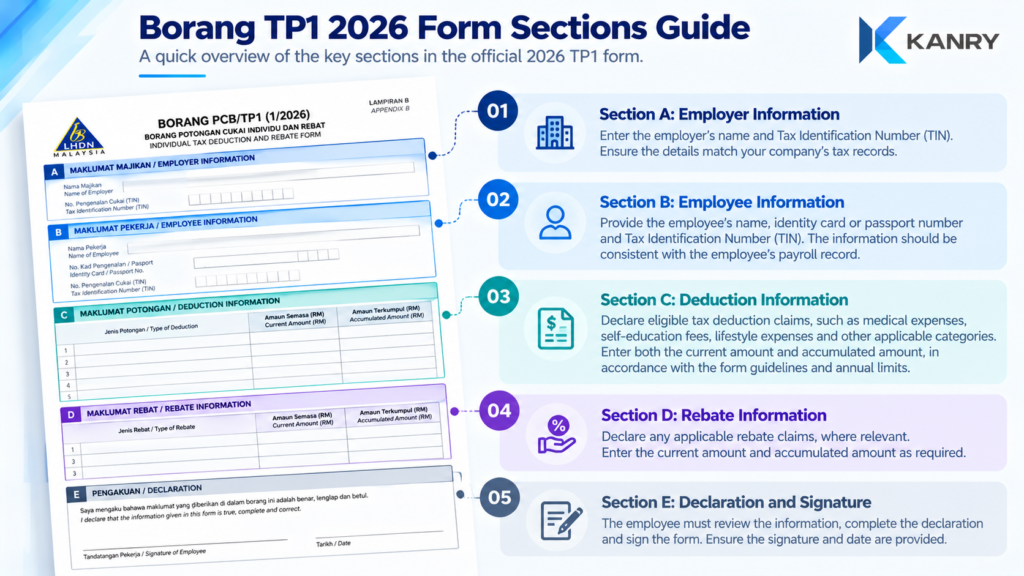
The 2026 TP1 form contains sections covering employer details, employee identification, deductions, rebates and declarations.
Section A: Employer Information
The form requests the employer’s name and Tax Identification Number (TIN).
HR should ensure that these details match the company’s tax records.
Section B: Employee Information
Employees provide their name, identity card or passport number, and TIN.
The information should match the employee’s payroll master record.
Section C: Deduction Information
This section contains the applicable deduction categories.
The employee enters the relevant claim amounts, taking account of the annual limits and any amounts already claimed.
The form distinguishes between current deductions and accumulated deductions.
This distinction is important because a claim should not be duplicated when an employee submits another TP1 later in the year.
Rebate Information and Declaration
Employees should complete any applicable rebate information and sign the declaration as required by the form.
The employer should review the relevant approval or acknowledgment fields before applying the claim to payroll.
Employers should follow the actual 2026 form layout rather than assuming that every year’s version contains identical fields.
What Tax Reliefs Can Employees Claim Through TP1 in 2026?
The official TP1 form includes several categories of deductions. The following are selected examples, not an exhaustive list.
Selected TP1 Tax Relief Categories — 2026
Annual deduction limits for selected categories in the official 2026 TP1 form.
PARENTS / GRANDPARENTS
RM8,000Qualifying medical, dental and care expenses.
DISABILITY SUPPORT EQUIPMENT
RM6,000Eligible basic support equipment.
SELF-EDUCATION
RM7,000Qualifying study fees and courses.
MEDICAL EXPENSES
RM10,000Qualifying expenses for self, spouse or child.
GENERAL LIFESTYLE
RM2,500Eligible books, devices, internet and courses.
These are selected annual limits, not guaranteed PCB reductions. Eligibility rules, sublimits and other conditions apply. Refer to LHDN’s official 2026 TP1 explanatory notes.
| Selected deduction category | 2026 annual limit | Important consideration |
|---|---|---|
| Medical treatment, dental treatment and care for parents or grandparents | RM8,000 | Eligible expenses and conditions apply |
| Basic support equipment for persons with disabilities | RM6,000 | Must meet the qualifying requirements |
| Self-education fees | RM7,000 | Eligible study and course conditions apply |
| Qualifying medical expenses for self, spouse or child | RM10,000 | Specific sublimits apply |
| General lifestyle expenses | RM2,500 | Limited to qualifying expenditure |
These limits are based on the official 2026 TP1 form and explanatory notes. Some categories contain sublimits and additional restrictions.
For example, not every medical purchase qualifies, and a lifestyle purchase is not automatically deductible simply because it falls within the general category.
Employees should consult the official explanatory notes before making a claim.
Important: The annual limits are not amounts that employees can automatically deduct from monthly PCB. They are limits on qualifying tax deductions, subject to the applicable tax calculation.
What Documents Should HR Collect for TP1 Claims?
LHDN’s explanatory notes state that employees submit the TP1 form to their employer without attaching receipts and supporting documents.
Employees must retain the relevant supporting documents for seven years from the year of the claim.
Employers must retain the TP1 form for seven years from the date of the claim.
TP1 Submission & Record Retention Checklist
Use this checklist before applying a claim to payroll.
Retain TP1 for seven years from the claim date.
Retain supporting receipts and documents for seven years from the claim year.
Checkbox selections are not saved. Supporting receipts are generally retained by the employee rather than attached to TP1.
HR should therefore distinguish between information the employer needs for payroll processing and documents the employee is required to retain personally.
A company may establish reasonable internal validation procedures, but these should be proportionate and protect employee privacy.
Can Employees Submit Borang TP1 More Than Once a Year?
Yes. LHDN permits TP1 to be submitted more than once during the current year.
This matters because employees may incur eligible expenses at different times.
For example, an employee might submit a qualifying lifestyle expense claim in March and later make a separate eligible medical-related claim in August.
When processing the later declaration, payroll must account for the relevant accumulated claims to avoid double-counting.
What employers should check
- The correct deduction month and year.
- Whether the claim falls within an eligible category.
- Whether annual limits and sublimits have been considered.
- Whether the amount was previously claimed.
- Whether the employee completed the necessary declaration.
- Whether the claim has been entered into payroll correctly.
Practical Example: An Employee Submits TP1 in November 2026
Consider a Malaysian employee who has been working with the same employer since January 2026.
In November, the employee wishes to declare qualifying lifestyle expenditure for PCB purposes.
The employee completes TP1 and provides the following illustrative information:
| Item | Example amount |
|---|---|
| Qualifying lifestyle expenses incurred | RM1,200 |
| Previously declared lifestyle deductions in 2026 | RM500 |
| Additional amount being declared | RM700 |
| General lifestyle annual limit | RM2,500 |
This example assumes the expenditure qualifies and that RM500 is already included in the employee’s accumulated claims.
PRACTICAL EMPLOYER EXAMPLE
November 2026 — Employee TP1 Claim
The employee declares RM1,200 in eligible lifestyle expenses for the year.
The employee has already declared RM500. HR confirms the new claim is properly recorded.
An additional RM700 is considered, subject to eligibility and the applicable annual limit.
Payroll applies LHDN’s prescribed calculation method rather than deducting RM700 directly from PCB.
A tax deduction claim is not the same as a cash reimbursement or an equivalent reduction in monthly PCB.
Does the employee receive RM700 more in take-home pay?
Not necessarily.
The RM700 is an additional deduction amount for tax calculation purposes, not a RM700 cash rebate or salary payment.
The actual effect on PCB depends on the employee’s taxable remuneration, other deductions and rebates, and LHDN’s prescribed calculation method.
Payroll should not simply subtract RM700 from the monthly PCB deduction.
How Does TP1 Affect Monthly PCB?
Monthly PCB is calculated using the applicable LHDN rules and payroll information.
When an employee submits a valid TP1 claim, eligible deductions and rebates may be reflected in the calculation.
However, the impact is not necessarily identical for every employee.
An employee with higher taxable income may see a different result from another employee making the same qualifying claim.
How TP1 Claims Reach Payroll
A simple control flow from employee declaration to monthly PCB.
Employee completes TP1.
HR checks completeness.
Payroll checks limits and previous claims.
Apply the official PCB method.
Always use the applicable LHDN calculation specification. A declared deduction does not reduce PCB ringgit-for-ringgit.
Employers should use the 2026 computerised PCB calculation specification or an applicable official LHDN calculation facility.
Official reference: LHDN — PCB Tables and Data Specifications.
Common Borang TP1 Mistakes Employers Should Avoid
Common TP1 Mistakes — And Better Approaches
Use these practical checks to reduce payroll errors.
Fields and limits may change.
Better: Use the official 2026 TP1.Accumulated deductions may be overstated.
Better: Reconcile current and previous claims.The PCB reduction may be miscalculated.
Better: Apply the prescribed PCB method.Some categories have additional restrictions.
Better: Read the official explanatory notes.Claims may lack required confirmation.
Better: Check form completeness before processing.Personal tax data may be exposed.
Better: Restrict access and retain records securely.Typical errors include using an outdated form, treating deduction limits as cash rebates, entering accumulated claims twice, accepting incomplete declarations and failing to retain records.
Employers should also avoid requesting unnecessary sensitive documentation or allowing unrestricted access to employee tax information.
A documented review process can reduce repeated corrections and improve payroll consistency.
Who Is Responsible for TP1 Compliance?
TP1 processing involves employee declarations and employer payroll administration.
The employee should provide accurate information and retain supporting evidence. HR should coordinate form collection and ensure that declarations are complete.
Payroll should apply the relevant figures in accordance with the prescribed PCB method.
Management should establish clear responsibilities, access controls and exception-handling procedures.
Who Does What for TP1 Compliance?
A practical division of responsibilities.
Declare eligible claims accurately and retain supporting evidence.
Collect the current form and check completeness.
Review claim figures and apply the correct PCB calculation.
Set approval controls, accountability and exception procedures.
The employer remains responsible for its applicable PCB obligations, including when payroll administration is delegated or outsourced.
Even where the payroll process is outsourced, the employer remains responsible for meeting its applicable statutory PCB obligations.
Frequently Asked Questions About Borang TP1 Malaysia 2026
Borang TP1 Malaysia 2026 — FAQs
Click a question to expand the answer.
What is Borang TP1 used for?
TP1 allows employees to declare eligible tax deductions and rebates for monthly PCB calculation purposes.
Is TP1 compulsory for every employee?
No. It is used when an employee wishes to claim applicable deductions or rebates for PCB purposes.
Can employees submit TP1 more than once in 2026?
Yes. LHDN permits multiple submissions during the current year. Previously claimed amounts should be considered to avoid duplication.
Must employees attach receipts to TP1?
LHDN’s explanatory notes state that the TP1 copy submitted to the employer is without receipts and supporting documents. Employees must retain their supporting evidence for the required period.
How long must employers retain TP1?
Employers must retain TP1 for seven years from the date of the claim, according to LHDN’s 2026 explanatory notes.
Does a RM1,000 tax deduction reduce PCB by RM1,000?
No. A qualifying tax deduction affects the calculation of taxable income. Its impact on PCB depends on the employee’s overall tax circumstances and the prescribed calculation method.
What is the difference between TP1 and TP3?
TP1 is used for eligible deduction and rebate claims. TP3 provides information from previous employment during the current year for PCB calculation.
Where can I download Borang TP1 2026?
Download the official form from LHDN’s TP1 2026 PDF and refer to the accompanying explanatory notes.
Information is general and subject to the applicable LHDN requirements for 2026.
How Kanry Search Supports Malaysian Employers
Managing payroll accurately requires more than entering salary figures into a system.
Employers must also coordinate employee declarations, statutory contributions, payroll deductions and record retention.
For companies with frequent hiring, multiple employee categories or outsourced workforce arrangements, clear processes can reduce administrative mistakes.
Kanry Search supports Malaysian employers with recruitment, contract staffing, payroll administration and workforce-related HR services.
Need Recruitment or Payroll Administration Support?
Contact Kanry Search to discuss your organisation’s recruitment, staffing and payroll administration requirements.
Official References
- LHDN — Borang TP1 2026 (Bahasa Malaysia)
- LHDN — Form TP1 2026 (English)
- LHDN — TP1 2026 Explanatory Notes
- LHDN — PCB Tables and Data Specifications
- LHDN — Employer Responsibilities
Disclaimer: This article provides general employer information as of 12 October 2026. Tax relief eligibility, limits and payroll treatment depend on the applicable rules and individual circumstances. Employers and employees should refer to LHDN’s official guidance or a qualified tax professional.