
Hiring a new employee in Malaysia involves more than preparing an offer letter and confirming a start date.
For employers, the onboarding process includes statutory registrations, payroll configuration, employee tax notifications, employment documentation and workplace orientation.
Missing an important step may result in incorrect statutory contributions, payroll discrepancies, incomplete employee records or compliance issues.
Whether your company is hiring its first employee or expanding an existing workforce, having a structured onboarding checklist helps HR and payroll teams manage their responsibilities consistently.
This guide outlines eight important employee onboarding obligations in Malaysia for 2026, including EPF, SOCSO, EIS, LHDN notifications and payroll preparation.
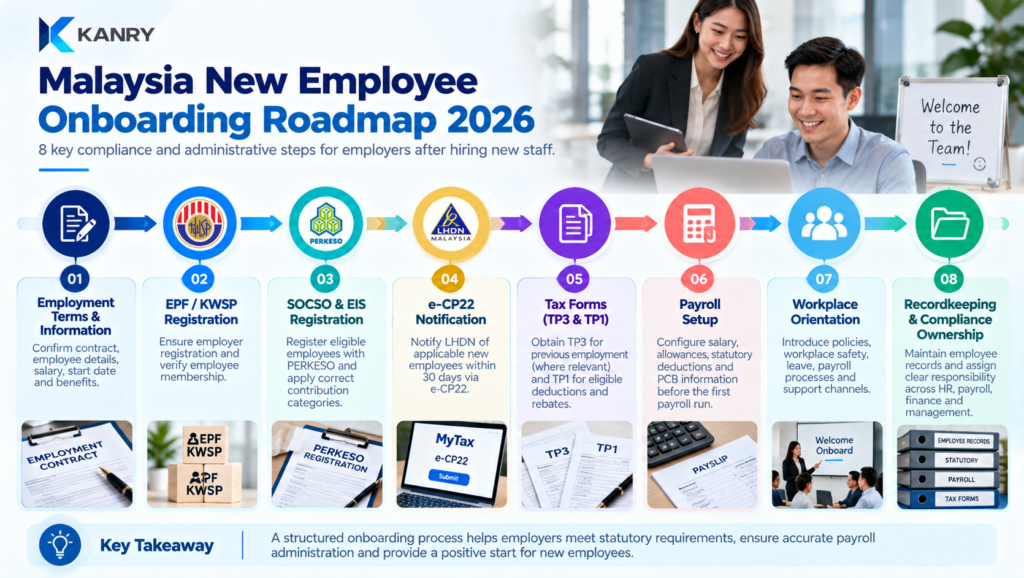
Confirm Employment Terms and Employee Information
Before a new employee begins work, HR should ensure that all essential employment information has been collected and verified.
This includes the employee’s full legal name, identification details, job title, reporting line, commencement date, agreed salary, working hours and employment benefits.
Employers should also ensure that employment terms comply with the applicable requirements of Malaysian employment law.
For employees working in Peninsular Malaysia and Labuan, the Employment Act 1955 is a key reference. Sabah and Sarawak have their respective labour legislation.
What HR should verify:
- Employment contract and agreed terms.
- Employee identification and contact information.
- Salary, allowances and payment arrangements.
- Working hours, leave and benefits.
- Nationality and work authorisation, where applicable.
A standardised employee information form helps reduce payroll errors caused by incomplete or inconsistent records.
Check EPF Registration and Employee Membership
The Employees Provident Fund (EPF), also known as KWSP, is an important part of statutory payroll administration.
Employers who become liable to contribute must register with KWSP within the applicable registration period. KWSP states that employer registration must be completed within seven days of becoming liable to contribute.
For a newly hired employee, HR should verify whether the individual already has an EPF membership.
Existing members generally do not need a new membership number.
Employers must also determine the correct contribution treatment based on the employee’s eligibility, age, nationality and applicable statutory requirements.
Employer Registration vs Employee Membership
| Employer registration | Employee membership |
|---|---|
| Registers the business as a contributing employer | Establishes or verifies the employee’s EPF membership |
| Relevant when the employer becomes liable to contribute | Relevant when onboarding an employee |
| Employer registration deadline applies | Verify membership and follow the applicable registration process |
| Managed through KWSP employer channels | Managed through applicable KWSP registration facilities |
Important for 2026: EPF contribution rules for eligible non-Malaysian employees have changed. Employers should confirm the current treatment rather than assuming that all foreign employees are exempt.
Official reference: KWSP — Employer Responsibilities.
Register Eligible Employees for SOCSO and EIS
Employers must assess whether new employees are covered under the relevant PERKESO social security schemes and the Employment Insurance System (EIS).
SOCSO provides statutory social security protection under applicable schemes, while EIS provides employment insurance benefits to eligible insured employees.
Employer and employee registration activities are generally managed through PERKESO’s ASSIST Portal.
HR and payroll should check employee eligibility, registration status, wage information and the applicable contribution category.
NEW EMPLOYEE COMPLIANCE
PERKESO / EIS Onboarding Checklist
Seven essential checks for registering eligible employees and preparing statutory contributions.
Complete registrations within the applicable statutory deadlines, verify employee coverage and apply current contribution requirements. Different rules may apply to foreign workers and other employee categories.
Reference: PERKESO Official Website . Checklist selections are not saved.
Employers should follow the applicable PERKESO registration and contribution deadlines.
Official reference: PERKESO.
Determine Whether e-CP22 Notification Is Required
Borang CP22 is used to notify Lembaga Hasil Dalam Negeri Malaysia (LHDN) when a new employee meets the applicable income tax notification criteria.
Where notification is required, the employer must generally submit it within 30 days of the employee’s commencement date.
Since 1 September 2024, the applicable notification is submitted electronically through e-CP22 via MyTax.
Not every new employee necessarily requires notification. Employers should assess the relevant criteria rather than treating all new hires identically.
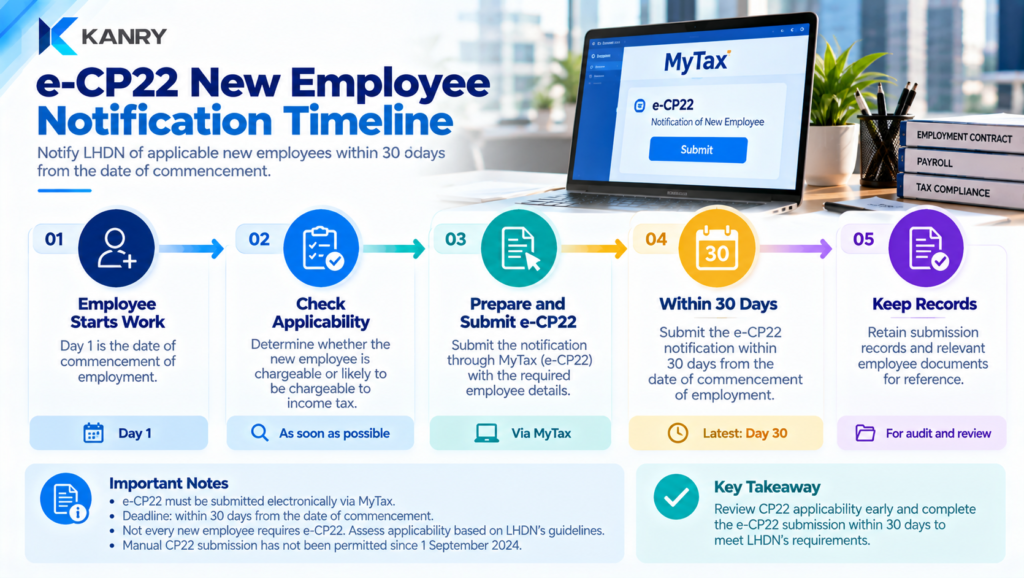
The notification deadline is calculated from commencement of employment, not from the first payroll date.
Official reference: LHDN — Employer Responsibilities.
Obtain Relevant Tax Forms, Including TP3
When an employee joins a new company during the calendar year, payroll may need information from the employee’s previous employment.
Borang TP3 is used to declare relevant previous-employment remuneration and tax deduction information for PCB purposes.
For example, an employee joining in October 2026 may have earned income and paid PCB through a previous employer between January and September 2026.
The new employer should consider the relevant information when applying the prescribed PCB calculation.
Employees may also submit Borang TP1 if they wish to claim eligible deductions and rebates for monthly PCB purposes.
Which form is used for what?
| Form | Purpose |
|---|---|
| e-CP22 | Employer notification of a qualifying new employee |
| TP3 | Current-year previous-employment information |
| TP1 | Eligible employee tax deduction and rebate claims |
These forms are not interchangeable.
For more details, refer to Kanry Search’s earlier articles on Borang TP3 Malaysia 2026 and Borang TP1 Malaysia 2026.
Configure Payroll and Statutory Deductions
Before processing the employee’s first salary, payroll should verify that all relevant information has been entered correctly.
This includes basic salary, taxable allowances, applicable overtime and commission arrangements, statutory contribution categories, bank details and employee tax information.
Incorrect payroll configuration may result in under-deductions, over-deductions or adjustments in subsequent months.
KANRY SEARCH | MALAYSIA 2026
First Payroll Readiness Checklist
Before approving a new employee’s first salary payment, verify these eight essential payroll items.
Payroll Compliance Reminder
An employee’s first payroll should reflect the correct remuneration, statutory deductions and tax information. Check the latest KWSP, PERKESO and LHDN requirements, including employee-specific eligibility and contribution rules.
Prepared by Kanry Search | Malaysia HR & Payroll Compliance Series. Checklist selections are for reference only and are not saved.
Employers should use the applicable 2026 LHDN PCB calculation specification and current KWSP and PERKESO contribution requirements.
Provide Workplace Orientation and Required Policies
Employee on-boarding should include an introduction to the organisation’s workplace expectations, internal procedures and support channels.
The orientation process may cover working hours, attendance reporting, leave applications, payroll dates, workplace safety, confidentiality and employee data protection.
Employees should also understand whom to contact if they encounter payroll discrepancies, workplace concerns or safety issues.
For employees working in manufacturing, engineering, warehousing or other operational environments, role-specific safety training may be especially important.
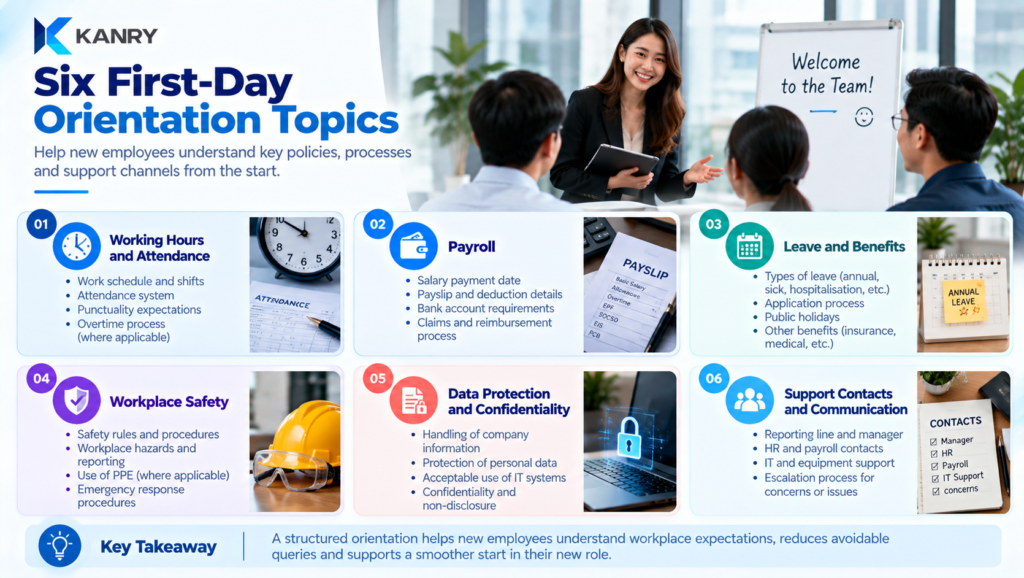
A structured orientation programme helps new employees understand their responsibilities and reduces avoidable HR queries.
Maintain Accurate Employee Records and Compliance Ownership
Employers should maintain appropriate employee records and ensure that on-boarding responsibilities are assigned clearly.
HR typically coordinates employment documentation and employee information.
Payroll manages salary configuration, statutory deductions and payroll processing.
Finance may oversee payment approvals and reconciliations, while management ensures that compliance procedures are established and followed.
Who is responsible?
| Department | Main responsibilities |
|---|---|
| HR | Employee documents, onboarding and notification coordination |
| Payroll | EPF, SOCSO, EIS, PCB and salary setup |
| Finance | Payment controls, reconciliations and remittances |
| Management | Compliance oversight and escalation |
Important: Delegating an on-boarding task to another department or external provider does not automatically remove the employer’s applicable statutory obligations.
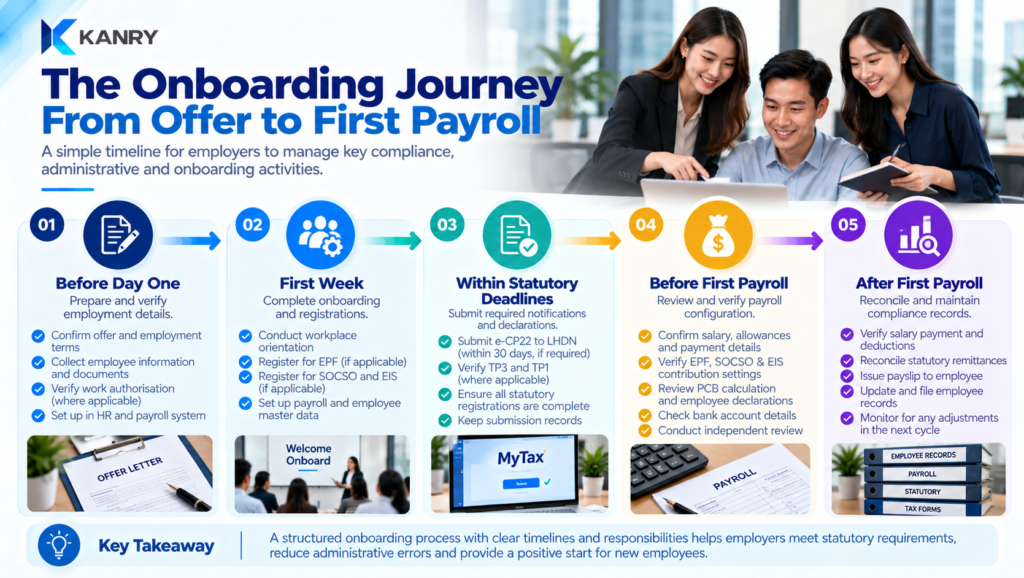
New Employee Onboarding Timeline: Before Day One to First Payroll
Common Employee Onboarding Compliance Mistakes
| Common mistake | Why it matters | Better approach |
|---|---|---|
| Missing a required e-CP22 notification | Employer tax reporting may be incomplete | Assess every new hire for applicability |
| Incorrect EPF registration handling | Contribution administration may be affected | Verify employer and employee registration status |
| Using the wrong SOCSO or EIS category | Contributions may be inaccurate | Check eligibility and applicable contribution rules |
| Missing TP3 information | Previous-employment income may be omitted from PCB | Review current-year previous employment |
| Incorrect first payroll | Employees may receive inaccurate deductions | Conduct a pre-payroll verification |
| No assigned onboarding owner | Tasks may be overlooked | Use an onboarding tracker with named responsibilities |
| Unsecured employee records | Personal information may be exposed | Apply access controls and secure storage |
Employers can reduce these risks by implementing a standardised on-boarding workflow with clear responsibilities, deadlines and review procedures.
Frequently Asked Questions About Employee Onboarding Malaysia 2026
KANRY SEARCH | MALAYSIA 2026
Frequently Asked Questions
Common questions about new employee onboarding, statutory registration, tax notifications and payroll compliance in Malaysia.
1. What documents should HR collect from a new employee?
2. Does every new employee need a new EPF account?
3. When must an employer register with KWSP?
4. Is e-CP22 required for every new employee?
5. What is the e-CP22 submission deadline?
6. Why does a new employee need Borang TP3?
7. Is Borang TP1 compulsory for new employees?
8. Who is responsible for compliance if payroll is outsourced?
Official References
KWSP / EPF | PERKESO | LHDN
Prepared by Kanry Search | Malaysia HR & Payroll Compliance Series. Information is general guidance; refer to current official requirements.
How Kanry Search Supports Malaysian Employers
Recruitment does not end when a candidate accepts an offer.
Employers must also coordinate employee on-boarding, workforce records, statutory deductions and payroll administration.
Kanry Search supports Malaysian businesses with recruitment, contract staffing, payroll administration and workforce-related HR services.
For companies expanding their workforce or managing multiple employee categories, structured on-boarding can help reduce administrative errors and improve operational consistency.
Contact Kanry Search to discuss your recruitment, staffing and payroll administration requirements.
Official References
- KWSP — Employer Registration
- KWSP — Employee Registration
- PERKESO — Official Website
- LHDN — Employer Responsibilities
- LHDN — PCB Tables and Data Specifications
Disclaimer: This article provides general employer information for 2026. Specific statutory obligations may differ depending on employee eligibility, employer status, nationality and applicable legislation. Refer to the relevant Malaysian authorities for current requirements.