
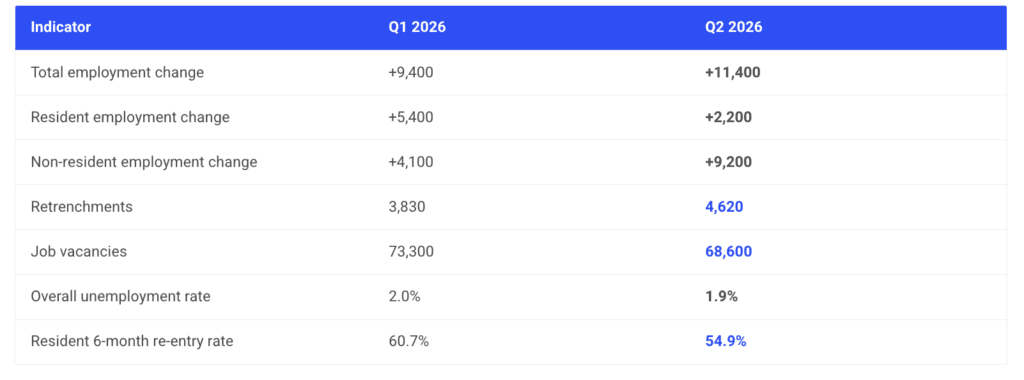
Singapore recorded its 19th consecutive quarter of employment growth in Q2 2026, with total employment increasing by 11,400. But beneath the headline, the labour market is becoming more cautious.
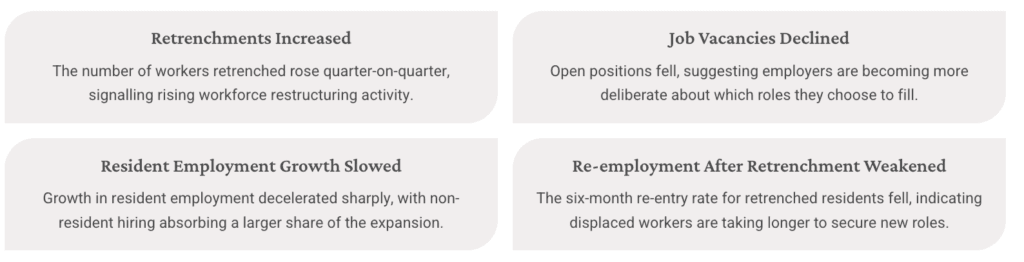
Singapore Labour Market: What Changed?
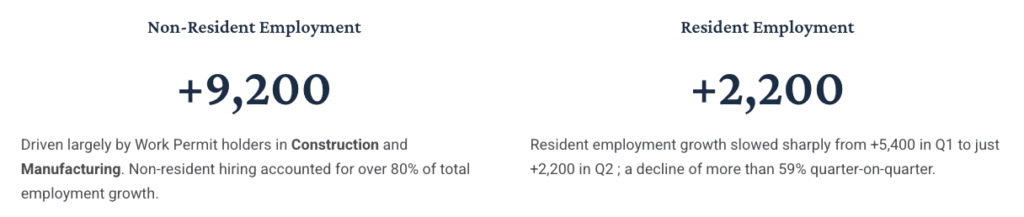
Where Employment Growth Came From
Of the 11,400 increase in total employment in Q2 2026, the composition reveals a significant structural shift in who is driving growth.
Retrenchments Are Rising
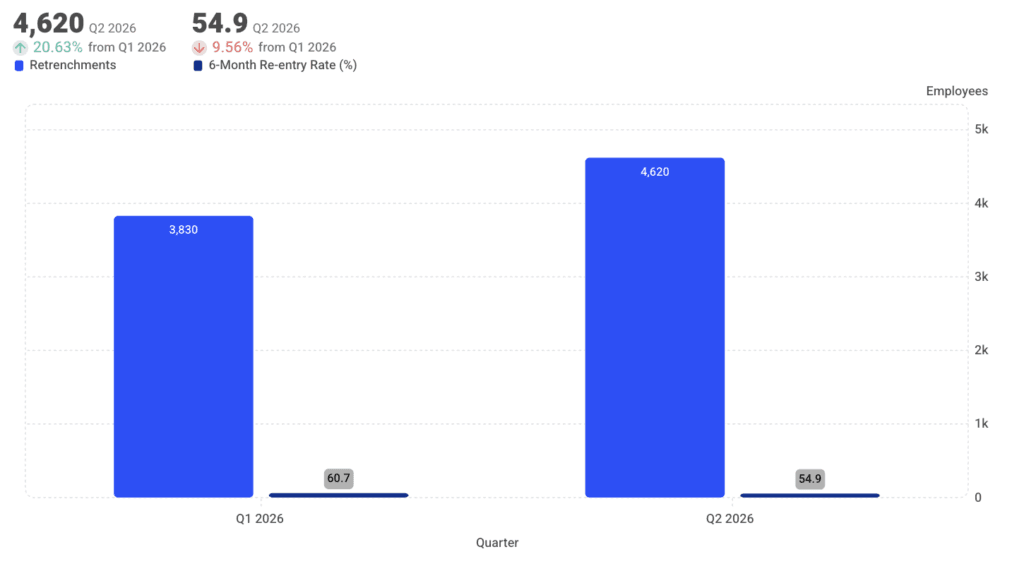
Retrenchments increased from 3,830 in Q1 2026 to 4,620 in Q2 2026, a rise of approximately 21% quarter-on-quarter. At the same time, the ability of displaced workers to re-enter employment has weakened.
The percentage of retrenched residents who found employment within six months fell from 60.7% to 54.9%, suggesting displaced workers may be taking longer to secure their next role.

Job Vacancies Are Falling
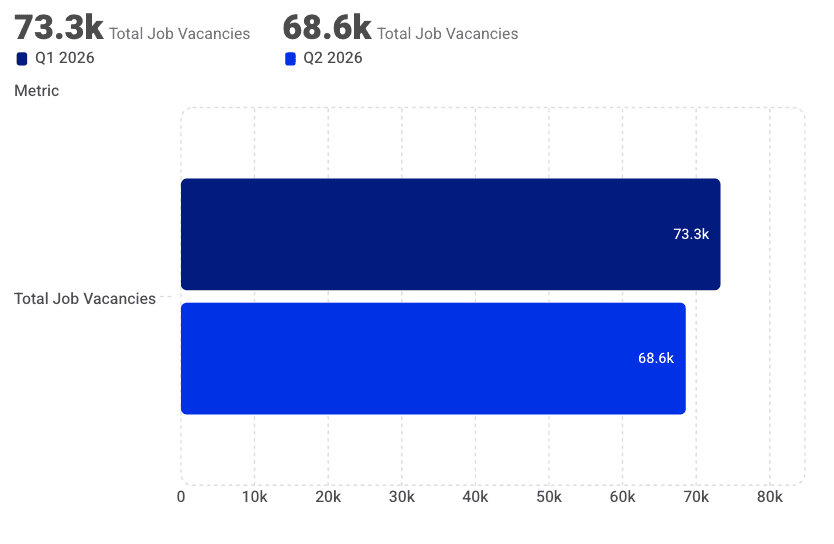
Job vacancies declined from 73,300 in Q1 to 68,600 in Q2; a drop of 4,700 open positions. PMET vacancies also softened in key knowledge-economy sectors.
Sectors Where PMET Vacancies Softened
- Financial Services
- Information & Communications
There are still more vacancies than unemployed people, but employers appear to be becoming more selective about which roles they hire for.
Hiring Intentions Are Mixed
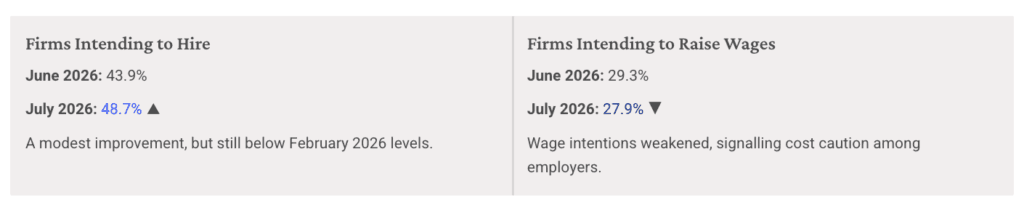
Employer hiring intentions improved slightly from June to July 2026, but wage intentions weakened and both remain below February 2026 levels. Companies are not necessarily stopping hiring; they are becoming more deliberate.
What This Means for HR
For HR leaders, the key question is no longer “Are we hiring?”. It is “Which positions are important enough to hire for now?”
Prioritise Business-Critical Vacancies
Not every open role warrants immediate action. Focus recruitment resources on positions that directly affect revenue, operations, or capability.
Redeploy or Re-skill Existing Employees
Before opening new headcount, assess whether internal talent can be redeployed or up-skilled to meet emerging needs.
Maintain Pipelines for Hard-to-Fill Roles
Talent pipelines for specialised or leadership positions should be maintained even when immediate hiring is paused.
Review Roles Vulnerable to Restructuring
Proactively identify positions at risk and develop contingency plans before restructuring becomes reactive.
Use Flexible Staffing Where Demand Is Uncertain
Temporary and contract arrangements allow organisations to respond to demand without committing to permanent headcount.
Workforce Strategy Is Changing
As companies manage uncertainty, workforce strategies may increasingly combine multiple hiring modalities. The objective is not simply to fill every vacancy, it is to maintain access to the right talent while controlling headcount risk.

Planning Your 2027 Workforce?
If your organisation is reviewing headcount, salary budgets or hard-to-fill positions, Kanry Search can support you with market insights and recruitment solutions across permanent hiring, executive search, and temporary & contract staffing.
Contact us now about your 2027 manpower plans!
Sources
- Ministry of Manpower, Singapore — Labour Market Report – Second Quarter 2026
- MOM Statistics — Labour Market Report Q2 2026