
Malaysia’s salary market continued to strengthen in 2025, but the national average tells only part of the story. Department of Statistics Malaysia (DOSM) Salaries & Wages Survey Report 2025, released in September 2026. It mainly examines monthly salaries and wages of Malaysian citizens working as paid employees in their principal jobs, with selected data on non-citizens.
DOSM’s Salaries & Wages Survey is a household-based labour market survey. The figures are useful for broad wage trends but should not be treated as direct market-rate benchmarks for individual vacancies.
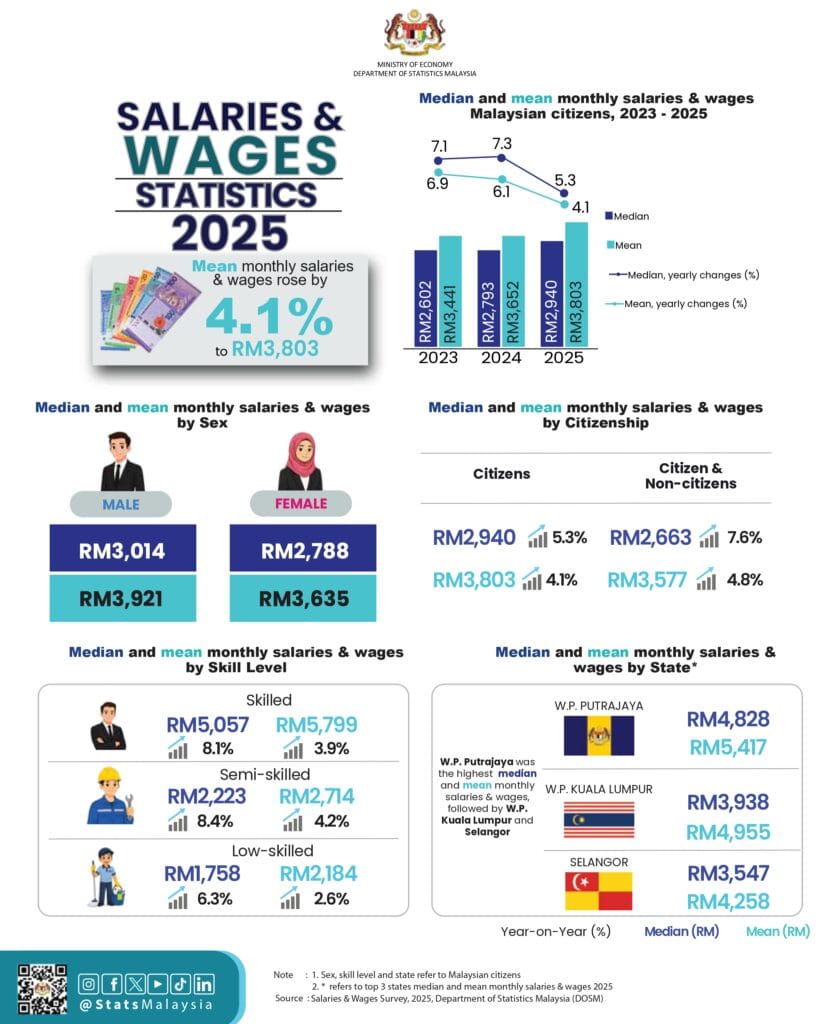
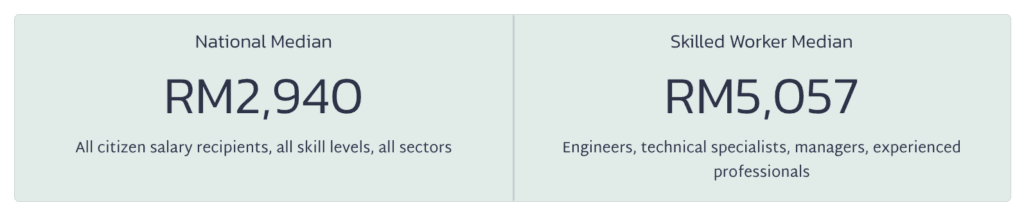
Malaysia’s Median Salary Reached RM2,940
In 2025, Malaysia had approximately 10.38 million citizen salary and wage recipients. The difference between the median (RM2,940) and mean (RM3,803) shows that higher earners are pulling the overall average upward.

Skill Level Creates a Major Salary Gap
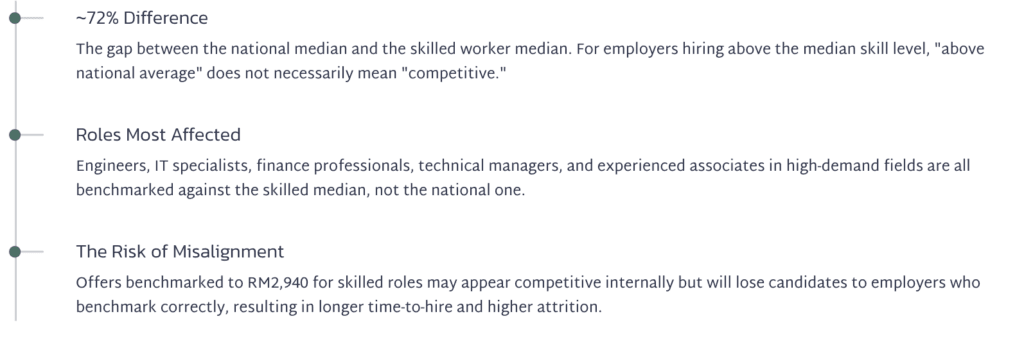
Salary levels vary significantly across skill categories. Skilled workers earn around 72% more than the national median, while low-skilled workers earn well below it. A national salary benchmark may significantly underestimate the market rate for skilled talent.
| Skill level | Median 2025 | Mean 2025 |
| Skilled | RM5,057 | RM5,799 |
| Semi-skilled | RM2,223 | RM2,714 |
| Low-skilled | RM1,758 | RM2,184 |
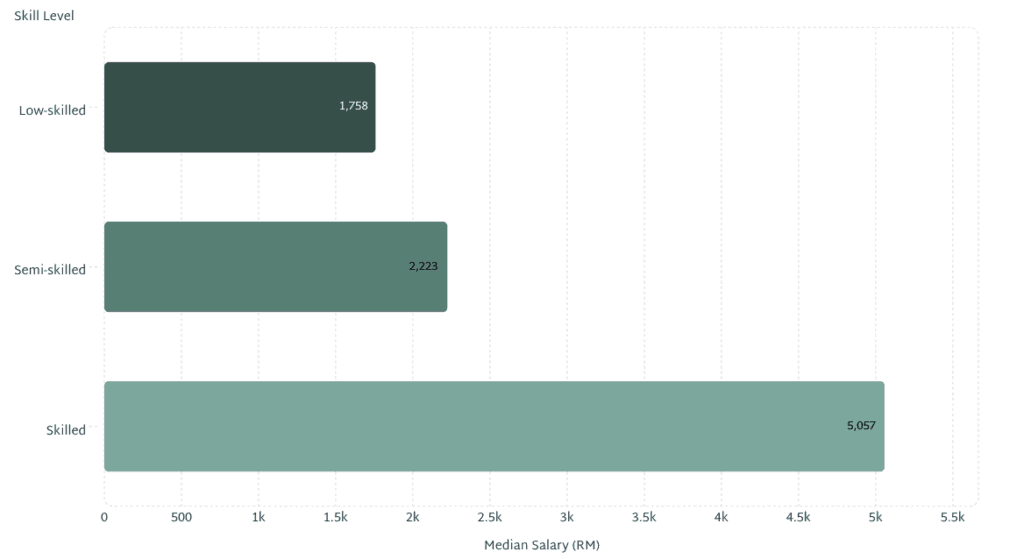
Using the national median of RM2,940 as a benchmark for skilled roles may underestimate the salary levels observed among skilled workers.
Managers and professionals remain Malaysia’s highest-paid occupational groups
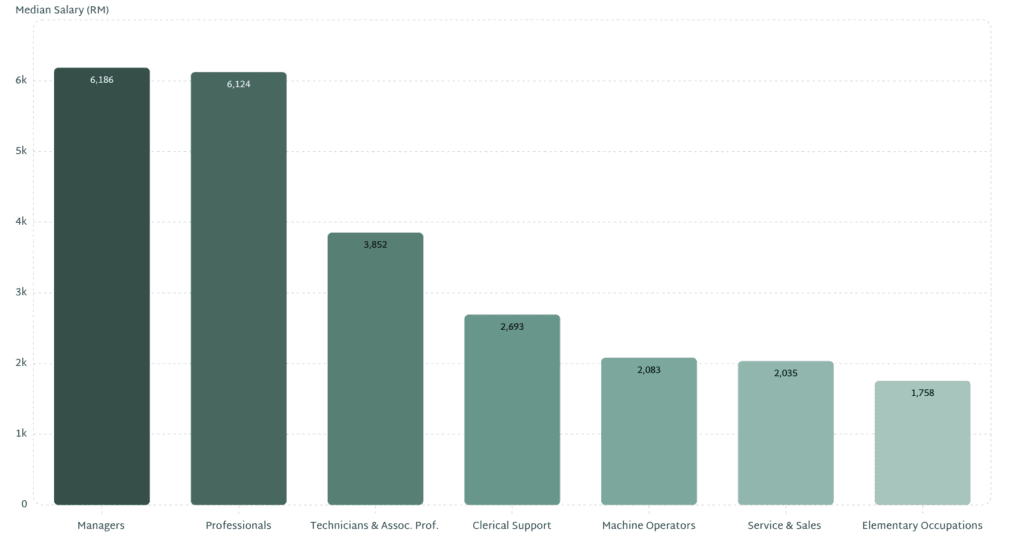
Salary levels differ substantially across occupational categories. Managers recorded the highest median at RM6,186 and the highest mean at RM7,344, closely followed by Professionals at RM6,124. Elementary occupations recorded the lowest median salary among occupational groups at RM1,758.
| Occupation | Median Salary |
| Managers | RM6,186 |
| Professionals | RM6,124 |
| Technicians & Associate Professionals | RM3,852 |
| Clerical Support | RM2,693 |
| Machine Operators & Assemblers | RM2,083 |
| Service & Sales | RM2,035 |
| Elementary Occupations | RM1,758 |
Higher Qualifications, Higher Earnings
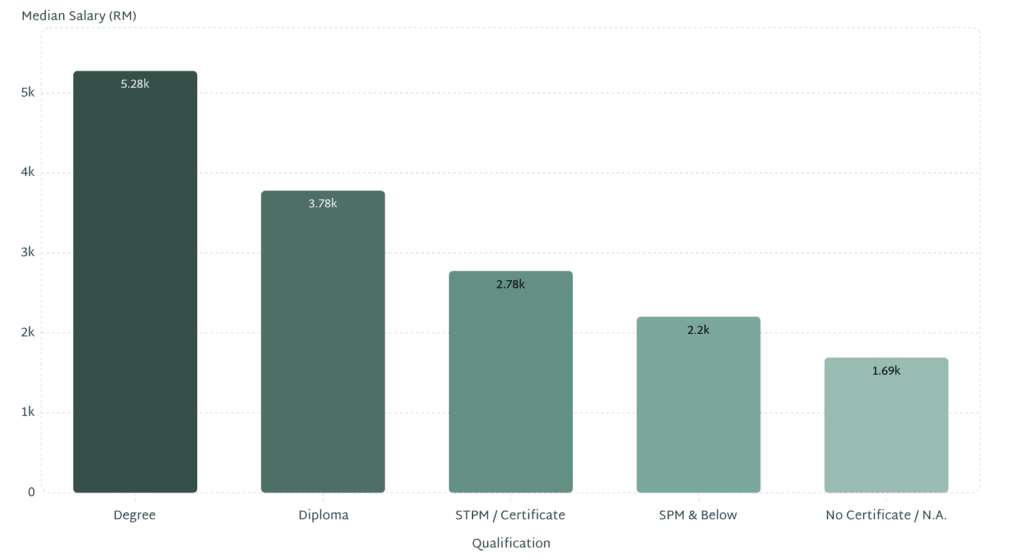
Salary levels differ significantly across educational attainment groups. Degree holders recorded a median of RM5,276 and an average monthly salary of RM6,453, more than three times the median for those with no certificate.
Employees with tertiary education recorded a median monthly salary of RM4,571, compared with:
- Secondary education: RM2,227
- Primary/lower education: RM1,754
- No formal education: RM1,642
Tertiary-educated workers also recorded an average monthly salary of RM5,260.
| Qualification | Median Salary |
| Degree | RM5,276 |
| Diploma | RM3,779 |
| STPM / Certificate | RM2,775 |
| SPM & Below | RM2,203 |
| No Certificate / N.A. | RM1,691 |
Degree holders had an average salary of RM6,453, while diploma holders averaged RM4,246.
A particularly interesting point is that the median for tertiary-educated employees jumped 10.7% year-on-year, from RM4,131 to RM4,571.
Location Matters
Geographic location is a critical but often overlooked dimension of salary benchmarking. Only four locations recorded median salaries above the national median of RM2,940. A salary considered competitive in one location may not be competitive in another.

For mean salaries, Putrajaya remained highest at RM5,417, followed by Kuala Lumpur at RM4,955, Selangor at RM4,258 and Penang at RM3,912.
Urban vs Rural Salary Gap
The urban-rural divide remains a defining feature of Malaysia’s wage landscape. Around 85.1% of salary recipients lived in urban areas in 2025. Rural wages did record strong growth, rising from RM1,698 in 2024 to RM2,035 in 2025. But the gap with urban earnings remains substantial.
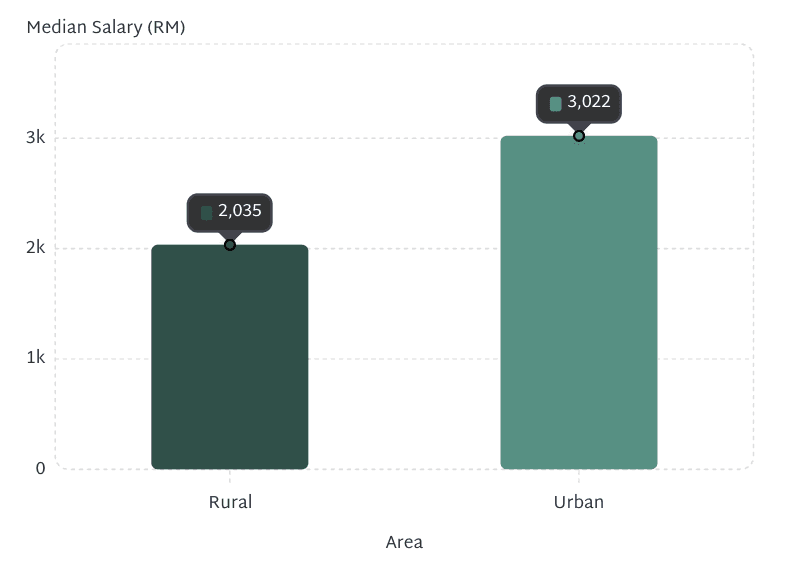
RM 3,022: Urban Median
85.1% of all salary recipients
RM 2,035: Rural Median
Up from RM1,698 in 2024. Strong YoY growth
The urban-rural gap stands at RM987 per month. The urban median was approximately 48.5% higher than the rural median. Despite rural wage growth outpacing some urban segments, the gap may be influenced by differences in job mix, industries and economic activity across urban and rural areas.
Which Sectors Pay More?
Industry sector is another key dimension for salary benchmarking. Mining & Quarrying recorded the highest median monthly salary at RM4,604. Agriculture sits at the bottom, consistent with its concentration of low-skilled and rural workers.
| Sector | Median Salary |
| Mining & Quarrying | RM4,604 |
| Services | RM3,043 |
| Manufacturing | RM2,663 |
| Agriculture | RM1,813 |
Industry-level figures should not be used alone to benchmark individual roles. Sector medians mask wide variation by occupation, skill level, and company size within each industry.
Men continue to earn more than women on both median and average measures
| In 2025: | Men | Women |
|---|---|---|
| Median | RM3,014 | RM2,788 |
| Mean | RM3,921 | RM3,635 |
Both groups recorded salary growth. DOSM data shows a difference between the median monthly earnings of male and female employees. Men’s median increased 5.8%, while women’s increased 5.6%.
Earnings generally rise with age before flattening or declining later
The highest median salary was recorded among employees aged 40–44, at RM3,826.
The highest mean salary, however, belonged to employees aged 50–54, at RM4,783.
Employees aged 15–19 recorded the lowest median, at RM1,776.
The different age groups with the highest median and highest mean also show why median and average salaries can tell different stories.
The Key Hiring Insight
The single most important takeaway from the 2025 DOSM data is the distance between the national headline figure and the skilled-worker reality. From a recruitment perspective, relying only on the national median may not accurately reflect compensation expectations for specialised roles.
Salary Growth vs Purchasing Power
Nominal median salary: RM2,940
Real median salary: RM2,184
Nominal mean salary: RM3,803
Real mean salary: RM2,825
Source: Department of Statistics Malaysia (DOSM), Salaries & Wages Survey Report 2025