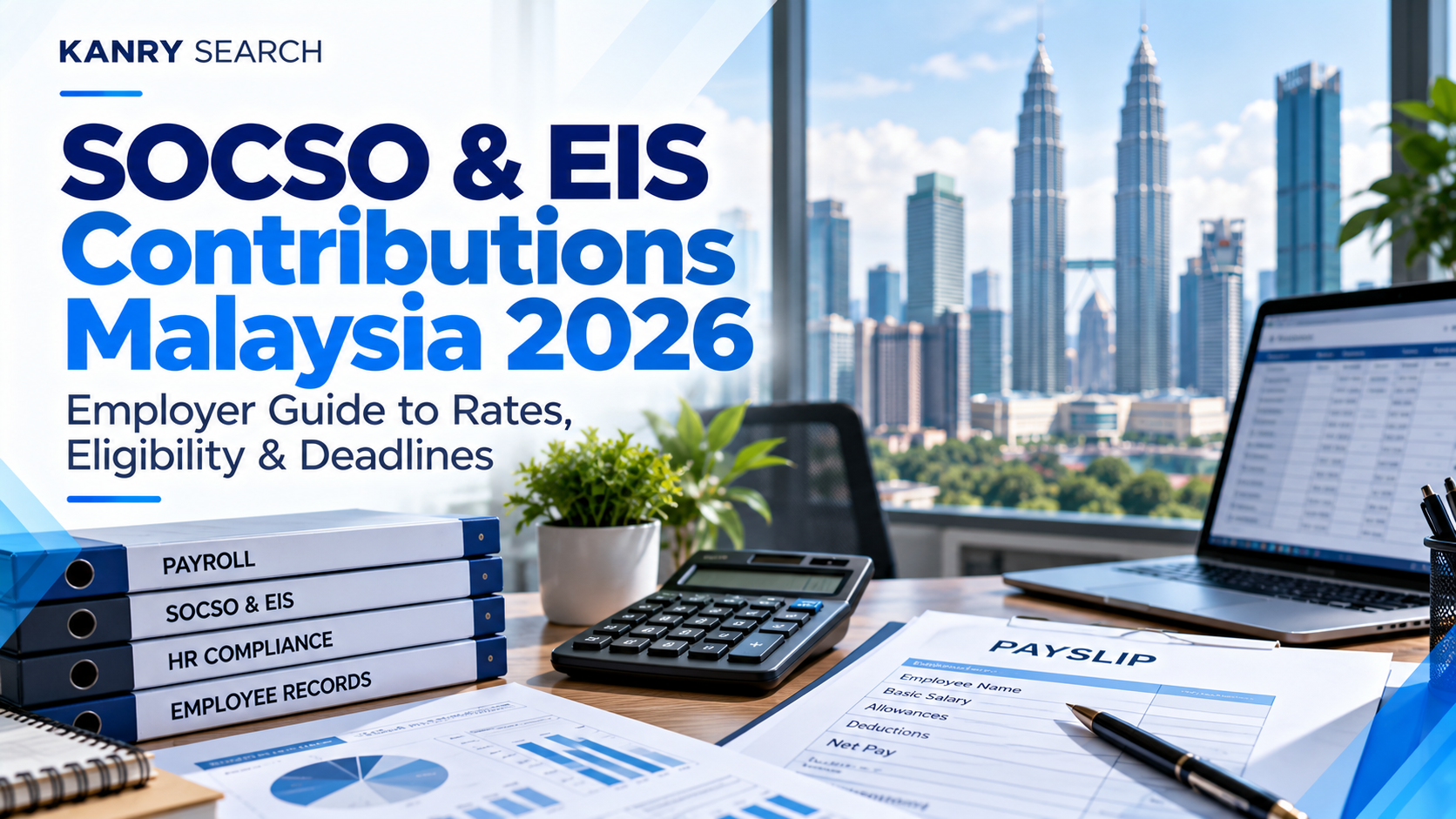

Managing employee payroll in Malaysia involves more than calculating basic salary, overtime and allowances.
Employers must also determine the correct statutory contributions, including the Social Security Organisation (SOCSO or PERKESO) and the Employment Insurance System (EIS or SIP).
Although SOCSO and EIS are administered by PERKESO, they provide different types of protection and have different eligibility requirements.
For employers, incorrect employee classifications, outdated contribution schedules or missed payment deadlines can lead to payroll discrepancies and compliance problems.
This guide explains how SOCSO and EIS contributions work in Malaysia in 2026, including the RM6,000 contribution wage ceiling, employer responsibilities, foreign worker considerations and practical payroll checks.
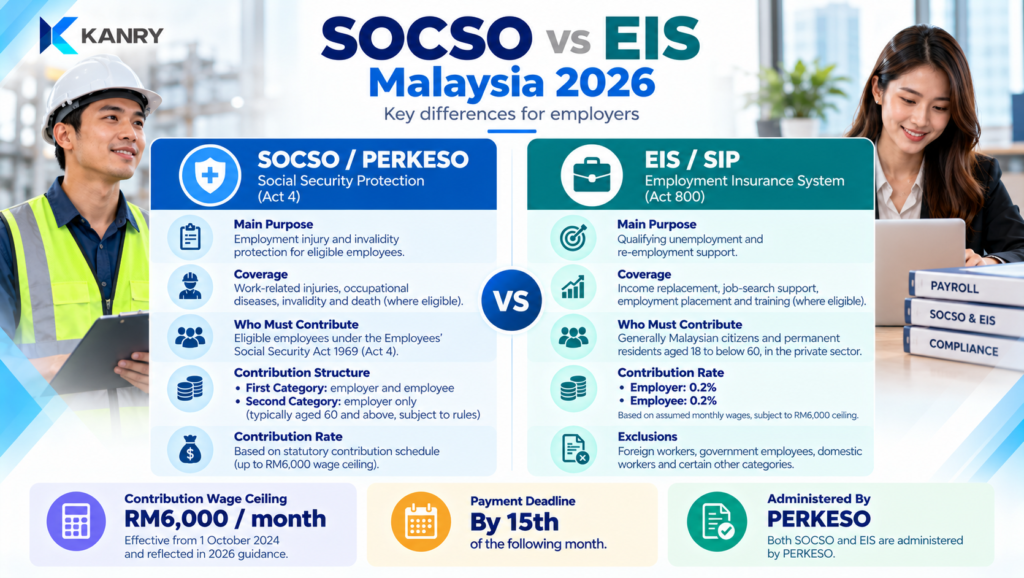
What Is SOCSO in Malaysia?
SOCSO, known in Bahasa Malaysia as PERKESO, administers social security protection under the Employees’ Social Security Act 1969 (Act 4).
For eligible employees, its principal protection schemes include:
- Employment Injury Scheme: Protection relating to employment injuries, occupational diseases and qualifying work-related incidents.
- Invalidity Scheme: Protection relating to qualifying invalidity or death, subject to applicable eligibility and contribution conditions.
The exact contribution category depends on factors such as the employee’s age and contribution history.
Employers must register eligible employees and make contributions according to the applicable statutory schedules.
Official reference: PERKESO — Employed Workers.
What Is EIS in Malaysia?
The Employment Insurance System, also known as SIP or LINDUNG KERJAYA, operates under the Employment Insurance System Act 2017 (Act 800).
Its purpose is to provide eligible insured employees with support following qualifying loss of employment.
Depending on eligibility, assistance may include temporary income replacement, job-search support, employment placement services and training opportunities.
SOCSO and EIS are not interchangeable.
SOCSO principally addresses social security risks such as employment injury and invalidity. EIS addresses qualifying unemployment and re-employment assistance.
An employee may be covered under SOCSO but not EIS, depending on the applicable eligibility rules.
SOCSO vs EIS: What Is the Difference?
| Feature | SOCSO / PERKESO | EIS / SIP |
|---|---|---|
| Main legislation | Employees’ Social Security Act 1969 | Employment Insurance System Act 2017 |
| Main purpose | Employment injury and invalidity-related protection | Qualifying unemployment and re-employment support |
| Employee coverage | Depends on applicable scheme and employee category | Primarily eligible Malaysian citizens and permanent residents |
| Employer contribution | Required for covered employees | Required for EIS-covered employees |
| Employee contribution | Depends on contribution category | Generally 0.2% under the applicable schedule |
| Administration | PERKESO | PERKESO |
ACT 4
SOCSO / PERKESO
Social security protection for eligible employees.
- Employment injury protection
- Invalidity protection, where eligible
- Different contribution categories
- Employer contributions required
- Employee share depends on category
ACT 800
EIS / SIP
Qualifying unemployment and re-employment support.
- Income replacement, where eligible
- Employment placement support
- Training and re-employment assistance
- Generally 0.2% employer share
- Generally 0.2% employee share
Employer reminder: SOCSO and EIS are administered by PERKESO, but eligibility and contribution requirements must be assessed separately.
What Is the SOCSO and EIS Wage Ceiling in 2026?
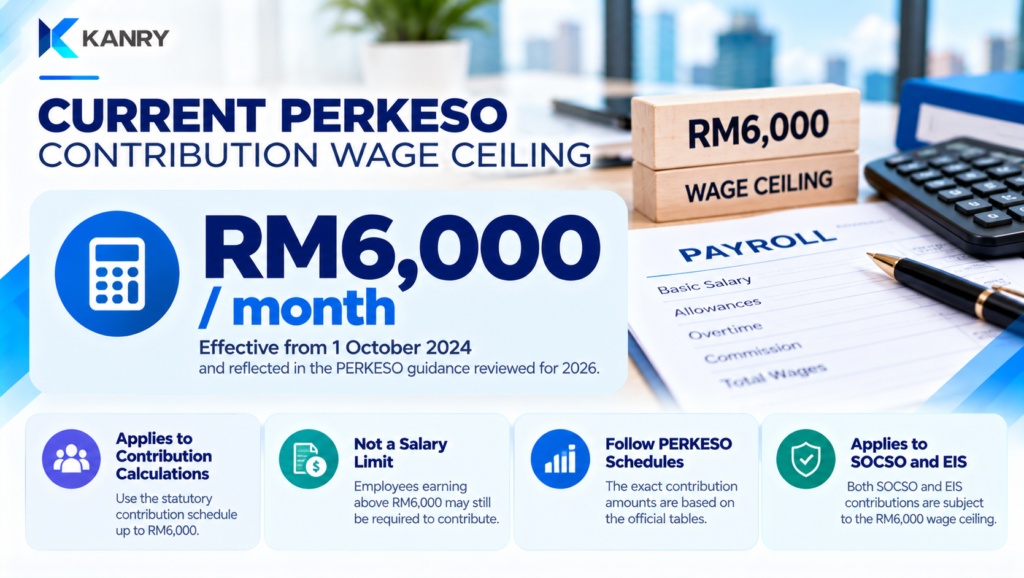
PERKESO increased its contribution wage ceiling from RM5,000 to RM6,000 per month, effective 1 October 2024.
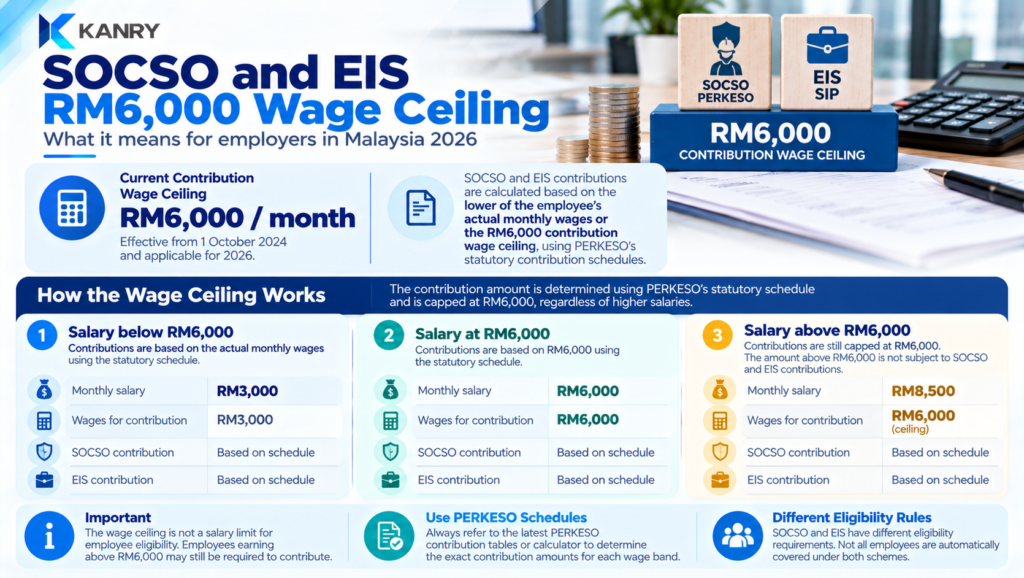
This means the applicable contribution schedules are capped at the RM6,000 wage ceiling.
For example, an employee earning RM7,500 per month does not automatically have SOCSO and EIS contributions calculated on the full RM7,500.
Instead, employers must apply the appropriate contribution schedule and the RM6,000 ceiling.
Important: The contribution wage ceiling is not a salary limit for employee eligibility. An employee earning above RM6,000 may still be required to contribute.
Employers should also avoid calculating every contribution as a simple percentage of actual wages. PERKESO publishes statutory contribution tables that must be followed.
Official reference: PERKESO — Contribution Rates.
SOCSO Contribution Categories Employers Should Know
SOCSO contributions under Act 4 are commonly divided into two categories.
KANRY SEARCH | MALAYSIA 2026
SOCSO Contribution Categories Under Act 4
SOCSO contributions under the Employees’ Social Security Act 1969 (Act 4) are generally divided into two categories, depending on employee eligibility, age and contribution history.
First Category
Employment Injury Scheme + Invalidity Scheme
WHO CONTRIBUTES?
Employer + Employee
Generally applies to:
- Eligible employees below age 60
- Employees covered under both schemes
- Cases meeting PERKESO’s applicable conditions
Second Category
Employment Injury Scheme only
WHO CONTRIBUTES?
Employer Only
Generally applies to:
- Eligible employees aged 60 and above
- Certain employees first covered at an older age
- Cases meeting PERKESO’s applicable conditions
FIRST CATEGORY
Employer + Employee
SECOND CATEGORY
Employer Only
Important Employer Reminder
Do not determine SOCSO contribution categories based on age alone. Review the employee’s previous contribution history, applicable coverage rules and current PERKESO contribution schedule before configuring payroll.
Official reference: PERKESO Malaysia
| Category | Protection | Contribution responsibility |
|---|---|---|
| First Category | Employment Injury and Invalidity | Employer and employee |
| Second Category | Employment Injury | Employer only |
How Much Is the EIS Contribution in 2026?
KANRY SEARCH | MALAYSIA 2026
EIS Contribution Breakdown
For eligible employees, EIS contributions are shared between the employer and employee.
Of assumed monthly wages, subject to the statutory schedule
Of assumed monthly wages, subject to the statutory schedule
COMBINED EIS CONTRIBUTION
Employer 0.2% + Employee 0.2%
Important: RM6,000 Wage Ceiling
EIS contributions follow PERKESO’s statutory contribution schedule, subject to the RM6,000 monthly wage ceiling. The 0.2% rates describe the general contribution structure; actual payable amounts must be determined from the official schedule.
The combined EIS contribution is generally described as 0.4% of assumed monthly wages, subject to the statutory schedule and the RM6,000 wage ceiling.
Example: For a covered employee at the RM6,000 ceiling, the indicative EIS contributions are RM11.90 from the employer and RM11.90 from the employee under the applicable schedule, for a total of RM23.80.
Employers should use PERKESO’s published contribution table or calculator to determine exact amounts, especially for lower wage bands.
Official reference: PERKESO — Contributions.
Who Must Contribute to EIS?
EIS generally covers eligible employees who:
- Are Malaysian citizens or permanent residents.
- Are aged 18 to below 60.
- Work in the private sector under a contract of service.
- Are not within an excluded category.
An important exception applies to employees aged 57 and above who had no EIS contributions before reaching age 57.
Government employees, domestic workers, self-employed individuals and certain other categories are excluded.
Employers should confirm the current rules when dealing with unusual employment arrangements, employee age transitions or changes in employment status.
Do Foreign Workers Need SOCSO and EIS Contributions?
Foreign workers require particular attention because their SOCSO treatment differs from EIS.
Eligible foreign workers, including expatriates and certain domestic workers, are covered under applicable PERKESO social security requirements.
For 2026, employers must also take account of PERKESO’s Non-Employment Injury Scheme (LINDUNG 24 JAM) for foreign workers, effective 1 June 2026.
PERKESO states that this additional protection covers qualifying accidents occurring outside working hours and is being introduced with phased employee contribution rates.
The initial phase rate is 0.75% for the Non-Employment Injury Scheme, in addition to other applicable contributions. Actual coverage and deductions must follow PERKESO’s current rules.
Foreign workers generally do not fall under the standard EIS eligibility requirements applicable to Malaysian citizens and permanent residents.
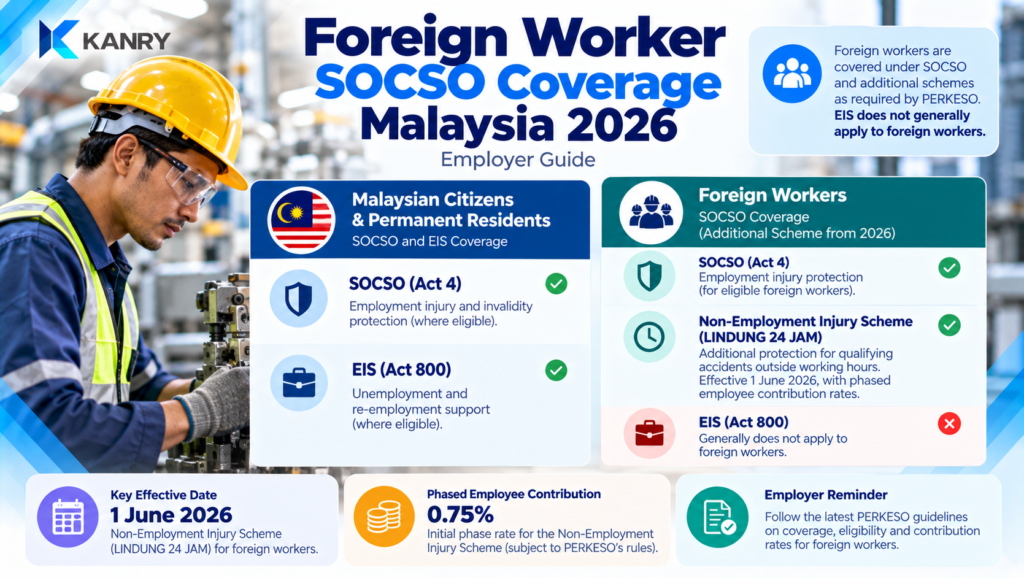
Employer reminder: Do not apply the same SOCSO and EIS configuration automatically to Malaysian and foreign employees.
Official reference: PERKESO — Foreign Workers.
Which Salary Components Are Subject to SOCSO and EIS?
Employers must determine which remuneration components are treated as wages for PERKESO contribution purposes.
Depending on the applicable rules, relevant payments can include basic salary, overtime, commission, incentives, certain allowances and other wage-related payments.
Not every payment made to an employee is necessarily treated in the same way.
For example, employers should distinguish between remuneration and genuine expense reimbursements according to the applicable definitions and guidance.
Payroll Wage Classification Checklist
SOCSO & EIS Wage Classification Checklist
Review each payroll component before calculating contributions.
Important: This checklist is for classification review. Refer to PERKESO’s current wage definitions and contribution schedules to determine actual contribution treatment.
A reliable payroll process should document how each pay component is classified and review any new allowance or incentive before adding it to the payroll system.
When Must Employers Pay SOCSO and EIS Contributions?
Employers must generally pay contributions by the 15th day of the following month.
For example:
| Contribution month | General payment deadline |
|---|---|
| January 2026 | 15 February 2026 |
| February 2026 | 15 March 2026 |
| March 2026 | 15 April 2026 |
| April 2026 | 15 May 2026 |
The payment deadline is different from the employee’s salary payment date.
Late payments may result in interest or other enforcement consequences under the applicable law.
Employers should verify operational cut-offs, banking arrangements and any official deadline adjustments.
MONTHLY EMPLOYER REMINDER
SOCSO & EIS Payment Deadline
Generally due by the
15th
of the following month
Example: Contributions for January are generally payable by 15 February. Set internal processing cut-offs early enough to allow for payroll checks and payment approval.
Check PERKESO for current payment instructions and any official deadline adjustments.
How to Manage SOCSO and EIS Through PERKESO ASSIST
PERKESO’s ASSIST Portal supports employer registration, employee records and contribution administration.
A typical payroll workflow involves verifying employee information, preparing contribution details, checking payable amounts and completing payment.
The exact portal screens and payment options may change.
Employers should follow the latest official ASSIST instructions rather than relying on outdated screenshots.
Official reference: PERKESO — Contribution Payment.
Common SOCSO and EIS Payroll Mistakes
| Mistake | Potential consequence | Better practice |
|---|---|---|
| Using the old RM5,000 ceiling | Incorrect contribution calculations | Apply the RM6,000 ceiling and current tables |
| Treating SOCSO and EIS as identical | Wrong employee deductions | Assess coverage separately |
| Incorrect age classification | Wrong contribution category | Review age and prior contributions |
| Ignoring foreign worker changes | Missing statutory contributions | Review current foreign worker schemes |
| Omitting relevant allowances | Under-calculated wages | Maintain a wage classification policy |
| Missing the monthly deadline | Late payment consequences | Set internal payroll and payment cut-offs |
| Not reconciling payments | Incomplete records | Match payroll reports to PERKESO receipts |
SOCSO and EIS Payroll Compliance Checklist for Employers
Before closing each payroll cycle, HR and payroll should confirm that employee eligibility, contribution categories, wages and payment records have been reviewed.
KANRY SEARCH | PAYROLL CONTROL
Monthly SOCSO & EIS Compliance Checklist
Use these checks before submitting monthly statutory contributions.
Compliance reminder: Keep payroll reports, contribution calculations and PERKESO payment confirmations for audit and reconciliation purposes. Checklist selections are not saved.
For companies managing large workforces, multiple locations or both Malaysian and foreign employees, a standardised monthly checklist helps reduce administrative inconsistencies.
Frequently Asked Questions About SOCSO and EIS Malaysia 2026
MALAYSIA HR & PAYROLL 2026
Frequently Asked Questions
Click a question to expand the answer.
1. What is the SOCSO contribution wage ceiling in 2026?
The contribution wage ceiling is RM6,000 per month, effective from 1 October 2024. Employers must apply the applicable PERKESO contribution schedule.
2. Is SOCSO the same as EIS?
No. SOCSO provides applicable employment injury and invalidity protection. EIS provides qualifying unemployment and re-employment assistance. Both are administered by PERKESO.
3. Do employees aged 60 and above contribute to SOCSO?
Eligible employees aged 60 and above generally fall under the Second Category for Employment Injury protection, with contributions borne by the employer. Verify the applicable rules and employee history.
4. Are foreign workers covered by SOCSO?
Eligible foreign workers are covered under applicable PERKESO social security schemes. Employers should also check the Non-Employment Injury Scheme introduced on 1 June 2026 and its phased contribution requirements.
5. Do foreign workers contribute to EIS?
Foreign workers generally do not qualify for standard EIS coverage, which primarily applies to eligible Malaysian citizens and permanent residents.
6. When are SOCSO and EIS contributions due?
Contributions are generally due by the 15th day of the following month. Employers should confirm official payment arrangements and any applicable deadline adjustments.
7. Is EIS calculated on an employee’s full salary above RM6,000?
No. The contribution schedule is subject to the RM6,000 wage ceiling. The employer should apply the prescribed schedule rather than simply multiplying the full salary by a percentage.
8. Can employers pay SOCSO and EIS through ASSIST?
Yes. PERKESO’s ASSIST Portal supports employer contribution administration and available payment methods. Refer to the official portal for current procedures.
Official source: PERKESO Malaysia. Check current eligibility and contribution schedules before processing payroll.
How Kanry Search Supports Employers in Malaysia
Accurate statutory contributions are an important part of workforce administration.
As businesses expand, managing payroll across permanent employees, contract workers and different employee categories can become increasingly complex.
Kanry Search supports Malaysian employers through recruitment, contract staffing, payroll administration and workforce-related HR services.
Our services help employers coordinate workforce needs and administrative processes while maintaining clear accountability for their statutory responsibilities.
Contact Kanry Search to discuss recruitment, staffing and payroll administration support for your business.
Official References
- PERKESO — Contribution Rates
- PERKESO — Employed Workers
- PERKESO — Contribution Payment
- PERKESO — Foreign Worker Protection
- PERKESO — Frequently Asked Questions
Disclaimer: This article is for general information. Employers should refer to the current PERKESO schedules, eligibility rules and official announcements when calculating contributions or determining statutory obligations.