

Singapore businesses face an important personal-data compliance deadline. From 1 January 2027, the Personal Data Protection Commission (PDPC) will step up enforcement against private organisations that improperly use full or partial National Registration Identity Card (NRIC) numbers for authentication.
Employers have until 31 December 2026 to phase out these practices.
The announcement has implications for human resources, recruitment, payroll administration and employee-data management.
However, it does not introduce a blanket prohibition on NRIC collection.
Singapore employers may still be required to collect identity information for statutory employment records and other purposes permitted under applicable law.
The distinction lies in why information is collected and how it is subsequently used.
This employer advisory explains the new enforcement timeline, relevant Personal Data Protection Act (PDPA) obligations, Ministry of Manpower (MOM) requirements and practical steps organisations should take before January 2027.
Singapore NRIC Rules 2027: What Is Changing?
On 3 February 2026, Singapore’s Ministry of Digital Development and Information (MDDI) confirmed the transition deadline for private organisations to stop using NRIC numbers for authentication.
This followed a joint advisory issued by the PDPC and Cyber Security Agency of Singapore (CSA) in June 2025.
The authorities highlighted the security risks associated with treating personal identification numbers as authentication credentials.
NRIC numbers are identifiers. Unlike passwords, they are not intended to be secrets known only to the individual.
An organisation that relies on an NRIC number to authenticate someone may expose personal information to unauthorised access.
NRIC enforcement timeline
| Date | Development | Employer implication |
|---|---|---|
| 26 June 2025 | PDPC and CSA issued their joint authentication advisory | Review existing authentication methods |
| 3 February 2026 | MDDI confirmed the transition timeline | Plan necessary changes |
| 31 December 2026 | Transition period ends | Complete the phase-out |
| 1 January 2027 | Stricter PDPC enforcement begins | Ensure improper NRIC authentication has been replaced |
Employers should note that the 2027 announcement focuses on authentication practices in the private sector.
Separately, the Government is progressively moving away from using partial NRIC numbers for identification in the public sector. Where accurate identification is necessary, full NRIC numbers may be used instead. This public-sector development is distinct from the stricter enforcement against improper NRIC-based authentication in the private sector from 1 January 2027.
Official reference: MDDI — Responsible Use of NRIC Numbers Across Public and Private Sectors.
NRIC Collection vs Authentication: What Employers Must Understand
NRIC collection and NRIC-based authentication are not the same activity.
Identification involves establishing or distinguishing a person’s identity.
Authentication involves confirming that someone is genuinely the person they claim to be.
An employer may need to record an employee’s NRIC number to meet a statutory requirement. That does not make the number suitable as a password or account-recovery secret.
PDPC’s NRIC guidelines also place limits on collection. Organisations should not assume that obtaining an NRIC number is permissible merely because it is administratively convenient.
Collection, use or disclosure should fall within the applicable legal requirements or permitted circumstances.
The following comparison illustrates how these principles apply to everyday employment administration.
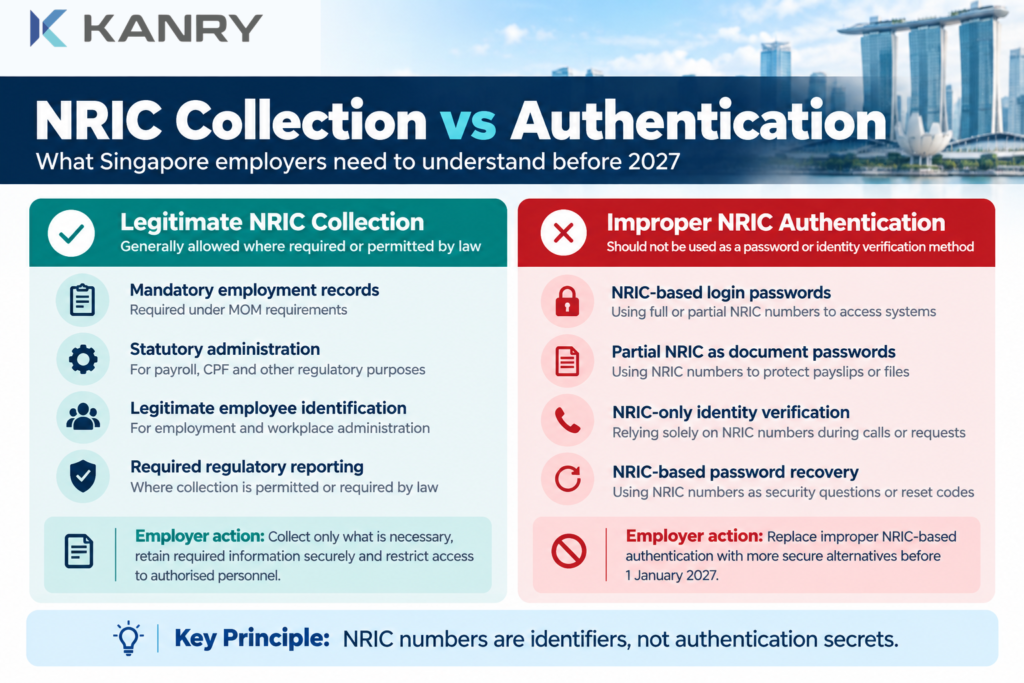
The distinction has practical consequences for HR systems.
A legitimate reason to retain employee identity information does not justify reusing that information as a security credential.
Employers should assess collection and authentication as separate compliance questions.
Why Is NRIC-Based Authentication a Security Risk?
NRIC numbers may be known to multiple organisations throughout a person’s working life.
They are therefore unsuitable as secrets used to establish identity or control access.
The problem becomes particularly serious when a system relies on information that another person could obtain.
For example, an unauthorised individual might possess someone’s name, birth date and NRIC number.
If a system treats those details as sufficient proof of identity, the individual may be able to impersonate the account holder.
The consequences depend on the affected system but may involve unauthorised access to confidential employee information or fraudulent account changes.
The PDPC and CSA advisory addresses this underlying weakness.
It is not simply a question of concealing personal information. It concerns whether the organisation has adopted an appropriate authentication method.
What are safer alternatives?
Depending on the system and risk involved, employers may consider individual account credentials, secure account-activation processes, multifactor authentication and verified account-recovery mechanisms.
These are examples of potential safeguards, not a universal list of technologies mandated for every employer.
The appropriate method should reflect the sensitivity of the information and the consequences of unauthorised access.
Official reference: PDPC and CSA — Joint Advisory Against Using NRIC Numbers for Authentication.
What Does the PDPA Require When Handling Employee NRIC Information?
The PDPA regulates how organisations collect, use, disclose, protect and retain personal data.
NRIC numbers constitute personal data and must be handled according to the applicable legal requirements.
For employers, four considerations are particularly relevant.
Collection and purpose
Organisations should establish an appropriate legal basis and purpose before collecting NRIC information.
Under PDPC’s Advisory Guidelines for NRIC Numbers, organisations should generally collect, use or disclose NRIC numbers or copies of NRIC cards only where required by law, where an applicable exception under the PDPA permits it, or where necessary to establish or verify an individual’s identity to a high degree of fidelity.
These restrictions on NRIC collection, use and disclosure are existing PDPA requirements and should be distinguished from the stronger enforcement against improper NRIC-based authentication beginning on 1 January 2027.
Employers should distinguish these circumstances from routine convenience.
For example, a statutory requirement to maintain an employee’s identity information does not automatically justify requesting copies of that information for unrelated administrative purposes.
Protection of personal data
The PDPA requires organisations to make reasonable security arrangements to protect personal data under their control.
This includes considering risks arising from unauthorised access, disclosure or misuse.
Appropriate safeguards depend on the organisation’s systems, operating environment and the sensitivity of the records.
Access and disclosure
Access to employee identity information should correspond to legitimate job responsibilities.
An employee’s ability to view general HR information does not necessarily mean that they should have access to other employees’ identity records.
Similarly, providing information to a recruitment agency, payroll provider or HR vendor requires consideration of the applicable legal and contractual arrangements.
Retention
Employers must balance data-protection responsibilities with statutory recordkeeping obligations.
Information required by law should be retained for the applicable period.
Where personal data is no longer required for any legal or business purpose, continued retention should be reviewed.
Important: These PDPA obligations already exist. The January 2027 announcement signals stronger enforcement against improper NRIC-based authentication; it does not postpone existing data-protection responsibilities.
Can Employers Still Collect NRIC Numbers in 2027?
Yes, where collection is required or otherwise permitted under the applicable legal framework.
One important example is mandatory employment recordkeeping.
MOM requires employers to maintain prescribed records for employees covered by the Employment Act.
These include identity-related information.
Mandatory employment records
| Requirement | MOM position |
|---|---|
| NRIC number | Required employee-record information |
| Non-citizen identification | Work-pass number and expiry date |
| Other employee particulars | Address, date of birth, gender and employment dates |
| Working-time information | Applicable working hours, breaks, holidays and leave details |
| Salary information | Prescribed salary records |
| Current employee retention | Latest two years of records |
| Former employee retention | Last two years of records, retained for one year after employment ends |
Employers may maintain these records electronically or in hard copy.
The rules apply to employees covered by the Employment Act; other statutory requirements may apply in particular circumstances.
Official reference: MOM — Employment Records.
Does this require employers to keep photocopies of NRIC cards?
MOM’s general employment-recordkeeping requirements specify the recording of employee identification particulars, including NRIC numbers where applicable. These requirements should not automatically be interpreted as requiring employers to retain photocopies of employees’ physical NRIC cards.
Employers should separately assess whether collecting or retaining an NRIC card copy is required by law or otherwise justified under applicable PDPA requirements.
Where only the relevant particulars are needed, retaining additional documents may create unnecessary data-protection exposure.
NRIC and FIN Requirements for Singapore Recruitment Agencies
Recruitment agencies operate under specific regulatory requirements that differ from ordinary employer recordkeeping.
Under MOM’s Employment Agencies Licence Condition 5(b), employment agencies must collect prescribed personal information, including NRIC or FIN details, for applicants referred to employers for:
- Permanent positions; or
- Contract positions lasting at least six months;
where the fixed monthly salary is S$3,300 or above.
MOM explains that the PDPA’s collection, use and disclosure requirements do not apply to collection undertaken pursuant to this particular regulatory obligation.
However, the information is subject to an important restriction.
Under MOM’s Employment Agencies Licence Condition 5(b), employment agencies must not disclose personal information collected specifically pursuant to this regulatory reporting requirement to other parties, including their employer clients.
This restriction concerns information collected under the licence condition and should not be interpreted as a blanket prohibition on sharing all candidate personal data for legitimate recruitment purposes, subject to applicable legal requirements.
This means that information collected for regulatory reporting should not automatically be included in client-facing candidate profiles or recruitment spreadsheets.
What does this mean for employers?
An employer may have a separate lawful reason to obtain identity information when hiring or onboarding an employee.
That does not override the restrictions imposed on an employment agency regarding information collected under its licence condition.
Employers and agencies should therefore establish suitable procedures for the relevant party to obtain information for its own legitimate purposes.
The recruitment process should also distinguish between information required for candidate assessment and information required later for regulatory or employment administration.
Official reference: MOM — Are Employment Agencies Allowed to Collect Personal Data Such as NRIC or FIN?.
Six HR Practices Employers Should Review Before 2027
NRIC-based authentication risks are not necessarily confined to an organisation’s main HR platform.
They can arise across legacy software, outsourced systems and routine administrative workflows.
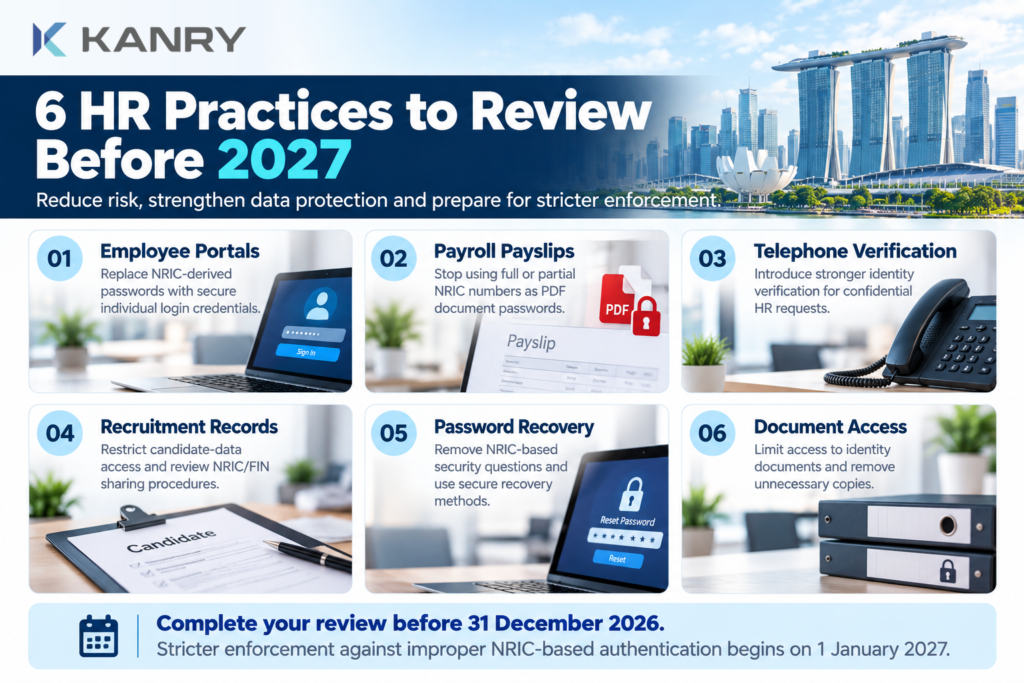
The purpose of this review is not simply to remove NRIC information from systems.
Instead, employers should determine whether each process relies on appropriate authentication, whether identity information is unnecessarily exposed and whether the relevant safeguards are effective.
The next step is to turn those findings into a documented compliance project.
What Are the Potential Consequences of Non-Compliance?
From 1 January 2027, the PDPC will step up enforcement against private organisations that continue improperly using NRIC numbers for authentication.
Such practices may indicate that an organisation has failed to make reasonable security arrangements to protect personal data under the PDPA.
Depending on the circumstances, enforcement action may include regulatory directions or financial penalties under the applicable statutory framework.
The announcement does not impose an automatic fixed penalty for every instance of improper NRIC use.
Regulatory consequences depend on the facts and applicable legal provisions.
For employers, the wider risk also includes unauthorised access to sensitive employee information, operational disruption and loss of workforce trust.
Organisations should therefore approach the transition as a security and governance matter rather than merely a documentation exercise.
Employer NRIC Compliance Checklist: Preparing for January 2027
A successful transition requires coordination between the people who manage employee information and the people responsible for the systems that protect it.
HR may own the business process, but IT, payroll, compliance and external service providers may control the underlying technology.
The first management decision should be to identify a responsible project owner with authority to coordinate those parties.
The second is to establish evidence of completion.
For example, a statement that the payroll vendor has updated its system is less useful than documented confirmation that the relevant authentication process has been replaced and tested.
Interactive Employer Checklist
Employer NRIC Compliance Checklist
Track implementation, responsibilities and evidence before the 2027 enforcement deadline.
Recommended completion schedule
| Period | Implementation milestone |
|---|---|
| October 2026 | Establish ownership and identify affected systems |
| November 2026 | Implement replacement controls and coordinate vendors |
| December 2026 | Complete testing, training and remediation |
| By 31 December 2026 | Confirm phase-out of improper authentication |
| From January 2027 | Monitor compliance and maintain updated controls |
This schedule is a recommended project plan, not an additional statutory timetable.
Who Should Own NRIC Compliance Within an Organisation?
A common weakness in compliance projects is unclear accountability.
When an issue affects several departments, each team may assume another team is responsible for resolving it.
Employers can reduce this risk by assigning responsibilities at three levels.
Management accountability: A designated senior manager oversees implementation, resources and outstanding risks.
Operational ownership: HR, payroll and relevant business teams identify affected processes, validate requirements and coordinate changes.
Technical and compliance oversight: IT, the Data Protection Officer and relevant specialists evaluate the security arrangements and verify that corrective actions are effective.
For smaller businesses, one individual may perform several coordinating roles.
The important consideration is that responsibility is explicit and the organisation can demonstrate what was reviewed, changed and verified.
Outsourced Payroll, HR Systems and Recruitment Providers: Who Is Responsible?
Many Singapore employers rely on third parties to manage employee records, payroll administration or recruitment operations.
Such arrangements may involve personal data being processed outside the employer’s internal systems.
However, outsourcing a process does not automatically transfer every legal responsibility to the service provider.
The allocation of responsibilities depends on the applicable PDPA provisions, each party’s role and the relevant contractual arrangements.
What should employers confirm with vendors?
Rather than asking only whether a vendor is “PDPA-compliant”, employers should request information about the relevant security controls and contractual commitments.
A useful vendor review considers:
| Review area | Evidence employers should seek |
|---|---|
| Authentication | Confirmation that affected authentication practices have been updated |
| Access management | Description of how permissions are assigned and controlled |
| Data handling | Applicable contractual and security arrangements |
| Incident management | Documented notification and response procedures |
| System changes | Testing records or confirmation of completed remediation |
| Ongoing oversight | Procedures for reviewing material changes and security risks |
The level of assurance should be proportionate to the nature and sensitivity of the information handled.
Where a provider operates in a regulated sector, employers should also determine whether additional sector-specific guidance applies.
Practical Example: Preparing a Singapore Company for the Deadline
Consider a Singapore logistics company with 180 employees. How can a Singapore employer implement the necessary changes while maintaining its statutory employment records?
The following illustrative scenario demonstrates a practical approach.
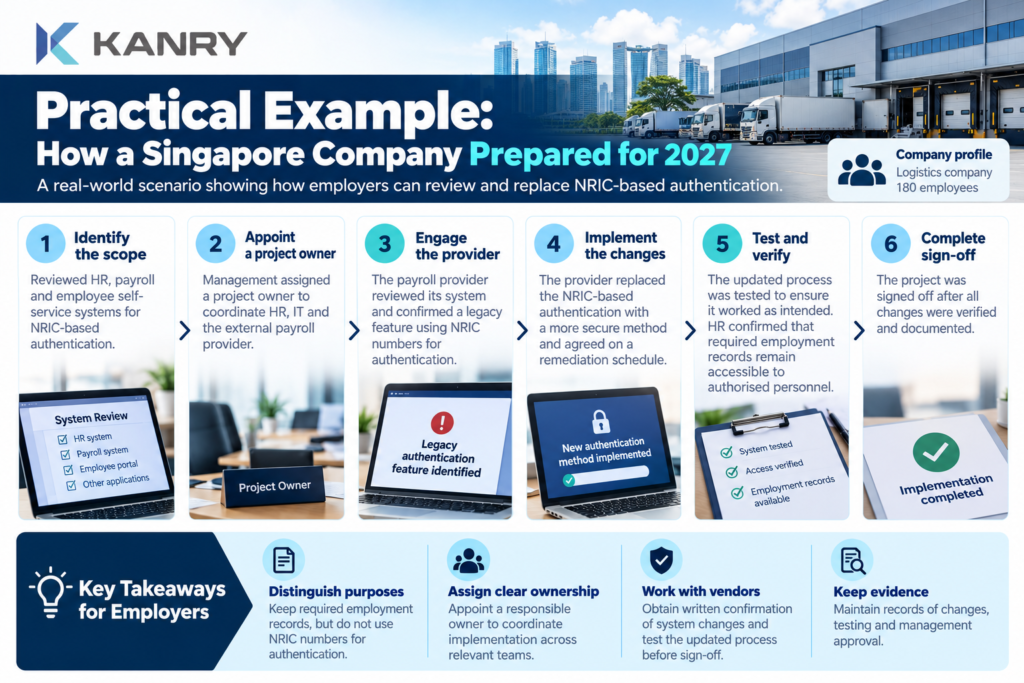
Its HR team manages employee records internally, while an external provider operates the payroll and employee self-service systems.
The company decides to review NRIC-related authentication before the end of 2026.
Rather than having HR independently assess the software’s technical security, management appoints a project owner and asks the payroll provider to confirm its authentication arrangements.
The provider identifies a legacy authentication feature requiring modification.
The company agrees on a remediation schedule, tests the updated process and records the outcome.
HR separately confirms that legally required employment records remain available to authorised personnel.
The project is signed off only after the relevant changes have been verified.
Frequently Asked Questions About Singapore NRIC Rules 2027
Employers may also have questions concerning implementation timing, system limitations, vendor arrangements and responding to possible security incidents.
The following FAQ addresses these supplementary issues.
Singapore NRIC 2027: Employer Implementation FAQ
Additional questions for HR, payroll and compliance teams.
What if our HR software vendor cannot complete the changes on time?
Request a written implementation schedule and assess whether an alternative secure authentication process can be introduced. Escalate unresolved risks internally. Do not assume that a vendor delay automatically creates a regulatory exemption.
Should employers change previously issued documents?
Employers should assess whether previously issued documents remain accessible through an insecure authentication method. Corrective action should reflect the continuing exposure, relevant retention requirements and available security controls.
What if we discover unauthorised access involving employee identity information?
Activate the organisation’s incident-response procedures, contain the exposure and assess the incident under applicable PDPA requirements. Determine whether notification obligations arise and obtain appropriate specialist advice. The circumstances of the incident matter.
Can a company adopt one authentication method across every HR system?
A consistent authentication framework may simplify administration, but the controls should remain appropriate to each system’s risks. Access to highly sensitive employee information may justify additional safeguards.
Should companies keep evidence of their NRIC authentication review?
Maintaining review records is a sensible governance practice. Useful evidence may include system inventories, approved changes, vendor confirmations, testing results and records of unresolved risks.
Refer to the PDPC NRIC information page for further regulatory information.
Final Employer Advisory
Singapore’s stricter NRIC authentication enforcement makes October to December 2026 an important preparation period for private-sector organisations.
Employers should use this opportunity to review relevant HR and payroll systems, confirm responsibility for necessary changes and ensure that inappropriate authentication practices are phased out before the deadline.
The objective is to maintain legitimate employment administration while strengthening the protection of employee information.
Need Support With Recruitment and Workforce Administration?
Kanry Search supports employers across Singapore and Malaysia with recruitment and workforce solutions.
If your business is reviewing recruitment processes, planning workforce expansion or seeking support with employment administration, our team can discuss suitable recruitment and HR-related services.
Official References
For the underlying regulatory requirements, employers should refer to:
- MDDI — Responsible Use of NRIC Numbers
- PDPC and CSA — Joint Authentication Advisory
- PDPC — Advisory Guidelines for NRIC Numbers
- MOM — Employment Records
- MOM — Employment Agency NRIC/FIN Collection
Disclaimer: This article provides general employer guidance based on information available as of 16 October 2026. It does not constitute legal advice. Organisations should assess their circumstances against applicable legislation and official regulatory guidance.