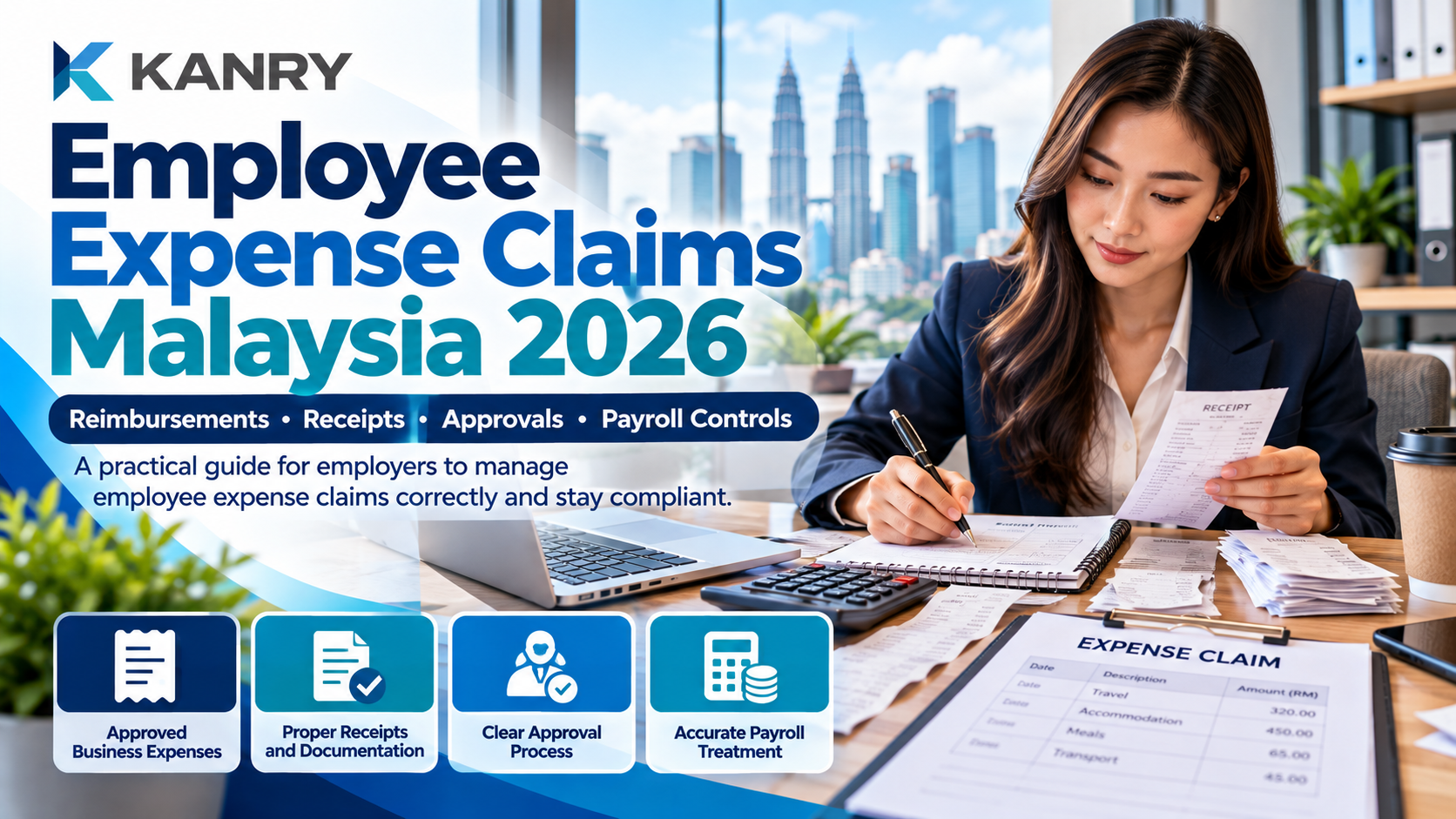

Employee expense claims are a routine part of running a business in Malaysia. Employees may pay for business travel, parking, tolls, client entertainment, site visits or approved medical expenses before requesting reimbursement.
Yet reimbursement problems can quickly become payroll disputes, accounting discrepancies and employee-relations issues.
A missing receipt may delay repayment. An unclear mileage policy may result in inconsistent approvals. A fixed monthly allowance may be incorrectly treated as a reimbursement. Finance may even reimburse the same expense twice if different payment systems are not reconciled.
For employers, the challenge is not simply approving claims quickly. It is ensuring that every payment has a clear purpose, proper authorisation, sufficient documentation and appropriate payroll or accounting treatment.
This guide explains how Malaysian employers can establish an effective expense-claims policy, distinguish reimbursements from wages and allowances, control approval risks and manage employee claims consistently.
What Are Employee Expense Claims in Malaysia?
An employee expense claim generally refers to a request for repayment of an expense incurred by an employee, either for an authorised business purpose or under an agreed employee-benefit arrangement.
For example, a sales executive may pay a parking fee while attending a client meeting. A service engineer may purchase approved replacement materials for an urgent site repair. An employee may submit a clinic receipt under the company’s medical reimbursement policy.
These expenses may all enter the same internal claims system, but they should not automatically be classified in the same way.
Common Types of Employee Claims
| Claim category | Examples | Main employer control |
|---|---|---|
| Business travel | Tolls, parking, train fares, approved flights | Verify business purpose and journey |
| Mileage | Approved business travel using a personal vehicle | Verify distance and applicable company rate |
| Accommodation | Hotel expenses for authorised assignments | Check travel authorisation and limits |
| Client entertainment | Approved client meals or hospitality | Verify business purpose and participants |
| Operational purchases | Materials, tools or urgent supplies | Confirm purchase authorisation |
| Medical benefits | Eligible clinic visits or treatment | Check benefit entitlement and policy limits |
| Communication | Approved work-related phone or internet expenses | Verify eligible amount and work purpose |
The category alone does not determine whether a payment is taxable, subject to statutory contributions or legally required.
Employers must consider the nature of each payment and the applicable rules.
Employee Reimbursement vs Allowance vs Salary: Why Classification Matters
One of the most important payroll controls is determining what the employee is actually being paid for.
Consider these three situations:
- An employee receives RM45 to repay an approved parking and toll expense.
- An employee receives a fixed RM300 monthly transport allowance.
- An employee receives RM300 as additional compensation for their work.
Although all three payments involve money paid to an employee, they have different underlying purposes.
Employer Classification Comparison
| Payment type | Typical characteristics | Employer consideration |
|---|---|---|
| Expense reimbursement | Repays an identifiable, authorised expense | Evidence, business purpose and reimbursement conditions |
| Fixed allowance | Usually a recurring payment under employment terms | Contract, applicable payroll definitions and tax treatment |
| Wages or salary | Remuneration for employment | Employment Act, tax and contribution requirements |
| Medical benefit or reimbursement | Provided under statutory rights, company policy or contract | Benefit eligibility and applicable tax rules |
| Wage advance | Payment of wages before the normal payment date | Advance and recovery requirements |
A payment should not be classified as a business reimbursement merely because the company labels it a “claim”.
Likewise, not every allowance is automatically taxable in the same way or subject to every statutory contribution.
Why Employers Should Avoid Misclassification
Incorrect classification can affect:
- Payroll accuracy.
- PCB calculations.
- EPF and other statutory contribution assessments.
- Employment-contract obligations.
- Financial accounting and audit evidence.
- Employee understanding of salary and benefits.
For example, an employer should not assume that a fixed monthly allowance is exempt from statutory contributions simply because the allowance is associated with transport.
The applicable treatment must be assessed against the relevant statutory definition and official guidance.
Employer advisory: HR and Finance should maintain a documented classification for recurring allowances, reimbursements and other payroll items, with supporting legal and tax verification.
Are Employers Legally Required to Reimburse Employee Expenses?
There is no single universal statutory rule requiring Malaysian employers to reimburse every expense an employee chooses to incur.
The obligation may depend on the employment contract, applicable employment legislation, collective agreements, company policies and the circumstances in which an expense was incurred.
An employer may, for example, agree to reimburse authorised travel expenses through its written policy.
Once such an entitlement forms part of an enforceable contractual arrangement, failure to pay may create a contractual dispute.
However, employers should distinguish ordinary business expenses from statutory employment obligations.
Medical Claims Require Particular Care
The Employment Act 1955 contains provisions concerning paid sick leave and medical examination arrangements for eligible employees.
These protections should not be confused with a company’s optional annual outpatient medical reimbursement limit.
An employer cannot assume that a discretionary RM500 medical-claims allowance replaces all applicable statutory medical obligations.
Similarly, maternity benefits, paid sick leave and contractual outpatient reimbursements are not interchangeable merely because they involve employee welfare.
What About Deducting Rejected Claims From Salary?
A rejected expense claim does not automatically authorise an employer to deduct money from an employee’s salary.
Section 24 of the Employment Act 1955 regulates lawful deductions from wages.
If an employee has received an erroneous payment, salary advance or other disputed amount, the employer should first determine whether a proposed recovery is permitted under the Act and applicable circumstances.
Employers should never treat the payroll deduction function as a general-purpose debt collection mechanism.
For businesses operating in Sabah or Sarawak, the relevant labour ordinances and contractual rules must also be considered.
The Seven-Step Employee Claims Approval Process
A well-designed claims process helps prevent duplicate reimbursement, unauthorised spending and unnecessary delays.
The following workflow is recommended for Malaysian employers.
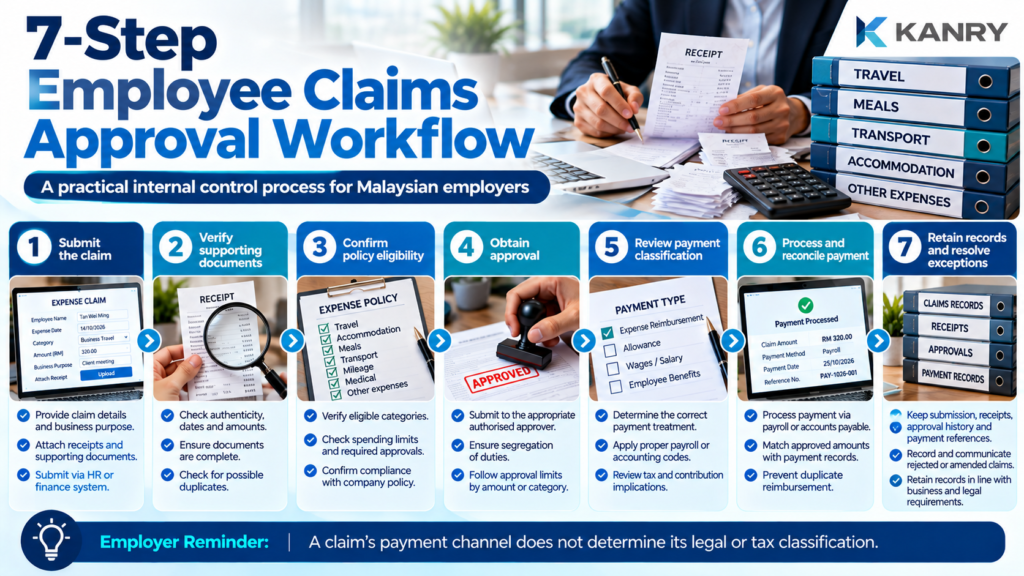
Step 1 — Employee Submits the Claim
Require employees to submit sufficient information about the expense.
Useful details include:
- Employee name and department
- Expense date
- Expense category
- Amount and currency
- Business purpose
- Relevant client, project or cost centre
- Receipt or other supporting evidence
The submission channel may be an HR system, finance portal or approved claim form.
Step 2 — Verify Supporting Documents
The reviewer checks that the expense is supported and consistent with the claim.
For example, a parking receipt submitted for a customer visit should reasonably correspond to the date and location of the appointment.
The employer should also check whether the same document has already been reimbursed.
Step 3 — Confirm Policy Eligibility
HR or Finance verifies whether the expense falls within the employer’s claim policy.
Check whether the expense was authorised, within limits and submitted in accordance with internal requirements.
Step 4 — Obtain Appropriate Approval
Claims should be reviewed by an authorised approver.
An employee should not normally approve their own reimbursement.
For larger organisations, approval authority may depend on the amount, department or expense category.
Step 5 — Review Payment Classification
Finance determines whether the approved amount should be processed as an expense reimbursement, contractual benefit, taxable allowance or another payment category.
This classification should occur before the payment file is finalised.
Step 6 — Process and Reconcile Payment
Finance verifies the approved total against payment records.
Claims processed through a payroll system should be clearly distinguished from statutory wage items in the underlying payroll records.
Where reimbursement is made through accounts payable instead, Finance should still maintain sufficient records to prevent duplicate payment.
Step 7 — Retain Records and Resolve Exceptions
Retain approved claims, receipts, approval history and payment references according to applicable record-retention requirements and business needs.
Where a claim is incomplete, rejected or amended, record the reason and communicate the outcome to the employee.
What Supporting Documents Should Employees Submit?
A receipt is important, but a receipt alone may not establish that an expense was authorised or incurred for business purposes.
Employers should therefore consider the evidence required for each category.
Suggested Supporting Evidence
| Claim type | Useful documents | Additional verification |
|---|---|---|
| Mileage | Journey log, destination, distance | Confirm authorised business travel |
| Parking and tolls | Receipts or recognised transaction records | Verify date and journey |
| Hotel accommodation | Itemised accommodation invoice | Confirm approved business trip |
| Client meals | Itemised receipt and purpose | Verify attendees and authorisation |
| Operational purchases | Invoice or receipt | Verify purchase need and approval |
| Medical reimbursement | Clinic receipt and relevant supporting documents | Confirm policy eligibility |
| Telephone expenses | Billing statement or relevant usage details | Determine eligible work-related portion |
What If an Employee Loses a Receipt?
A missing receipt does not automatically mean a claim can never be approved.
However, employers should not establish an uncontrolled exception process.
A practical alternative is to require a missing-receipt declaration stating:
- What was purchased.
- When the expense occurred.
- Why it was necessary.
- Why the receipt is unavailable.
- What alternative evidence exists.
The employer may permit limited exceptions with additional approval.
This is an internal policy option, not a general legal requirement to accept unsupported claims.
For tax and accounting purposes, alternative documentation should be assessed for adequacy.
Mileage Claims: How Should Employers Calculate Them?
Mileage reimbursement is especially relevant to sales teams, site engineers, recruitment consultants and employees who travel between customer premises.
A simple internal formula is:
Approved mileage reimbursement = Eligible business distance × Approved reimbursement rate
Illustrative Mileage Calculation
A service engineer travels 86 kilometres on an approved customer-site assignment.
The employer’s documented reimbursement rate is RM0.70 per kilometre.
| Item | Calculation |
|---|---|
| Eligible distance | 86 km |
| Company mileage rate | RM0.70/km |
| Reimbursement | RM60.20 |
The result is RM60.20, before considering any separately approved toll or parking expenses.
Important: RM0.70 per kilometre is an illustrative company rate, not a universal statutory reimbursement rate.
Employers should establish their own reasonable mileage policies and separately confirm the tax treatment of any travel or petrol allowance.
Common Mileage Control Problems
Problems can arise when employees:
- Claim ordinary home-to-work commuting as an approved business journey.
- Use inconsistent distance calculations.
- Include personal detours.
- Submit the same trip more than once.
- Claim both mileage reimbursement and overlapping transport benefits without an applicable policy basis.
For employers with mobile workforces, consistent definitions of eligible travel can be more valuable than simply increasing the reimbursement rate.
Expense Claims for Manufacturing, Logistics and Recruitment Businesses
Claims policies should reflect the operational realities of different industries.
Manufacturing — Pasir Gudang
A maintenance technician is required to purchase an urgent component while supporting production equipment.
The company should have controls for:
- Authorisation of emergency purchases.
- Proof that the component was required for business use.
- Supporting invoices.
- Proper cost-centre allocation.
- Verification that the supplier invoice has not also been paid directly.
For manufacturing employers, the priority is avoiding disruption without weakening procurement controls.
Logistics — Johor and Klang Valley
A logistics coordinator may incur parking, toll or travel expenses while visiting customers, transport partners or operational sites.
Employers should define which journeys qualify and how expenses are approved.
Where an employee works across several facilities, the policy should explain how normal commuting is distinguished from authorised business travel.
Recruitment and Professional Services
Recruitment consultants may incur expenses while attending client meetings, job fairs or candidate assessment events.
A suitable policy might require claims to identify the client or project, event purpose and supporting documentation.
For example, a recruiter visiting a client manufacturing facility in Senai should record the approved business journey rather than submitting an unexplained mileage total.
These scenarios are illustrative, not descriptions of actual Kanry Search client reimbursement policies.
How to Build an Employee Claims Policy
A good claims policy should answer the questions employees and approvers routinely face.
It should not merely state that “all claims are subject to management approval”.
Recommended Policy Components
| Policy area | What employers should define |
|---|---|
| Eligible expenses | Which categories are reimbursable |
| Approval authority | Who may approve each category |
| Spending limits | Caps or prior-approval thresholds |
| Submission period | Internal deadline for ordinary claims |
| Supporting documents | Required receipts and additional evidence |
| Missing receipts | Whether exceptions are allowed |
| Mileage | Eligible trips and reimbursement method |
| Foreign currency | Applicable exchange-rate policy |
| Payment timing | Normal claim-processing cycle |
| Disputes and appeals | How employees can challenge a decision |
| Record retention | Where evidence is retained and who has access |
| Exceptions | Approval authority for unusual circumstances |
Statutory Obligations vs Company Policy
This distinction should appear clearly in every employer’s policy.
| Issue | Legal consideration | Recommended internal control |
|---|---|---|
| Contractual expense entitlement | Enforceable employment terms must be considered | Publish eligibility rules |
| Salary deductions | Subject to applicable legal restrictions | Separate claim disputes from payroll deductions |
| Tax treatment | Depends on applicable tax law and payment facts | Finance classification review |
| Claims submission deadline | Not one universal deadline for every expense | Set a reasonable policy deadline |
| Approval turnaround | Depends on the underlying obligation and agreement | Establish a service target |
| Missing-receipt exception | Evidence and accounting requirements apply | Require documented escalation |
A company-imposed submission deadline should not be used to extinguish statutory or contractual rights where doing so would be unlawful.
Employee Claims Policy Checklist
Use this checklist when introducing or reviewing your company’s expense reimbursement controls.
Recommended internal controls; not a substitute for applicable statutory, contractual or tax requirements.
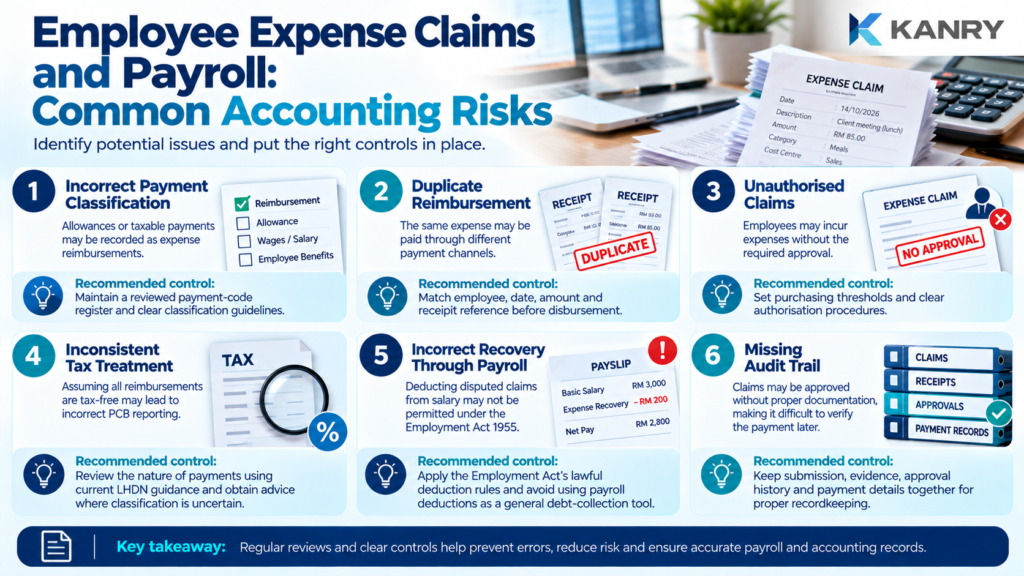
Employee Expense Claims and Payroll: Common Accounting Risks
Many payroll errors originate outside the payroll department.
For example, an employee’s manager may approve a payment without identifying whether it is a reimbursement, allowance or salary-related entitlement.
Finance may then process the payment using an incorrect payroll code.
Employee Claims Audit: What Should HR and Finance Check Every Month?
A periodic claims review does not need to be complicated.
Employers can use a simple monthly exception report to identify unusual patterns.
Suggested Monthly Claims Audit
| Control area | Audit question | Follow-up |
|---|---|---|
| Duplicate claims | Has the same expense appeared before? | Investigate before repayment |
| Missing receipts | Are exceptions frequent or concentrated? | Review policy and evidence |
| Approval limits | Were claims authorised correctly? | Escalate unauthorised payments |
| Mileage | Are journeys and distances reasonable? | Validate unusual claims |
| Claims trends | Have departmental costs increased sharply? | Review underlying business activity |
| Payroll treatment | Were payment codes applied correctly? | Correct classification where needed |
| Payment reconciliation | Do approved amounts match amounts paid? | Investigate differences |
The purpose of the review is not to assume employee misconduct.
It is to identify control weaknesses, process errors and potentially unsupported payments before they become larger problems.
When Should Employers Escalate a Claim?
Escalation may be appropriate where there is evidence of:
- Repeated duplicate submissions.
- Altered or potentially falsified documents.
- Unauthorised use of company funds.
- Significant unexplained amounts.
- Suspected conflicts of interest.
- Repeated bypassing of approval controls.
Employers should investigate fairly and distinguish an honest administrative error from suspected misconduct.
An unusual claim is not, by itself, proof of fraud.
Should Employers Process Claims Through Payroll or Accounts Payable?
Both approaches can be appropriate, depending on the payment and the employer’s systems.
Payroll Processing
Payroll processing may be convenient where reimbursements are paid together with employees’ regular salaries.
However, payment codes should clearly distinguish reimbursements from wage elements and taxable or contribution-bearing items.
Accounts Payable Processing
Accounts payable may be suitable where employee reimbursements are processed through a separate finance workflow.
This can support more detailed expense-category and cost-centre reporting.
Comparison
| Consideration | Payroll | Accounts payable |
|---|---|---|
| Payment frequency | Often aligned with payroll cycle | Can follow approved payment runs |
| Employee visibility | May appear in employee payment records | May require a separate claims statement |
| Expense coding | Requires careful payment-code design | Often uses expense-account classification |
| Duplication risk | Exists if other channels also reimburse | Exists if payroll also processes claims |
| Statutory classification | Must be assessed | Still must be assessed |
Key principle: The system used to pay a claim does not, by itself, determine its legal or tax classification.
How Kanry Search Can Support Employers
For businesses with growing workforces, expense claims are part of a wider HR administration challenge.
Increasing headcount can also increase the volume of payroll adjustments, employee records, benefits administration and monthly reconciliations.
Kanry Search supports employers through recruitment and HR-related services, including permanent recruitment, contract staffing, employer-of-record solutions and HR shared services.
For companies operating across manufacturing, logistics, engineering and professional services, effective workforce administration requires clear employment terms, reliable processes and consistent coordination between HR, Finance and operations.
Strengthen Your Recruitment and HR Operations
If your organisation is expanding its workforce or reviewing how employment administration supports operational growth, Kanry Search can discuss suitable recruitment and HR service arrangements.
Contact Kanry Search to speak with our team about your business requirements.
Frequently Asked Questions
Employee Expense Claims Malaysia — FAQs
Must Malaysian employers reimburse every employee expense?
Not automatically. Whether reimbursement is required depends on the applicable law, employment contract, company policy, collective agreement and circumstances. Employers should distinguish contractual expense entitlements from discretionary benefits and statutory employment obligations.
Can a company reject a claim without a receipt?
A company may establish reasonable evidence requirements, subject to applicable legal and contractual obligations. Employers can also provide a documented exception procedure for lost receipts where alternative evidence is sufficient.
Is an expense reimbursement the same as an allowance?
No. A reimbursement generally repays an identifiable expense, while an allowance may be a fixed or recurring payment under employment terms. Their treatment depends on the facts and applicable payroll and tax rules, not merely their labels.
Is there a statutory mileage reimbursement rate in Malaysia?
There is no single universal mileage reimbursement rate prescribed for every private-sector employee. Employers should define their rates and eligible journeys, while checking applicable employment and tax requirements.
Are employee expense reimbursements always tax-free?
No blanket assumption should be made. Tax treatment depends on the actual payment, purpose, supporting evidence and relevant LHDN rules. Some allowances and benefits may have specific conditions or exemptions.
Can employers deduct a disputed claim from salary?
Employers must establish a lawful basis before making deductions from wages. Section 24 of the Employment Act 1955 regulates permitted deductions in its applicable jurisdiction. A claim dispute alone does not automatically authorise a payroll deduction.
Should employers reimburse claims through payroll?
Payroll or accounts payable may be appropriate depending on the nature of the payment and company processes. Whichever system is used, proper classification, authorisation, recordkeeping and payment reconciliation remain important.
Official References and Further Reading
For Malaysian employers, the following official resources provide the starting points for verifying employment and tax treatment:
- JTKSM — Employment Act 1955 and Labour Guidance
- JTKSM — Labour Case FAQ
- LHDN / HASiL — Official Portal
- KWSP — Employees Provident Fund
- PERKESO — Social Security Organisation
This article provides general employer guidance as at October 2026 and should be applied alongside current legislation, contractual obligations and professional advice where required.