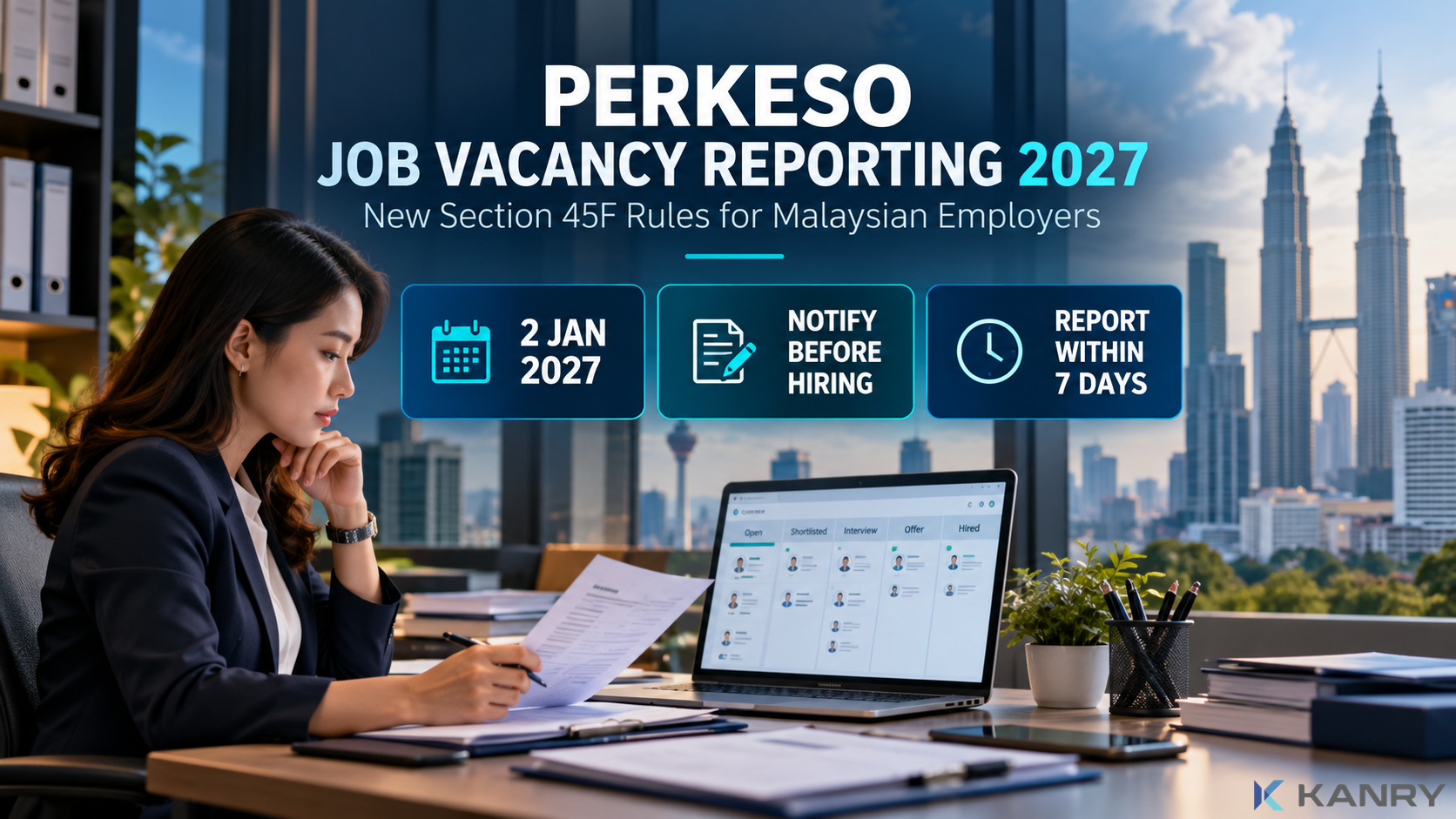

From 2 January 2027, employers in Malaysia must comply with a new statutory requirement to notify the Social Security Organisation (PERKESO or SOCSO) of job vacancies and newly created positions before hiring employees to fill them.
The requirement is introduced under Section 45F of the Employment Insurance System Act 2017, as amended by the Employment Insurance System (Amendment) Act 2026 (Act A1796).
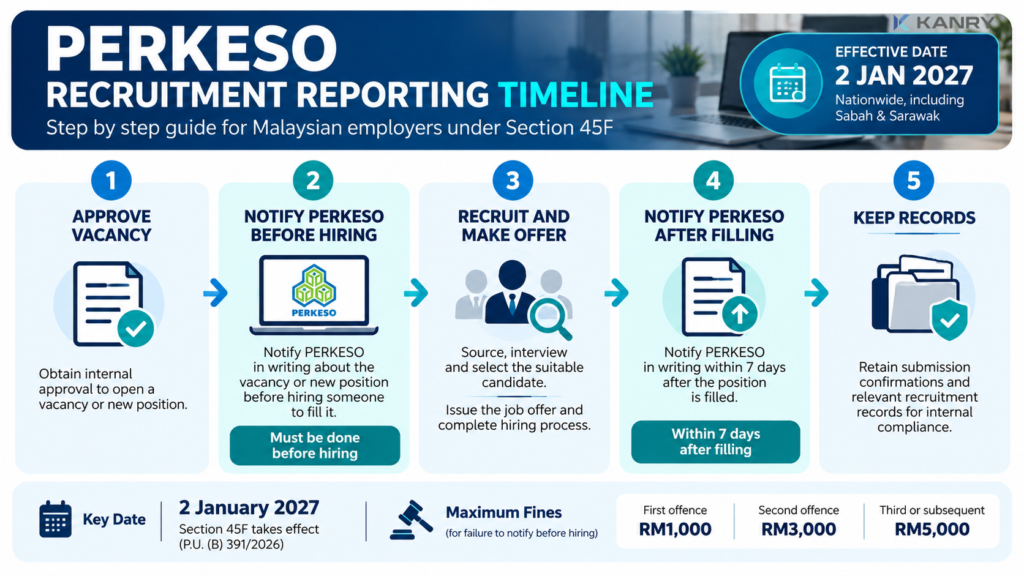
Employers must also notify PERKESO within seven days after a vacancy has been filled.
For Malaysian businesses, this is more than another administrative reporting requirement. It introduces a new compliance checkpoint into recruitment operations, affecting how employers open vacancies, engage recruitment agencies, issue offers and close completed placements.
Organisations that recruit regularly, particularly manufacturing companies, logistics operators, shared service centres and businesses managing multiple hiring locations, should review their procedures before the new requirement takes effect.
In this guide, Kanry Search explains the legal obligations, potential penalties and practical steps employers can take to prepare.
What Is the New PERKESO Job Vacancy Reporting Requirement?
The Employment Insurance System (Amendment) Act 2026 introduces Section 45F, establishing an employer obligation to report vacancies and newly created positions to PERKESO.
The provision is part of broader legislative changes concerning employment services and job matching.
The reporting obligation has two stages.
| Reporting stage | Employer requirement | Deadline |
|---|---|---|
| Vacancy opening | Notify PERKESO in writing about the vacancy or newly created position | Before hiring to fill the position |
| Vacancy filled | Notify PERKESO in writing that the position has been filled | Within seven days after filling |
| Recordkeeping | Retain submission confirmations and related recruitment records | Recommended internal control; no specific retention period established by Section 45F itself |
The first two requirements are statutory obligations. Maintaining a reporting register and submission evidence is a recommended compliance practice.
Important: The legislation requires written notification before hiring. Section 45F does not itself impose a universal requirement to advertise every vacancy for 14 days before making an appointment.
Employers should avoid confusing this new obligation with separate immigration, work pass or MYFutureJobs advertising requirements.
When Does Section 45F Come Into Effect?
The commencement date is confirmed by the Attorney General’s Chambers through Federal Government Gazette P.U. (B) 391/2026, published on 30 September 2026.
The Gazette establishes two commencement dates:
| Legislative provision | Effective date |
|---|---|
| Act A1796, except Section 11 | 1 October 2026 |
| Section 11, introducing Section 45F and related employment services provisions | 2 January 2027 |
The reporting obligation is therefore confirmed in legislation but is not yet operative as at 30 October 2026.
Employers should use November and December 2026 to update their recruitment processes rather than wait until the first vacancy arises in January.
The new provisions are federal legislation and are relevant to employers throughout Malaysia, including Sabah and Sarawak.
Official reference: Federal Government Gazette P.U. (B) 391/2026.
What Are the Penalties for Failing to Report Job Vacancies?
Section 45F(4) introduces tiered fines for employers who fail to comply with the requirement to notify PERKESO before hiring.
| Offence | Maximum fine |
|---|---|
| First offence | RM1,000 |
| Second offence | RM3,000 |
| Third or subsequent offence | RM5,000 |
These are maximum statutory fines, not automatic fixed penalties.
An important legal distinction is that the offence provision specifically refers to failure to comply with the pre hiring notification obligation under Section 45F(1).
The seven day notification after filling a position remains a statutory duty under Section 45F(3). However, employers should not assume that the same tiered fine automatically applies to a late post filling notification.
Both notifications should be incorporated into recruitment procedures.
Why repeated recruitment activity creates greater compliance exposure
Consider a manufacturer operating three plants in Malaysia.
Each plant independently recruits production operators, technicians and supervisors. Vacancies may be opened by different hiring managers, with some filled internally and others through external recruitment agencies.
Without a central reporting process, the organisation could overlook notifications when urgent replacements are required.
The operational risk is not limited to the maximum fine for one offence. Repeated reporting failures can also create audit weaknesses, additional administrative work and uncertainty over recruitment records.
Which Employers and Job Vacancies Are Affected?
Section 45F refers broadly to employers and to job vacancies or newly created positions.
Until PERKESO issues further operational clarification, employers should adopt a conservative approach and review reporting requirements across their recruitment activities.
| Recruitment scenario | Recommended employer approach |
|---|---|
| Permanent employee recruitment | Include PERKESO notification before hiring |
| Contract employee recruitment | Review and incorporate the notification requirement |
| Replacement of a resigned employee | Treat the replacement vacancy as potentially reportable |
| Newly created management position | Include the new position in the notification workflow |
| Recruitment through an employment agency | Agree on notification ownership with the agency |
| Multiple production operator vacancies | Record headcount and reporting evidence for the recruitment exercise |
| Internal transfers or promotions | Seek clarification on applicability rather than assuming an exemption |
| Foreign worker recruitment | Assess Section 45F separately from immigration and foreign hiring requirements |
This table is an operational planning guide, not a definitive list of legal exemptions or inclusions.
PERKESO’s implementing instructions should be consulted to determine any exemptions, prescribed reporting formats and treatment of unusual recruitment arrangements.
How Should Employers Notify PERKESO?
The legislation specifies that notification must be provided in writing.
PERKESO operates MYFutureJobs, Malaysia’s national employment services platform.
However, employers should distinguish between the existence of the MYFutureJobs platform and confirmation of the precise reporting mechanism for Section 45F.
As at 30 October 2026, the final operational submission procedure for this particular obligation has not been independently established in this review.
Employers should confirm the following directly with PERKESO before implementation:
- Whether MYFutureJobs will be the prescribed reporting channel.
- Whether vacancy advertisements automatically satisfy the statutory notification requirement.
- How employers must report filled positions.
- Whether recruitment agencies may submit on behalf of client employers.
- Whether exemptions, alternative submission channels or special procedures apply.
Until those matters are clarified, HR departments should prepare their internal data and reporting responsibilities without assuming that an existing job advertisement necessarily fulfils the new legal requirement.
How to Update Your Recruitment SOP Before January 2027
The most effective approach is to incorporate PERKESO reporting into the existing recruitment process rather than manage it as a separate administrative exercise.
Step 1: Register every approved vacancy
Once a hiring manager obtains approval to recruit, HR should create a vacancy record containing the job title, department, location, headcount, hiring entity and expected recruitment timeline.
This creates a central reference for the vacancy notification.
Step 2: Introduce a pre-hiring compliance checkpoint
Before an appointment is made, the responsible employee should confirm that the required PERKESO notification has been submitted.
A recruitment management system can prevent a job order from progressing to the final hiring stage without a recorded submission confirmation.
Step 3: Keep proof of notification
HR should retain relevant evidence, such as a submission reference, confirmation email, portal acknowledgement or other written record.
Where no electronic acknowledgement is available, employers should follow PERKESO’s eventual guidance on acceptable evidence.
Step 4: Track the date the vacancy is filled
The 7-day notification deadline runs from when the position is filled.
Employers should distinguish between offer acceptance, contract signing and commencement of employment. These dates may differ.
Because the precise operational interpretation may require further guidance, the organisation should use a documented and conservative trigger, with clarification from PERKESO where necessary.
Step 5: Submit the post-filling notification
Once the vacancy is filled, the responsible team must ensure the required written notification is submitted within seven days.
An internal reminder should be generated immediately when the position is marked as filled.
Step 6: Conduct periodic compliance checks
HR should reconcile filled vacancies against reporting records, identifying missing confirmations or overdue notifications.
For businesses with high recruitment volumes, a weekly review may be more effective than relying on individual hiring managers.
PERKESO 2027 Employer Compliance Checklist
Use this practical checklist to prepare your recruitment operations for Section 45F.
Internal planning tool. Checklist selections are not stored or submitted to PERKESO.
What Information Should HR Track in Its ATS or HRIS?
Employers do not necessarily need to purchase a new HR system.
Existing spreadsheets, applicant tracking systems and human resource information systems can be adapted to record the required information.
| Recommended field | Purpose |
|---|---|
| Job order reference | Identify the recruitment exercise |
| Employer legal entity | Establish the responsible employer |
| Job title and location | Identify the vacancy |
| Approved headcount | Track multiple positions |
| Vacancy approval date | Record internal recruitment approval |
| PERKESO pre-hiring notification date | Track initial compliance |
| Submission reference or evidence | Support internal verification |
| Vacancy filled date | Establish the post-filling reporting trigger |
| Post-filling notification date | Monitor the 7-day obligation |
| Reporting owner | Assign accountability |
| Compliance status | Identify outstanding action |
These are recommended internal controls rather than a statutory data template.
Who Is Responsible for PERKESO Reporting?
Recommended coordination between the client employer and recruitment agency.
| Activity | Employer | Recruitment Agency |
|---|---|---|
| Vacancy approval | Accountable | Receives job order |
| Initial PERKESO notification | Ensures compliance | Assists if permitted |
| Candidate sourcing | Reviews candidates | Coordinates sourcing |
| Placement confirmation | Confirms filled date | Updates job order |
| Seven day notification | Ensures compliance | Supports follow up |
| Compliance records | Maintains evidence | Shares agreed records |
This matrix is recommended practice. Any delegated reporting arrangement must comply with official PERKESO requirements.
What Happens When a Company Uses a Recruitment Agency?
This is one of the most important operational questions for employers using external recruiters.
Many Malaysian companies outsource candidate sourcing, screening, interview coordination and placement management to recruitment agencies.
However, appointing an external recruiter should not automatically be treated as transferring the employer’s statutory obligations.
Recommended division of responsibilities
| Recruitment activity | Client employer | Recruitment agency |
|---|---|---|
| Approve vacancy and headcount | Accountable | Receive approved requirements |
| Confirm statutory reporting responsibility | Accountable | Coordinate agreed procedure |
| Submit initial PERKESO notification | Employer or authorised representative, subject to official rules | Assist if authorised and permitted |
| Source and screen candidates | Review shortlisted candidates | Lead recruitment activity |
| Confirm vacancy has been filled | Notify HR and agency | Communicate placement outcome |
| Complete post-filling notification | Ensure compliance | Provide supporting information |
| Retain statutory reporting evidence | Maintain employer records | Retain agreed operational records |
The contractual allocation of administrative tasks should be clearly documented.
Even where an agency assists with notification, the employer should maintain visibility over submission status and supporting evidence.
Example: Manufacturing recruitment in Johor
A manufacturing company in Pasir Gudang appoints a recruitment agency to source 30 production operators.
Instead of managing the recruitment exercise only through candidate submissions and interview schedules, the company should also establish:
- The approved vacancy and headcount record.
- Who is responsible for notifying PERKESO before hiring.
- How notification confirmations are shared.
- How each filled position is recorded.
- Who monitors the 7 day reporting deadline.
This becomes particularly important when workers are recruited in batches and commence employment on different dates.
Example: Executive search in Kuala Lumpur
A company engages an executive search firm to recruit a Finance Director.
Although the recruitment process may be confidential, the employer should not assume that confidential hiring is exempt from Section 45F.
The company should seek official guidance on the appropriate reporting process and any applicable exceptions while maintaining its recruitment confidentiality controls.
Does Section 45F Require Employers to Change Payroll or Employment Contracts?
Section 45F is primarily a recruitment reporting provision.
It does not, by itself, introduce a new payroll contribution rate or require employers to amend every existing employment contract.
| HR area | Impact |
|---|---|
| Recruitment SOP | Update required |
| Vacancy approval workflow | Add reporting checkpoint |
| ATS or HRIS | Recommended update |
| Recruitment agency agreement | Review responsibilities |
| Onboarding checklist | Add post-filling notification tracking |
| Employment handbook | No automatic amendment solely due to Section 45F |
| Employment contracts | No automatic amendment solely due to Section 45F |
| Payroll contribution rates | No rate change arises from Section 45F itself |
Employers should nevertheless assess other provisions of Act A1796 separately, rather than assume the entire amendment is limited to vacancy reporting.
For existing statutory contribution guidance, see Kanry Search’s Malaysia HR and employer compliance resources.
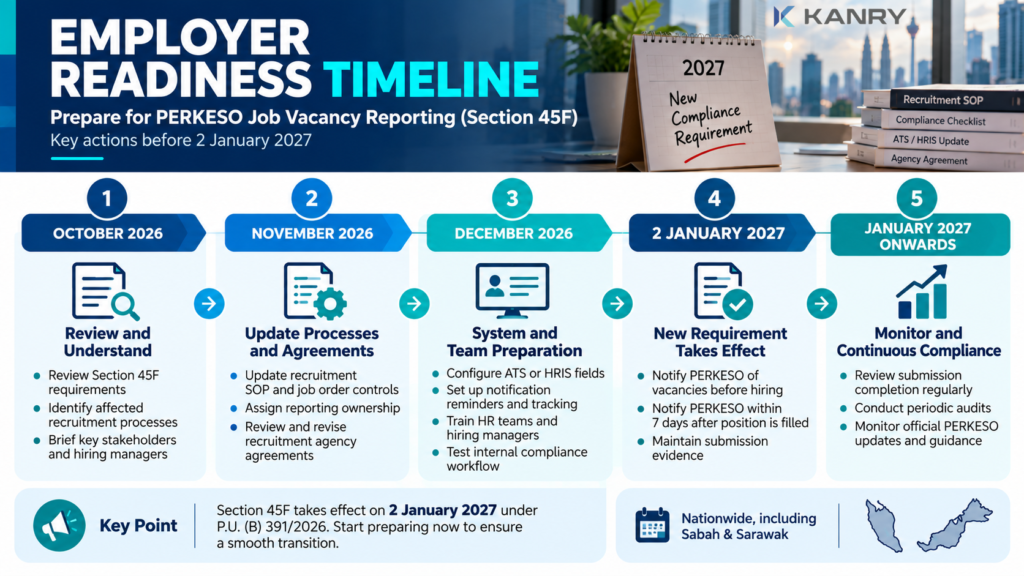
Employer Preparation Timeline: October 2026 to January 2027
| Period | Recommended action | Responsible team |
|---|---|---|
| October 2026 | Review Section 45F and identify affected recruitment processes | HR leadership |
| November 2026 | Update job order approval procedures and assign reporting ownership | HR operations |
| November 2026 | Review recruitment agency agreements and reporting responsibilities | HR and procurement |
| December 2026 | Configure ATS fields, evidence storage and notification reminders | HRIS and recruitment |
| December 2026 | Train hiring managers and test reporting controls | HR compliance |
| 2 January 2027 | Implement the confirmed statutory reporting obligation | Employer |
| January 2027 onward | Monitor submission completion and official PERKESO updates | HR operations |
Common Mistakes Employers Should Avoid
Assuming a recruitment agency handles everything
The employer should confirm reporting responsibility rather than rely on an informal assumption.
Treating job advertising as automatic statutory compliance
Until PERKESO confirms the implementation mechanism, publishing an advertisement should not automatically be treated as proof of Section 45F compliance.
Forgetting the second notification
The reporting process does not end when the employer finds a suitable candidate. A further notification is required within seven days after the position is filled.
Applying an assumed 14-day waiting period
Section 45F itself does not establish a universal 14-day advertising or waiting requirement.
Failing to maintain a central reporting register
When different departments recruit independently, missing reporting records can become difficult to identify.
Waiting until January to establish the process
The legal commencement date is confirmed. Employers can prepare their internal workflows now, even while awaiting further operational instructions.
How Kanry Search Can Support Employers
At Kanry Search, we work with employers across Malaysia and Singapore on permanent recruitment, executive search and workforce solutions.
The introduction of Section 45F reinforces the importance of maintaining clear recruitment records and coordinating responsibilities between hiring companies and external recruitment partners.
For employers using recruitment agencies, we recommend incorporating statutory notification checkpoints into the job order opening and placement closure processes.
Kanry Search can support clients through structured recruitment coordination, vacancy tracking, placement status updates and communication between hiring managers and recruitment teams.
The client employer should remain responsible for ensuring statutory compliance, while any delegated submission arrangements must follow PERKESO’s official requirements.
Preparing your recruitment operations for 2027?
Whether you are expanding a manufacturing workforce, recruiting specialist professionals or strengthening your recruitment procedures, Kanry Search can help you build a more structured hiring process.
Contact Kanry Search: https://kanrysearch.com/contact-us/
FAQ: PERKESO Vacancy Reporting 2027
When does mandatory PERKESO vacancy reporting begin?
Must employers notify PERKESO before hiring?
Is another notification required after the position is filled?
What are the maximum fines?
Does every vacancy need to be advertised for 14 days?
Can recruitment agencies submit notifications for employers?
Is MYFutureJobs the mandatory reporting platform?
Does the requirement apply in Sabah and Sarawak?
Does Section 45F change SOCSO contribution rates?
Official Government References
- Employment Insurance System (Amendment) Act 2026, Act A1796. Refer to Section 45F on printed page 8.
- Federal Government Gazette P.U. (B) 391/2026. Confirms commencement on 2 January 2027.
- PERKESO Official Website
- MYFutureJobs Official Platform
Disclaimer: This article provides general employer information based on the cited legislation and commencement notification as at 30 October 2026. It is not legal advice. Employers should refer to subsequent PERKESO instructions for prescribed reporting procedures and any exemptions.