
Hiring a new employee involves more than issuing an offer letter, collecting identification documents and setting up payroll. Employers in Malaysia must also ensure that eligible employees are properly registered with the Employees Provident Fund (EPF), also known as KWSP.
For employers hiring their first employee, this may involve registering the business with KWSP. For an established company, the process generally focuses on checking whether the new employee already has an EPF membership number and completing any necessary registration.
In 2026, employers must also account for the expanded mandatory EPF coverage of qualifying non-Malaysian employees, which took effect from October 2025 wages.
This guide explains how to register employees for EPF in Malaysia, the available registration channels, required information, common onboarding mistakes and the responsibilities employers should include in their HR and payroll processes.
Is EPF Registration Mandatory for Employers in Malaysia?
Under Section 41(1) of the Employees Provident Fund Act 1991, an employer must register with EPF within seven days from the date it becomes liable to contribute, generally when it first employs an employee.
This requirement is separate from registering individual employees as EPF members.
| Registration type | What it means | Who is responsible? |
|---|---|---|
| Employer registration | Registering the business or organisation with KWSP | Employer |
| Employee registration | Registering an eligible employee who is not already an EPF member | Employer, through an applicable registration channel |
| Existing member verification | Checking and using an employee’s existing EPF number | Employer / HR |
| Monthly contributions | Calculating, submitting and paying statutory contributions | Employer |
A company that is already registered with KWSP does not ordinarily need a new employer registration simply because it hires additional employees.
However, it must maintain accurate employee records and ensure eligible employees are included in the contribution process.
How to Register as an EPF Employer
If a business is hiring its first employee, it should confirm whether it already has an EPF employer reference number.
Employers can register through KWSP’s applicable registration channels, including online registration for eligible SSM-registered businesses and registration at EPF offices.
Documents employers may need
The documentation depends on the type of employer and registration method.
EPF Employer Registration — Document Checklist
Prepare the following information and documents before starting the registration process.
Employer particulars and company information.
Relevant SSM registration documents or other supporting documents.
Identification details of the authorised employer representative.
Completed KWSP registration forms, where applicable.
Authorisation documentation where a representative handles the application.
Once registered, retain the EPF employer reference number and registration records. Ensure authorised payroll personnel have appropriate account access.
Required documents may differ according to employer type and registration method. Confirm the latest requirements with KWSP.
Employers should retain these records and ensure the authorised payroll personnel have appropriate access to the employer account.
Official reference: KWSP — Employer Registration.
How to Register a New Employee for EPF
The correct process depends on whether the employee is already an EPF member and which registration channel is applicable.
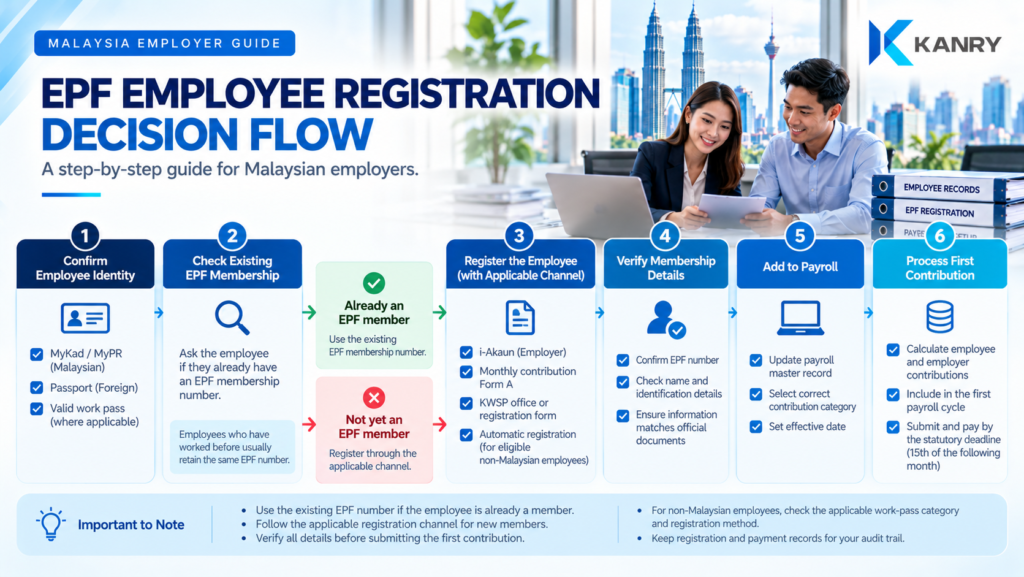
Step 1: Confirm the employee’s identity
Collect and verify the relevant identification information.
For Malaysian citizens and permanent residents, this normally includes MyKad or MyPR details.
For non-Malaysian employees, employers should verify the employee’s valid passport and relevant work pass information.
Step 2: Check existing EPF membership
Ask whether the employee already has an EPF membership number.
An employee who changes employers generally continues using their existing EPF membership rather than opening a new account.
Employers should avoid creating duplicate employee records.
Step 3: Select the applicable registration channel
KWSP provides several employee registration methods, including:
| Registration channel | Suitable use |
|---|---|
| i-Akaun (Employer) | Online registration of eligible employees |
| Monthly contribution Form A | Automatic registration of eligible Malaysian citizens and permanent residents |
| KWSP office or applicable registration form | Cases requiring physical registration or supporting documents |
| Automatic registration for qualifying non-Malaysian employees | Eligible work-pass holders under KWSP’s direct registration arrangements |
Step 4: Verify the EPF membership number
Once registration is successful, confirm that the membership details match the employee’s identity documents.
Check for errors in names, identification numbers or passport details before preparing the first contribution.
Step 5: Add the employee to payroll
Update the payroll master record with the correct EPF membership details and applicable contribution category.
Step 6: Process the first contribution
Calculate the employee and employer contributions using the applicable KWSP Third Schedule.
Contributions are generally payable by the 15th day of the following month.
Official reference: KWSP — Register Your Employees.
EPF Registration for Malaysian Citizens and Permanent Residents
For Malaysian citizens and permanent residents, employee registration is generally straightforward when identity details can be verified.
Employers with an activated i-Akaun (Employer) may register eligible employees online.
KWSP also provides automatic registration through the monthly contribution Form A for Malaysian citizens and permanent residents who are not yet EPF members.
The employee’s name and identification number must match their MyKad or MyPR information.
Important distinction: New employee versus new EPF member
A new hire is not necessarily a new EPF member.
For example, an employee joining a new company after working elsewhere may already have an EPF number.
In this situation, the employer should verify the existing membership details and use the correct number for future contributions.
Registering a duplicate account is not the objective of employee onboarding.
EPF Registration for Foreign Employees in 2026
Mandatory EPF coverage for qualifying non-Malaysian employees began with October 2025 wages.
The expanded coverage includes eligible non-Malaysian employees with valid passports and employment authorisation, subject to the applicable conditions and exemptions.
For qualifying employees in the standard non-Malaysian contribution category, both employer and employee generally contribute 2% of wages.
However, the registration method depends on the employee’s work-pass category and existing EPF membership status.
Registration channels for non-Malaysian employees
| Employee situation | Registration approach |
|---|---|
| Eligible Employment Pass holder | May be covered by automatic registration |
| Eligible Visitor’s Pass (Temporary Employment) holder | May be covered by automatic registration |
| Other eligible pass holder | Check applicable i-Akaun or EPF office registration arrangements |
| Already registered EPF member | Verify and use existing membership details |
| Registration unsuccessful or incomplete | Follow KWSP instructions to complete verification or registration |
Employers should check the employee’s registration status through i-Akaun (Employer) where available.
They should also verify whether additional personal information updates or biometric verification are required.
Are domestic workers covered?
Domestic servants are excluded from the expanded mandatory contribution requirement, although voluntary contribution arrangements may be available.
Employers should confirm the applicable category rather than assuming that every non-Malaysian worker follows the same rules.
For further reading, see Kanry Search’s EPF Contributions for Non-Malaysian Employees.
What Information Should HR Prepare Before EPF Registration?
An accurate employee master record reduces registration delays and contribution errors.
EPF New Employee Registration Checklist
Use this checklist when onboarding a new employee.
Checklist selections are not saved. Handle employee information securely and verify registration requirements with KWSP.
The information collected during onboarding should be reviewed against official identification documents before being entered into the payroll system.
Employers should also handle employee personal information securely and restrict access to authorised HR and payroll personnel.
EPF Registration and First Contribution Timeline
Employee registration should be treated as part of onboarding, not as an administrative task postponed until the first payroll deadline.
Recommended onboarding timeline
| Stage | Recommended action |
|---|---|
| Before the start date | Collect the necessary identification and employment details securely |
| On the employee’s first day | Verify identity, employment category and existing EPF membership |
| During payroll setup | Complete registration where required and confirm the EPF number |
| Before payroll approval | Validate EPF-liable wages and contribution category |
| Following the wage month | Submit and pay EPF contributions by the applicable statutory deadline |
| After payment | Retain acknowledgement, payment records and reconciliation evidence |
This is a recommended internal process. It does not replace statutory registration and payment deadlines.
Example: A new employee joins in October 2026
A Malaysian employee joins a company on 5 October 2026.
Practical Employer Example
New Employee Joins in October 2026
Follow how HR and payroll handle EPF registration for an employee who already has an EPF membership number.
A Malaysian employee joins the company and provides existing EPF membership details.
HR confirms that the employee already has an EPF membership number from a previous employer. A new membership is not required.
Payroll uses the existing EPF number, verifies the correct contribution category and calculates the employee and employer contributions.
The October EPF contribution is generally payable by this date. Finance ensures the payment is completed and the supporting records are retained.
Employees who change employers generally keep their existing EPF membership number. The new employer must verify the details and ensure contributions are submitted under the correct membership.
Common EPF Registration Mistakes Employers Should Avoid
| Common mistake | Potential problem | Recommended action |
|---|---|---|
| Registering the employer too late | Statutory non-compliance | Register within the applicable deadline |
| Assuming every new hire needs a new EPF account | Duplicate or inconsistent records | Verify existing membership first |
| Incorrect MyKad or passport details | Registration or payment matching issues | Check against official documents |
| Using an outdated passport number | Incorrect employee records | Maintain current identification details |
| Assuming foreign employees are exempt | Missed mandatory contributions | Review current coverage rules |
| Incorrect employee classification | Wrong contribution category | Verify age, citizenship and membership status |
| Failing to confirm registration success | Contributions may be misallocated | Check membership information before submission |
| Missing the first contribution | Arrears and enforcement exposure | Include EPF in the payroll approval checklist |
Employers should document exceptions and resolve them promptly rather than carrying inaccurate employee records into subsequent payroll cycles.
Who Is Responsible for EPF Registration During Onboarding?
EPF registration requires coordination between HR, payroll, finance and management.
EPF Registration Responsibility Matrix
How employers can divide onboarding and EPF registration responsibilities.
Management
Maintain compliance oversight, assign responsibilities and resolve registration or payroll issues.
Human Resources
Collect and verify employee information, confirm existing EPF membership and maintain accurate onboarding records.
Payroll
Complete applicable employee registration steps, set up EPF contribution details and prepare payroll submissions.
Finance
Verify contribution totals, authorise statutory remittances and retain payment and reconciliation records.
Although HR, payroll and finance may share administrative responsibilities, the employer remains legally responsible for meeting applicable EPF registration and contribution obligations.
The employer remains responsible for fulfilling statutory EPF obligations even where administrative tasks are delegated.
What Happens If an Employer Fails to Register or Contribute?
EPF registration and contribution requirements are legal obligations, not optional HR procedures.
Failure to register as an employer within the statutory period may result in enforcement action under Section 41(1) of the EPF Act 1991.
Failure to remit contributions on time may also expose employers to statutory penalties and other enforcement measures.
Importantly, deducting the employee’s EPF contribution from wages without remitting it to KWSP can result in serious legal consequences.
Employers should review outstanding registrations, reconcile unpaid contributions and seek guidance from KWSP where corrections are necessary.
Official reference: KWSP — Compliance and Enforcement.
Frequently Asked Questions About EPF Employee Registration
EPF Employee Registration — FAQs
Click a question to expand the answer.
Must an employer register with KWSP after hiring its first employee?
Yes. An employer must generally register with KWSP within seven days of becoming liable to contribute, normally upon employing its first employee.
Does every new employee need a new EPF account?
No. Employees who are already EPF members generally retain their existing membership number when changing employers.
Can employers register employees through i-Akaun?
Yes. Employers with an activated i-Akaun (Employer) can register eligible employees online, subject to KWSP’s requirements.
Can a Malaysian employee be registered automatically?
Eligible Malaysian citizens and permanent residents who are not yet EPF members may be registered automatically through the monthly contribution Form A, provided their identification details are correctly submitted and verified.
Must foreign employees register for EPF in 2026?
Qualifying non-Malaysian employees are covered by the expanded mandatory EPF requirements effective from October 2025 wages. Employers should check the employee’s work-pass category, membership status and applicable exclusions.
What if a foreign employee’s automatic registration is unsuccessful?
Follow KWSP’s instructions for completing registration. Depending on the circumstances, the employee may need to visit an EPF office for identity verification or registration.
When is the first EPF contribution due?
EPF contributions for a wage month are generally payable by the 15th day of the following month. Employers should verify any applicable payment arrangements with KWSP.
Can a company use its existing employer number when hiring foreign employees?
Yes. An already registered employer generally uses its existing EPF employer number and does not need a second employer registration simply because it hires qualifying foreign employees.
For official registration information, visit KWSP — Register Your Employees .
How Kanry Search Supports Employer Onboarding and Payroll Administration
Efficient onboarding depends on accurate employee records, clear internal responsibilities and reliable payroll processes.
For businesses recruiting frequently, even small registration mistakes can create recurring payroll reconciliation problems.
Kanry Search supports Malaysian employers through recruitment, contract staffing, payroll administration and HR-related services.
Whether your company is hiring its first employees, expanding its workforce or managing different employee categories, structured onboarding processes help reduce administrative risk.
Need Recruitment or Payroll Administration Support?
Kanry Search works with employers seeking practical recruitment and workforce administration solutions.
Contact Kanry Search to discuss your hiring and payroll administration requirements.
Official References
- KWSP — Employer Registration
- KWSP — Register Your Employees
- KWSP — Employer Responsibilities
- KWSP — Non-Malaysian Citizen Employees
- KWSP — Mandatory Contributions
- KWSP — Compliance and Enforcement
Disclaimer: This article provides general employer information as of 12 October 2026. Employers should verify employee-specific registration procedures, contribution requirements and statutory deadlines with KWSP.