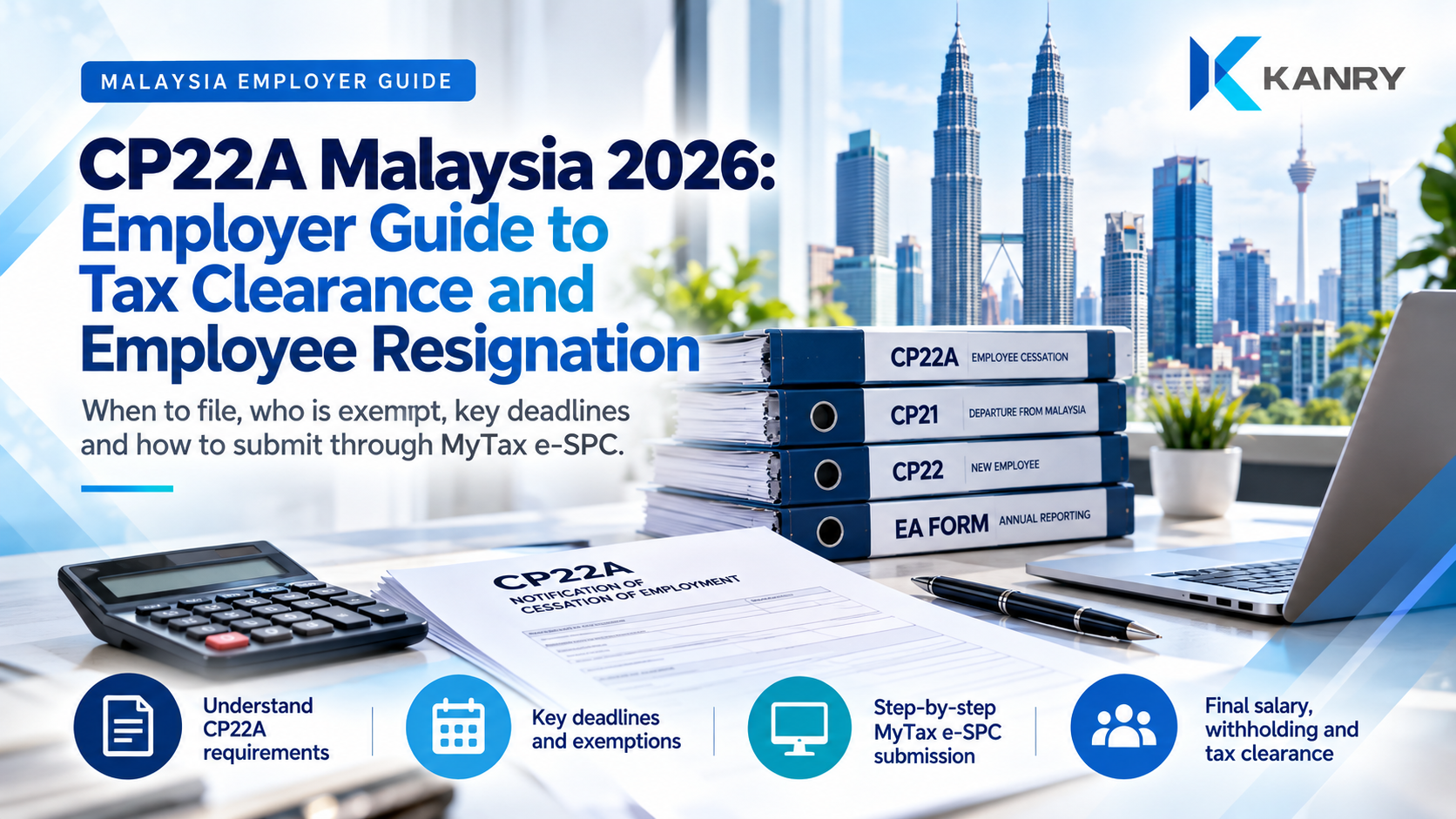

When an employee resigns, retires or is terminated in Malaysia, employers may need to do more than calculate the final salary and close the employee’s payroll record.
Depending on the circumstances, the employer may also need to submit Form CP22A to Lembaga Hasil Dalam Negeri Malaysia (HASiL/LHDN) and obtain a tax clearance letter before releasing certain payments.
However, CP22A is not mandatory for every resignation. Understanding the applicable exemptions is just as important as knowing the submission deadline.
This guide explains when CP22A is required, how to submit it through MyTax e-SPC, what happens to an employee’s final salary, and how employers can build tax clearance checks into their offboarding process.
CP22A Malaysia 2026: Key Facts for Employers
| Requirement | What employers need to know |
|---|---|
| Form | CP22A — Notification of Cessation of Employment |
| Applies to | Relevant private-sector employment cessation and death cases |
| Main legal provision | Subsection 83(3), Income Tax Act 1967 |
| Standard advance notice | At least 30 days before cessation, where notification is required |
| Employee death | Within 30 days after the employer is informed |
| Submission channel | MyTax → e-SPC |
| Tax clearance | HASiL issues a Surat Penyelesaian Cukai (SPC), where applicable |
| Final payments | Withholding requirements may apply |
| Exemptions | Certain cases do not require CP22A or related withholding |
Key takeaway: Do not automatically submit CP22A for every departing employee, but do not automatically release final payments without first checking whether tax clearance and withholding requirements apply.
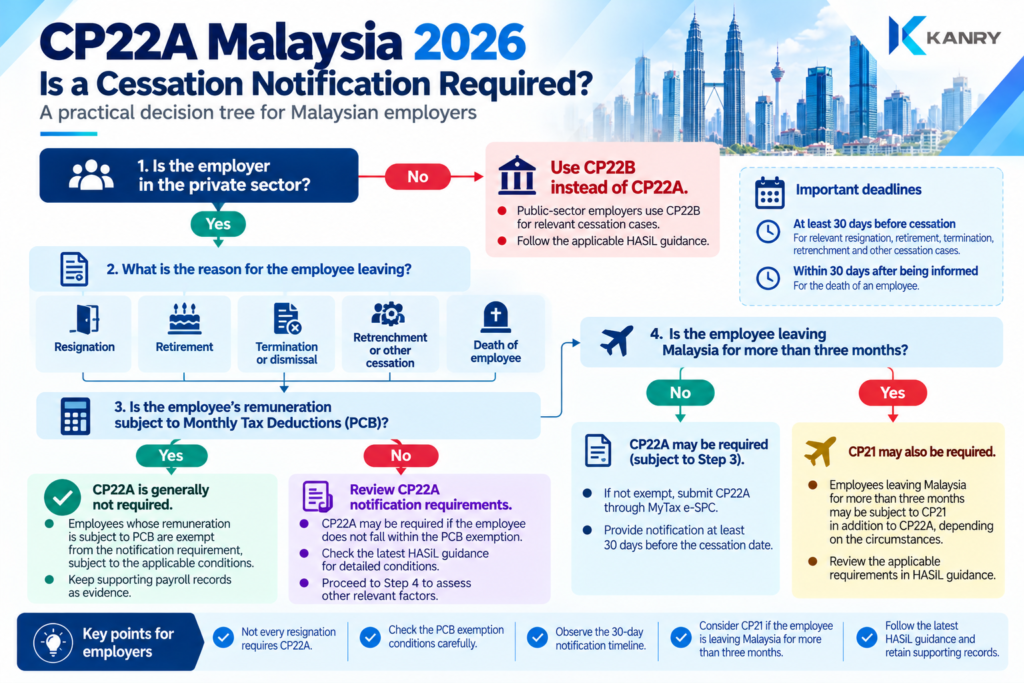
ⓘ Employer Reminder: Not Every Resignation Requires CP22A
Employers should assess the statutory notification requirements and applicable exemptions before submitting CP22A. Certain employees whose remuneration is subject to Monthly Tax Deductions (PCB) may be exempt, subject to HASiL’s conditions.
What Is CP22A in Malaysia
CP22A is the prescribed notification used by private-sector employers for relevant cases where an employee ceases employment, retires or dies.
It forms part of Malaysia’s employee tax clearance process.
Under subsection 83(3) of the Income Tax Act 1967, employers have notification obligations when the applicable statutory conditions are met.
The purpose is to allow HASiL to review the employee’s tax position and determine whether tax clearance action is required.
Is CP22A the Same as a Tax Clearance Letter?
No.
| CP22A | Tax Clearance Letter (SPC) |
|---|---|
| Notification or application submitted by the employer | Document issued by HASiL |
| Contains relevant employee and remuneration details | Communicates the tax clearance outcome and relevant instructions |
| Initiates the applicable process | Helps the employer determine how to handle withheld amounts |
Submitting CP22A does not mean that a tax clearance letter has already been issued.
Official reference: HASiL — Notification of Cessation of Employment
When Must an Employer Submit CP22A?
Employers should assess CP22A whenever a private-sector employee is leaving employment and the circumstances fall within the notification requirements.
Potentially relevant situations include:
- Resignation.
- Retirement.
- Termination or dismissal.
- Retrenchment.
- Other cessation of employment.
- Death of an employee.
The employee’s departure reason alone does not determine whether CP22A must be filed.
The employer must also assess the statutory criteria and exemptions.
CP22A Submission Deadlines
| Situation | General notification deadline |
|---|---|
| Employment cessation requiring CP22A | At least 30 days before the cessation date |
| Employee death requiring CP22A | Within 30 days after the employer is informed |
These deadlines are different because an employer cannot provide advance notice of an unexpected death.
Example: Employee Resignation
An employee gives notice on 1 November 2026, with the final employment date of 30 November 2026.
HR should assess whether CP22A is required as soon as the resignation is received.
If notification is required, the employer must ensure that the statutory advance-notice requirement is met.
Where the employee provides insufficient notice for the employer to comply with the full 30-day period, the employer should seek guidance from HASiL and submit the required notification as promptly as possible. A short resignation notice does not automatically remove the statutory obligation.
Is CP22A Required for Every Employee Who Resigns?
No. This is one of the most important points for Malaysian employers.
HASiL identifies circumstances in which the employer does not need to submit a cessation notification.
These include applicable cases where:
- The employee’s remuneration is subject to Monthly Tax Deductions (PCB/MTD).
- The employee’s monthly remuneration is below the minimum amount subject to PCB.
The exemption must be assessed against the actual employee circumstances and current HASiL guidance.
CP22A Eligibility Guide
Click each question to review the relevant employer requirements.
1. Is CP22A required for every resignation?
No. Employers must assess the statutory requirements and applicable exemptions, including relevant PCB-related exemptions.
2. Private-sector or public-sector employer?
CP22A generally applies to relevant private-sector cessation cases. CP22B is the corresponding form for relevant public-sector cases.
3. Is the employee leaving Malaysia?
If the employee is leaving Malaysia for more than three months, CP21 notification requirements may also apply. Check the relevant conditions and exemptions.
4. What is the CP22A deadline?
Where notification is required, the general deadline is at least 30 days before cessation. For applicable employee death cases, notification is generally required within 30 days after the employer is informed.
This guide is for general information only. Confirm the requirements with HASiL before filing.
Practical CP22A Assessment
| Employee situation | Recommended employer action |
|---|---|
| Employee resigns and PCB is being deducted | Check the applicable exemption before filing |
| Employee’s remuneration is below the PCB threshold | Assess the relevant exemption |
| Employee has taxable remuneration but no PCB deduction | Review CP22A notification requirements |
| Employee receives substantial final payments or unusual remuneration | Review tax clearance requirements carefully |
| Employee dies during employment | Assess the death-notification requirements |
| Employee intends to leave Malaysia for more than three months | Check whether CP21 applies instead or in addition |
An employer should not rely on the employee’s salary level alone without checking the full circumstances.
Does a New Job in Malaysia Affect Tax Clearance?
HASiL’s cessation guidance also discusses circumstances involving employees who are taking up employment elsewhere in Malaysia.
Where an employer knows the employee is moving to another Malaysian employer, this may affect the applicable notification and withholding requirements.
HR should verify the circumstances and refer to the current official guidance rather than treating every job change as a tax clearance case.
Official source: HASiL — Termination of Service / Employment
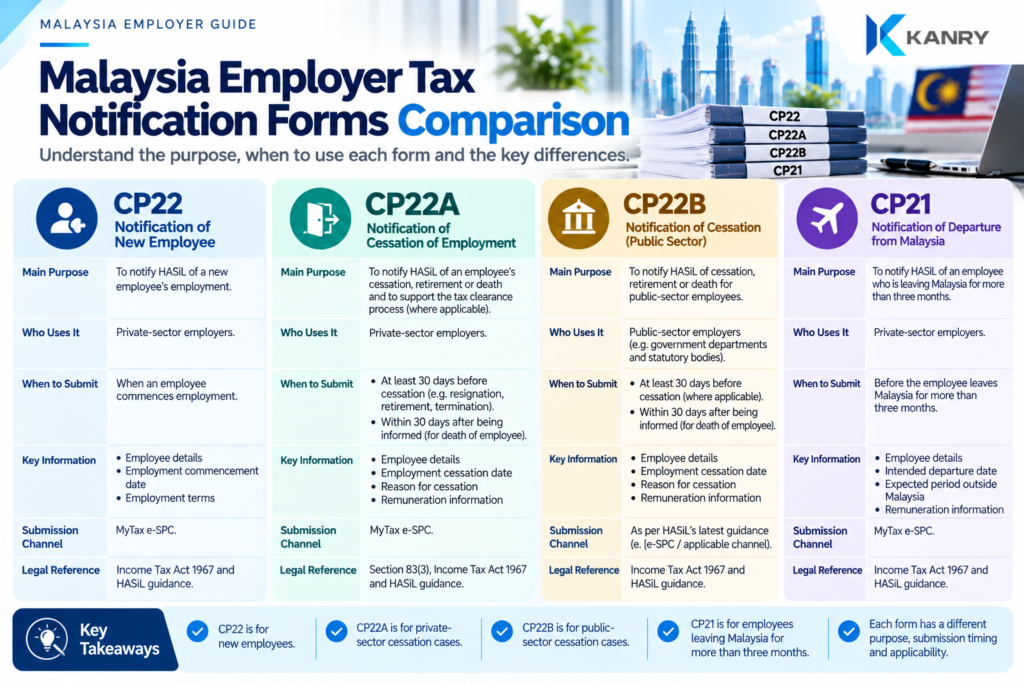
CP22A vs CP22B vs CP21 vs CP22
These forms are frequently confused because they all concern employer tax administration.
| Form | Purpose | When Used |
|---|---|---|
| CP22 | Notification of new employee | When an employee commences employment, subject to applicable requirements. |
| CP22A | Private-sector employment cessation notification | Qualifying resignation, retirement, termination or death cases. |
| CP22B | Public-sector employment cessation notification | Qualifying public-sector cessation or death cases. |
| CP21 | Notification of employee departure from Malaysia | Applicable cases involving departure from Malaysia for more than three months. |
Each form has separate statutory requirements and exemptions. Refer to current HASiL guidance before submission.
Important Differences
CP22 is generally associated with employee onboarding.
CP22A and CP22B relate to cessation of employment, with the appropriate form depending on the employer sector.
CP21 concerns relevant employees leaving Malaysia for an extended period.
For an employee who resigns and plans to leave Malaysia, employers should assess the applicable departure and cessation requirements rather than assuming that filing one form automatically satisfies every obligation.
Official source: HASiL — Employer Responsibilities
How to Submit CP22A Through MyTax e-SPC
Employers must use the applicable electronic tax clearance process.
HASiL’s guidance specifies mandatory online submission through MyTax e-SPC for the relevant CP22A process.
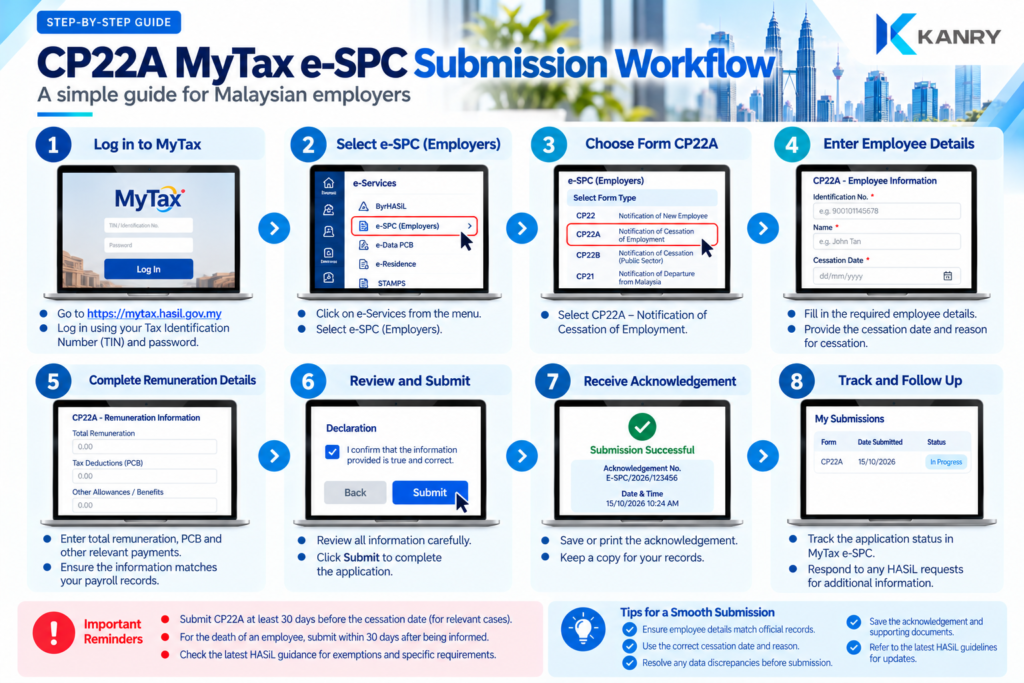
CP22A MyTax e-SPC Submission Workflow
Eight practical steps for Malaysian employers
Check Applicability
Confirm whether CP22A is required and check the applicable exemptions.
Prepare Records
Verify employee identification, tax reference and employment dates.
Reconcile Payroll
Review salary, bonuses, allowances, PCB and outstanding payments.
Access MyTax
Sign in to the official MyTax portal and access the e-SPC service.
Complete CP22A
Enter the required cessation, employee and remuneration information.
Review and Submit
Check the information, submit the application and save the acknowledgement.
Monitor Application
Track the clearance status and respond to any HASiL requests.
Follow Clearance Instructions
Handle final payments according to applicable requirements and HASiL instructions.
Important: CP22A is not required for every resignation. Check applicable exemptions and notification deadlines before submitting. The MyTax interface may change over time.
Official references:
What Information Should HR Prepare for CP22A?
A complete and accurate application depends on reliable employee and payroll records.
CP22A Preparation Checklist
CP22A Preparation Checklist
A practical employer checklist for employee tax clearance preparation.
0% completed
Tick the tasks as you complete them.
This checklist is for general employer guidance and does not replace official HASiL requirements. Complete the acknowledgement step only after a submission has been made, where applicable. Progress resets when the page is refreshed.
The list is a recommended employer preparation checklist. Actual fields and required supporting documents are determined by the current official e-SPC process.
Why Does Payroll Reconciliation Matter?
Incorrect remuneration information may delay the clearance process or create questions from HASiL.
For employers with variable salary structures, final pay may include several components processed at different times.
For example, a retail employee may receive basic salary, sales commission, unused annual leave payments and a final incentive.
HR should ensure that the relevant information is reconciled rather than submitting only the employee’s last monthly basic salary.
Must Employers Withhold Final Salary While Waiting for Tax Clearance?
Where the applicable statutory tax clearance and withholding requirements apply, employers must withhold relevant money payable to the employee.
HASiL’s guidance refers to withholding for up to 90 days, or until the applicable tax clearance process permits payment.
However, the withholding requirement should not be applied indiscriminately to every resignation.
The employer must first determine whether the case falls within the relevant legal provisions and exemptions.
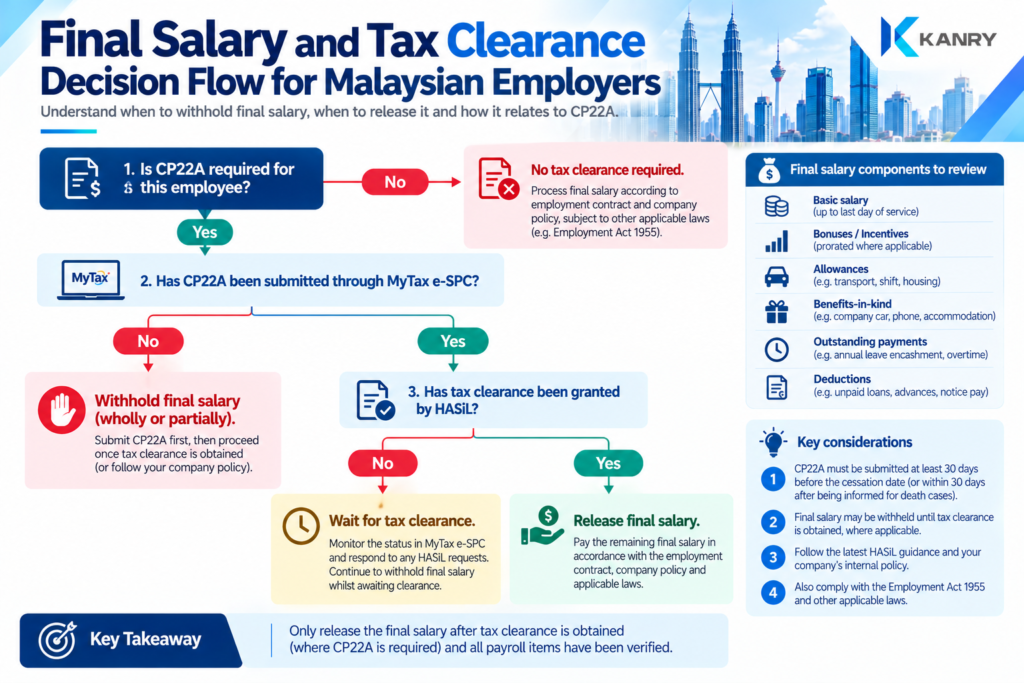
What Payments May Need to Be Reviewed?
Depending on the circumstances, relevant money payable may include:
- Outstanding salary.
- Bonuses and commissions.
- Certain final employment payments.
- Other amounts payable to the employee.
The legal treatment of individual payments depends on the circumstances.
Example: Final Salary Pending Clearance
An employee’s final remuneration includes:
Practical Example: Employee Final Salary
An employee resigns with the following outstanding remuneration:
| Payment Component | Amount |
|---|---|
| Outstanding basic salary | RM5,000 |
| Commission | RM2,000 |
| Other final payment | RM1,500 |
| Total before deductions | RM8,500 |
Employer Reminder: Where statutory tax clearance withholding applies, the employer must handle money payable in accordance with the relevant legal requirements and HASiL instructions. Do not assume every resignation requires withholding.
Illustration only. Actual entitlements, deductions and withholding obligations depend on the case.
What if Tax Clearance Is Delayed?
Employers should monitor the application, respond to HASiL requests and document the status of the withheld payments.
Do not promise employees a guaranteed clearance date.
Employers should also distinguish tax clearance requirements from their separate employment-law obligations concerning wages and final payments, and seek professional advice where the obligations interact.
Official reference: HASiL — Notification of Cessation of Employment
How Long Does HASiL Take to Process Tax Clearance?
HASiL’s published educational guidance states that a tax clearance letter may be processed within 14 working days where all required documents have been submitted and no further queries arise.
This is a conditional processing indication, not a guaranteed turnaround for every application.
The timeline may be affected by incomplete records, outstanding tax matters, additional queries or other case-specific circumstances.
Employer Planning Tip
Build a tax clearance review into the resignation and termination process as early as possible.
Waiting until the employee’s final working day to determine whether CP22A is required can create avoidable delays and disputes.
Official reference: HASiL — Tax Clearance Educational Guidance
Common CP22A Mistakes Employers Should Avoid
| Common mistake | Better approach |
|---|---|
| Assuming every resignation requires CP22A | Check statutory criteria and exemptions |
| Assuming PCB automatically resolves every tax issue | Review the actual employee circumstances |
| Confusing CP22A with CP21 | Identify whether the issue is cessation, departure or both |
| Filing too late | Assess notification requirements when notice is received |
| Using incomplete remuneration figures | Reconcile payroll and final payments |
| Releasing withheld amounts prematurely | Follow applicable legal requirements and HASiL instructions |
| Failing to track clearance status | Assign an owner and maintain a case register |
| Using outdated manual submission procedures | Follow current MyTax e-SPC requirements |
| Failing to retain records | Keep supporting documents and correspondence |
A Practical Control for HR Teams
Add a mandatory Tax Clearance Assessment field to the employee exit checklist.
The field should record whether CP22A, CP21 or another process is applicable, the reason for the decision, and the person who approved it.
This helps ensure that tax clearance is reviewed consistently rather than only when a payroll problem occurs.
Special Considerations for Foreign Employees and Expatriates
Foreign employees may have more complex tax clearance circumstances, especially when their employment ends and they intend to leave Malaysia.
Employers should review:
- The employee’s Malaysian tax position.
- Whether the employee is leaving Malaysia for more than three months.
- The applicability of CP21.
- Any outstanding remuneration or benefits.
- Whether a tax clearance application is required.
- Relevant payroll and immigration administration.
Example: Expatriate Leaving Malaysia
An expatriate employee resigns from a Malaysian company and plans to relocate overseas.
The employer should assess the departure notification requirements and applicable tax clearance process before finalising the employee’s exit arrangements.
A work pass cancellation and an income tax clearance process are different administrative matters.
Completing one does not automatically satisfy the other.
How CP22A Fits Into Employee Offboarding
Employee offboarding should coordinate HR, payroll, finance and management responsibilities.
Employee Offboarding Responsibility Matrix
A recommended division of responsibilities to help employers coordinate employee tax clearance.
| Offboarding Task | Suggested Owner |
|---|---|
| Confirm resignation or termination details | HR |
| Assess CP22A / CP21 applicability | HR / Payroll |
| Reconcile final remuneration | Payroll |
| Review PCB and outstanding tax matters | Payroll / Finance |
| Submit applicable e-SPC application | Authorised Representative |
| Monitor tax clearance status | HR / Payroll |
| Approve final payment release | Finance / Management |
| Retain offboarding documentation | HR |
Suggested internal controls only. Actual responsibilities may differ depending on company size, structure and authorisation arrangements.
Example: Manufacturing Company With High Employee Turnover
A manufacturing business processes numerous resignations each month.
Without a standardised exit checklist, HR may close an employee’s record while finance processes the final payment without confirming the employee’s tax clearance position.
A centralised offboarding workflow helps ensure that the relevant notification assessment happens before final payment approval.
Does CP22A Replace the Annual EA Form?
No.
CP22A and the EA Form serve different purposes.
| CP22A | EA Form |
|---|---|
| Relevant cessation notification | Annual employee remuneration statement |
| Used in the applicable tax clearance process | Supports the employee’s annual tax reporting |
| Triggered by qualifying cessation circumstances | Prepared for the relevant annual reporting period |
| Submitted through the applicable HASiL process | Provided to the employee |
An employee who leaves during the year may still need to be included in the employer’s annual remuneration reporting.
For more information, see Kanry Search’s EA Form Malaysia 2026: Complete Employer Guide for YA 2025.
Employers should also review their broader payroll obligations using Kanry’s Malaysia Payroll Contribution Guide 2026.
What Should Employers Do if CP22A Was Not Submitted on Time?
If the employer discovers that a required notification was missed, the issue should be addressed promptly.
Recommended Corrective Steps
- Confirm that CP22A was actually required.
- Identify the employee and the relevant cessation date.
- Reconcile the employee’s remuneration and tax information.
- Contact HASiL where necessary for guidance on the late application.
- Submit the required information through the applicable process.
- Review whether any final payments were handled incorrectly.
- Retain records of the corrective action.
- Strengthen the offboarding controls to prevent recurrence.
Late submission does not automatically eliminate any original non-compliance.
Where significant tax liabilities, employee disputes or potential penalties are involved, employers should seek qualified professional advice.
How Kanry Search Supports Employers With Workforce Administration
Employee departures affect more than recruitment planning.
They involve payroll calculations, employee records, statutory notifications, final payments and workforce replacement decisions.
Kanry Search supports Malaysian and Singaporean businesses through recruitment, staffing and HR solutions.
Permanent and Executive Recruitment
Helping employers identify suitable professionals, managers and operational talent.
Contract and Temporary Staffing
Supporting businesses with flexible workforce requirements and changing operational needs.
Payroll and HR Administration
Supporting agreed payroll and employee administration processes.
Employer-of-Record Solutions
Helping businesses explore eligible employment arrangements and associated local administrative support.
Strengthen Your Employee Lifecycle Processes
Whether your business is expanding, restructuring or managing frequent employee movements, coordinated recruitment, HR and payroll administration can reduce avoidable operational problems.
Contact Kanry Search to discuss recruitment, staffing, payroll and HR support for your Malaysian operations.
Kanry Search’s services do not replace legal or tax advice or official determinations made by HASiL.
Frequently Asked Questions About CP22A Malaysia
Is CP22A Mandatory for Every Resignation?
No. Employers must assess the statutory notification requirements and applicable exemptions. Certain employees subject to PCB or earning below the relevant threshold may fall within the exemptions.
What Is the CP22A Deadline?
Where required, the general notification deadline is at least 30 days before cessation of employment. For relevant employee death cases, notification is required within 30 days after the employer is informed.
Where Do Employers Submit CP22A?
Through the applicable MyTax e-SPC service.
Can CP22A Be Submitted Manually?
The standard CP22A submission process is electronic through e-SPC. HASiL identifies specific arrangements for cancellation applications, which may be handled manually.
What Is the Difference Between CP22A and CP21?
CP22A relates to qualifying private-sector employment cessation cases. CP21 concerns relevant employees leaving Malaysia for more than three months.
Does an Employer Have to Withhold Final Salary?
Withholding may be required where the applicable tax clearance provisions apply. Employers should assess the statutory requirements and exemptions before deciding whether payment can be released.
How Long Does Tax Clearance Take?
HASiL has indicated a processing period of 14 working days for complete applications without further queries. Actual processing may vary.
Can an Employee Receive Their Final Pay Before Tax Clearance?
This depends on whether the applicable withholding requirements apply and on the relevant HASiL instructions. Employers should not assume that all final payments may be released immediately.
What Happens if an Employee Resigns With Less Than 30 Days’ Notice?
The employer should assess the notification requirement immediately, seek HASiL guidance where necessary and complete the applicable process as promptly as possible.
Does CP22A Replace the EA Form?
No. CP22A concerns the relevant cessation and tax clearance process. The EA Form is an annual employee remuneration statement.
Does CP22A Apply to Foreign Employees?
It may, depending on the circumstances. Employers should also assess whether CP21 is required when an employee is leaving Malaysia.
Can Employers Amend a CP22A Application?
HASiL provides procedures for amendment and additional applications through e-SPC. Employers should follow the current official instructions.
Conclusion: Make Tax Clearance Part of Every Employee Exit Assessment
CP22A is an important component of Malaysia’s employer tax compliance framework, but it should not be treated as a form that must automatically be filed for every employee resignation.
Employers need to assess the applicable notification requirements, exemptions, submission deadlines and final payment obligations.
The most effective approach is to integrate tax clearance checks into the employee offboarding process.
Key takeaway: Before finalising an employee’s departure, confirm whether tax clearance is required, reconcile the employee’s remuneration and document the decision.
For employers managing large or frequently changing workforces, consistent HR and payroll coordination is essential.
Contact Kanry Search to explore recruitment, staffing and HR administration solutions.
Official Government References
- HASiL — Employer Responsibilities — Employer notifications, deadlines, withholding and record keeping.
- HASiL — Notification of Cessation of Employment — CP22A/CP22B exemptions, deadlines and electronic submission.
- HASiL — Termination of Service / Employment — Tax clearance and relevant cessation circumstances.
- HASiL — MyTax Portal — Official e-SPC access.
- HASiL — e-SPC User Manual — Application workflow and form information.
- HASiL — Tax Clearance Educational Guidance — Tax clearance procedures and conditional processing timeline.
Disclaimer: This article provides general employer compliance information based on official Malaysian tax guidance reviewed in October 2026. It is not legal or tax advice. Employers should confirm current requirements with HASiL and obtain professional advice for individual cases, tax clearance disputes and statutory compliance questions.