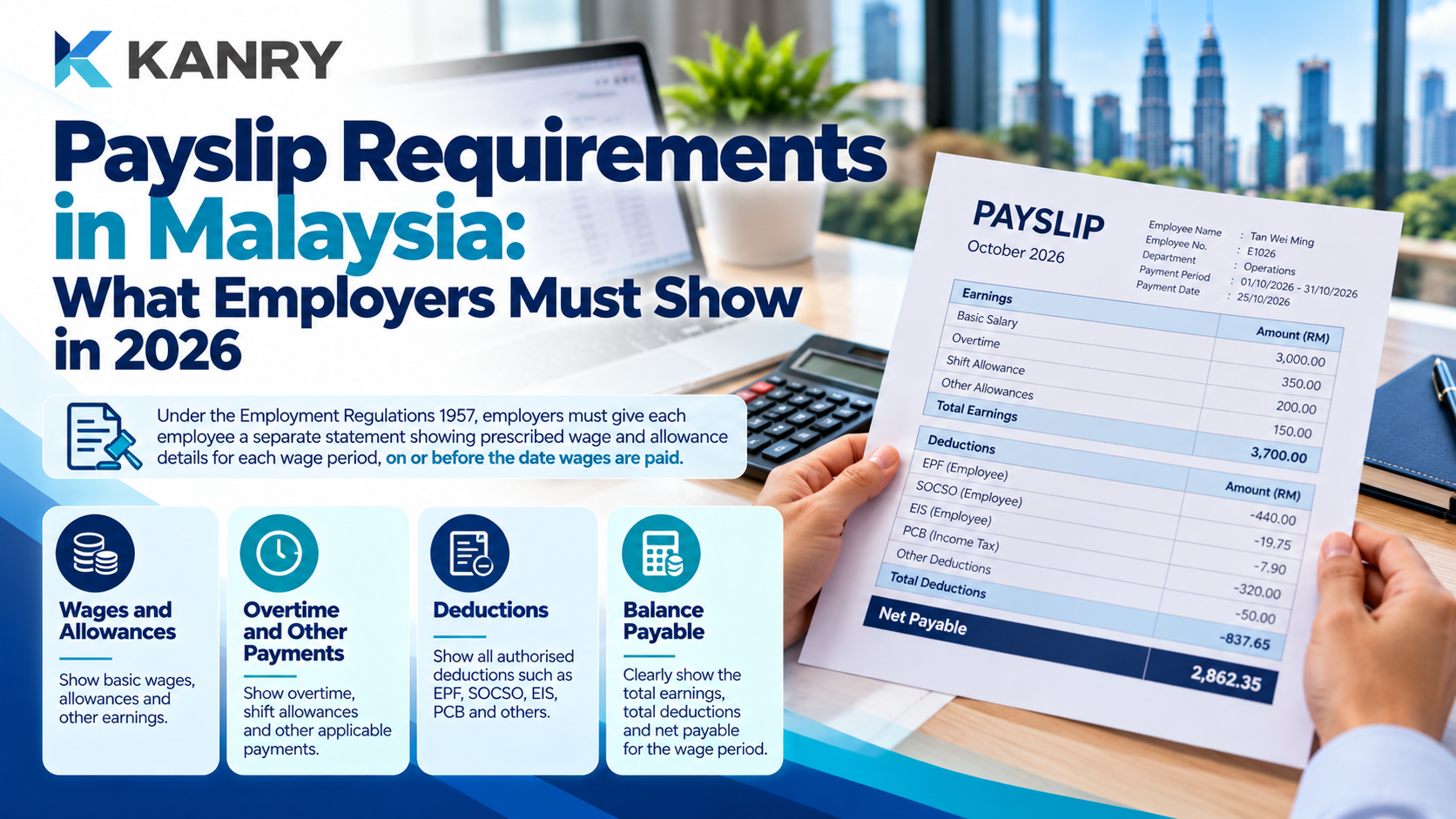

For employees covered by the Employment Act 1955 in Peninsular Malaysia and Labuan, the Employment Regulations 1957 require an employer to give each employee a separate statement or card showing prescribed wage and allowance details for each wage period. The statement must be furnished on or before the date wages are paid.
The required details depend in part on how the employee is paid. A clear pay statement should let the employee understand how normal wages, overtime, allowances, deductions and the balance payable were calculated.
Which rules apply?
The Employment Regulations 1957 apply to the Employment Act 1955 framework in Peninsular Malaysia and Labuan. Sabah and Sarawak have separate labour rules and published wage-record formats, so employers working across Malaysia should verify the requirements for each work location.
- JTKSM’s Employment Regulations 1957 set out the wage-period record details in Regulation 5(c) and the employee statement requirement in Regulation 9.
- JTK Sabah’s wage and allowance statement form is based on Rules 3(c) and 8 of the Labour Rules (Sabah) 2009.
- JTK Sarawak’s workplace inspection guidance says a copy of a payslip containing full wage and allowance details should be given to each employee at each wage period.
Use the applicable state authority’s guidance before treating one jurisdiction’s form or deadline as a Malaysia-wide rule.
What should the wage statement show?
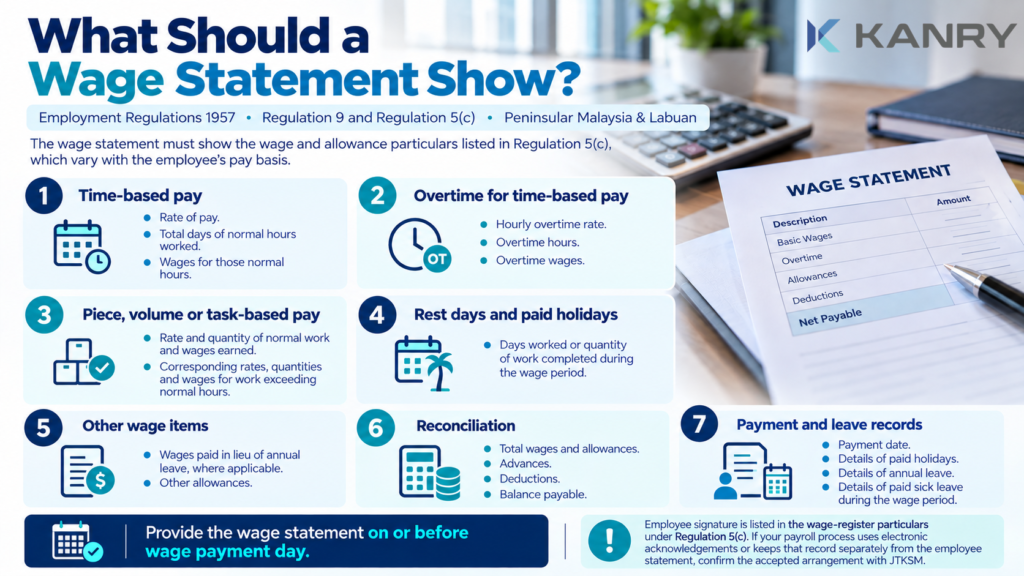
For Peninsular Malaysia and Labuan, Regulation 9 refers to the wage and allowance particulars listed in Regulation 5(c). These vary with the employee’s pay basis.
| Pay or record area | Details listed in Regulation 5(c) |
|---|---|
| Time-based pay | Rate of pay; total days of normal hours worked; and wages for those normal hours |
| Overtime for time-based pay | Hourly overtime rate, overtime hours and overtime wages |
| Piece, volume or task-based pay | Rate and quantity of normal work, wages earned, and corresponding rates, quantities and wages for work exceeding normal hours |
| Rest days and paid holidays | Days worked or quantity of work completed during the wage period |
| Other wage items | Wages paid in lieu of annual leave, where applicable, and other allowances |
| Reconciliation | Total wages and allowances, advances, deductions and the balance payable |
| Payment and leave records | Payment date and details of paid holidays, annual leave and sick leave during the wage period |
Regulation 5(c) also includes an employee-signature field among the wage-register particulars. If your payroll process uses electronic acknowledgements or keeps that record separately from the employee statement, confirm the accepted arrangement with JTKSM.
Keep the statement deadline separate from the register deadline
Two deadlines are easy to confuse:
- Employee statement: Regulation 9 says to furnish the separate statement or card on or before the date wages are paid.
- Underlying register: Regulation 5(c) says the employer’s register particulars must be brought up to date no later than the third day after the end of the wage period.
The register deadline does not extend the deadline for giving the employee their statement. Set payroll cut-offs so the calculation, review and delivery are finished by payday.
JTKSM lists a missing copy of a salary statement among the employment issues that may be lodged as a complaint. See its official complaints page.
Show the calculation clearly
A statement should make the arithmetic traceable. Consider this hypothetical monthly payroll:
| Item | Amount |
|---|---|
| Normal wages | RM3,000 |
| Overtime wages | RM120 |
| Other allowance | RM180 |
| Total wages and allowances | RM3,300 |
| Advance | RM100 |
| Other authorised deductions | RM200 |
| Balance payable | RM3,000 |
The figures are illustrative. The employer must calculate each amount under the applicable contract and law. Listing a deduction on a payslip does not make it lawful: deductions must be authorised under the relevant labour rules. For the Employment Act framework, see Section 24 of the Employment Act 1955.
Separate each deduction so the employee can see what was deducted and how the final balance was reached. Keep employer contributions separate from amounts deducted from the employee’s pay. Employer contributions are the employer’s cost; they should not be subtracted when explaining the employee’s take-home amount.
Separate required details from helpful additions
Regulation 5(c) prescribes wage-period details, but it is not a ready-made design template. A statement is easier to identify and reconcile if it also shows:
- Employer and employee names, with a suitable employee identifier.
- The wage-period start and end dates.
- The payment date and payment method.
- Separate labels for each earning and deduction.
- The amount actually transferred or paid.
These are practical presentation controls. Do not describe a field as a specific Regulation 5(c) requirement unless it appears in the applicable law or local authority’s prescribed format.
If statements are delivered through a payroll portal, ensure employees can actually access their own statement by payday and retrieve it later. Keep access secure because the document contains personal and financial information.
A five-step payroll check before payday
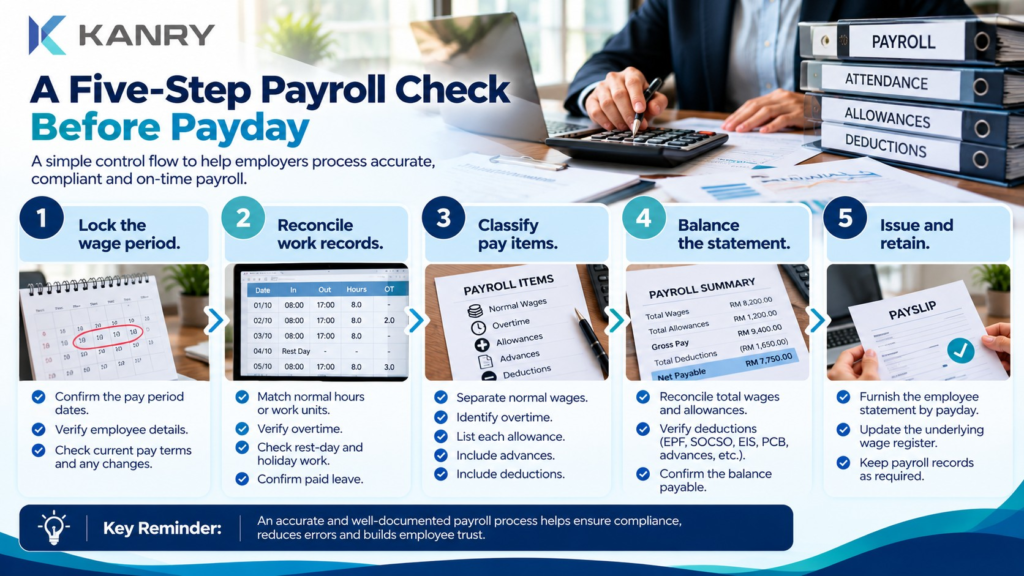
- Lock the wage period. Confirm the dates, employee details and current pay terms.
- Reconcile work records. Match normal hours or work units, overtime, rest-day and holiday work, and paid leave.
- Classify pay items. Separate normal wages, overtime, each allowance, advances and deductions.
- Balance the statement. Reconcile total wages and allowances against deductions and the balance payable.
- Issue and retain. Furnish the employee statement by payday and update the underlying wage register on time.
Payslips are not the same as annual tax forms
A payslip explains one wage period. The EA Form summarises relevant remuneration for a calendar year and serves a separate annual reporting purpose. Issuing period statements does not replace the annual EA Form obligation. For that related process, see Kanry’s EA Form Malaysia employer guide.
For contribution calculations, consult the relevant statutory authority and Kanry’s Malaysia Payroll Contribution Guide 2026. A contribution figure on a payslip should reconcile to payroll records, but the wage statement and contribution filing remain separate controls.
Frequently asked questions
What must a payslip show in Malaysia?
For employees covered by the Employment Act 1955 in Peninsular Malaysia and Labuan, Regulations 5(c) and 9 of the Employment Regulations 1957 require a separate statement or card for each wage period. The particulars include pay rates and normal wages, overtime rates, hours and wages where applicable, work on rest days and paid holidays, allowances, advances, deductions, the balance payable and payment date. The details vary with the employee’s pay basis.
When must the employee receive the statement?
Regulation 9 says the separate statement or card must be furnished on or before the date wages are paid. Separately, Regulation 5(c) says the employer’s register particulars must be brought up to date no later than the third day after the wage period ends.
Must the payslip show the employer’s statutory contributions?
Regulation 5(c)’s wage-period details focus on wages, allowances, advances, deductions and the balance payable. Showing employer contributions separately can help explain total employment costs, but keep them distinct from employee deductions and the employee’s take-home amount.
Are the same payslip rules used across Malaysia?
Peninsular Malaysia and Labuan use the Employment Act 1955 framework. Sabah and Sarawak have separate labour rules and published wage-record formats. Confirm the applicable requirements with JTK Sabah or JTK Sarawak for employees working in those states.
Need support with payroll administration?
For help coordinating payroll operations and HR support, contact Kanry Search.