
Flexible working arrangements (FWA) are becoming an increasingly important consideration for Malaysian employers. From hybrid office schedules to adjusted working hours and compressed working weeks, employees are seeking greater flexibility in how they work.
For employers, however, flexibility must be balanced against operational requirements, productivity, customer service and workforce availability.
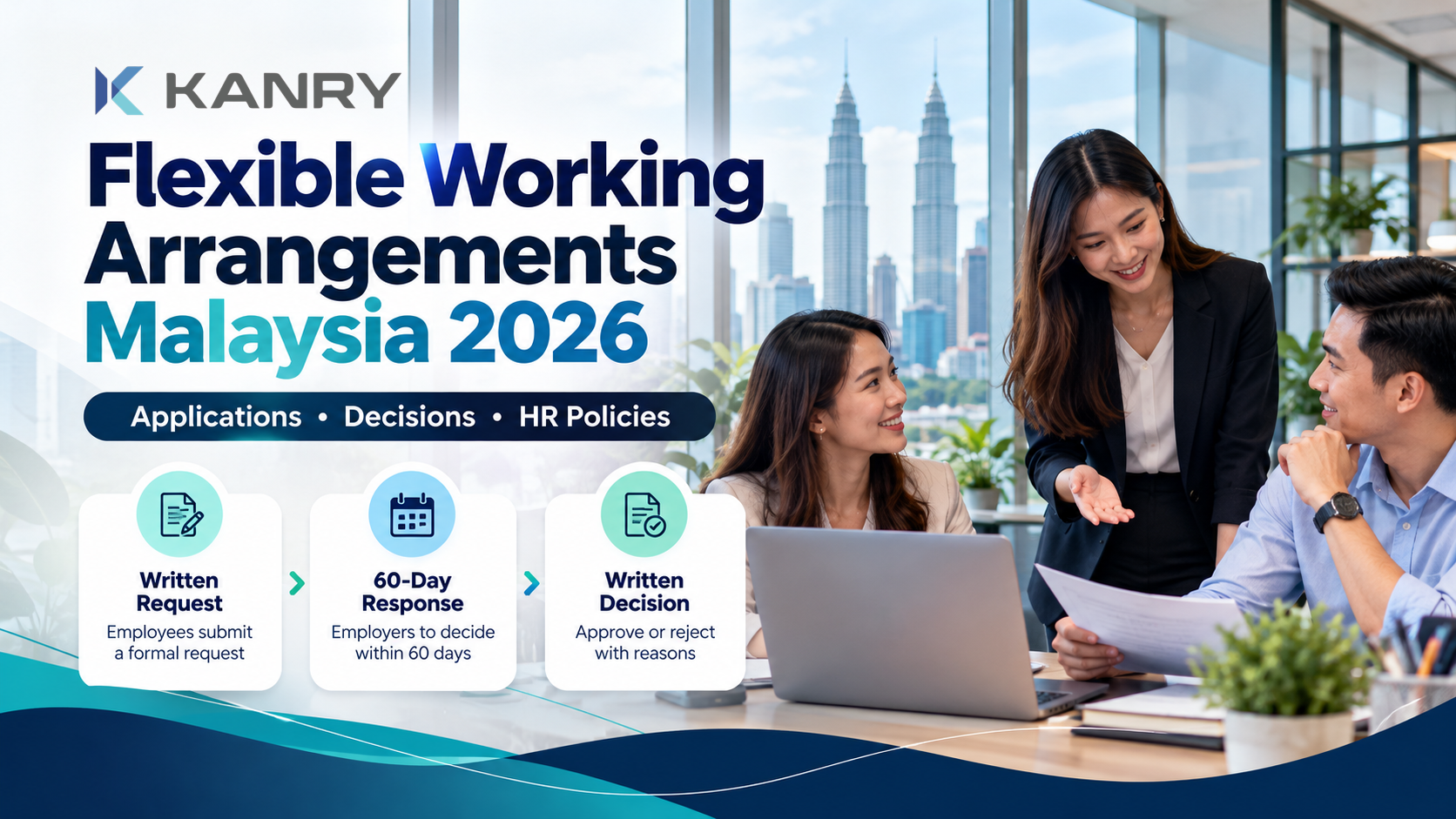
Malaysia’s Employment Act 1955 provides a statutory framework for employees to apply for flexible working arrangements. Under Sections 60P and 60Q, employees may request changes to their working hours, working days or workplace, while employers must respond to applications within the prescribed period.
The important distinction is that employees have a statutory right to apply for flexible working arrangements—not an automatic right to have every request approved.
This guide explains the legal requirements, application procedures, legitimate operational considerations and practical HR policies Malaysian employers should understand in 2026.
What Are Flexible Working Arrangements in Malaysia?
A flexible working arrangement allows an employee to request changes to one or more aspects of their normal working arrangement.
Under Section 60P of the Employment Act 1955, these may include:
- Hours of work
- Days of work
- Place of work
Employers should distinguish between flexible working arrangements and other employment benefits, such as annual leave, unpaid leave or additional rest days.
Common Types of Flexible Working Arrangements
| Arrangement | Description | Workplace example |
|---|---|---|
| Flexible working hours | Employees adjust their starting and finishing times | HR executive works 8 AM–5 PM instead of 9 AM–6 PM |
| Hybrid working | Employees divide their working time between office and another location | Finance employee works remotely two days weekly |
| Remote working | Employees perform agreed duties away from the employer’s premises | Recruitment consultant works from home |
| Compressed working week | Employees redistribute working hours across fewer days | Eligible office employee requests four longer working days |
| Flexible working days | Employees request different scheduled working days | Customer support employee requests an alternative roster |
These examples describe possible arrangements, not statutory entitlements to particular schedules.
Employer advisory: A compressed working week must still comply with applicable working-hour limits, rest-day requirements, contractual terms and overtime provisions.
An employer should not assume that redistributing hours automatically removes overtime obligations.
What Does Malaysia’s Employment Act Say About Flexible Working?
Malaysia’s statutory flexible working arrangement framework was introduced through the Employment (Amendment) Act 2022.
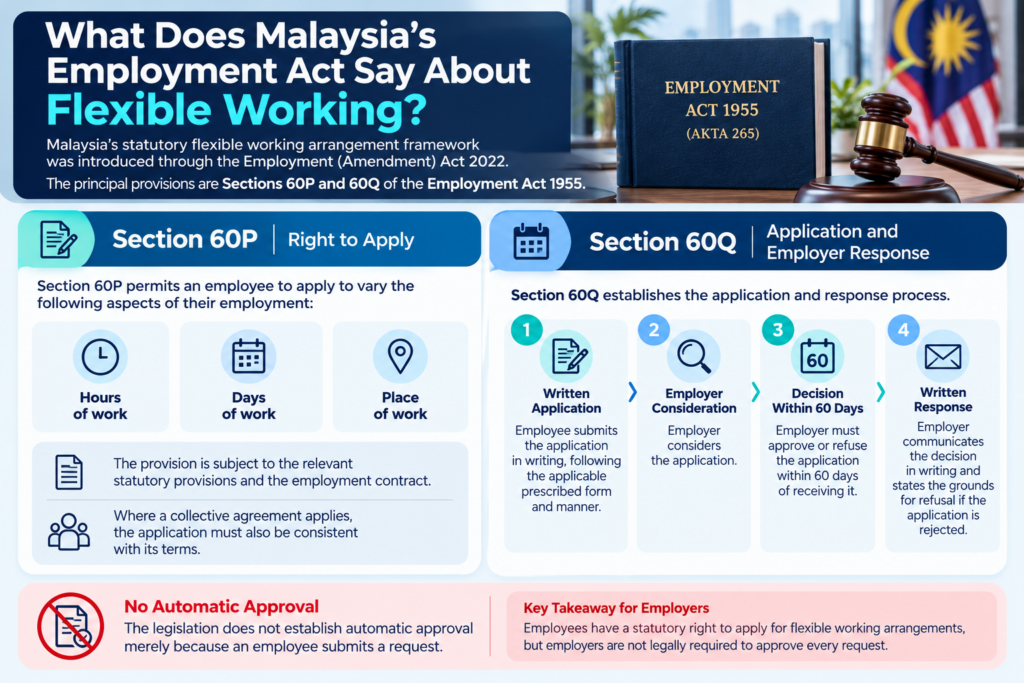
Official reference: Employment Act 1955 — JTKSM
Statutory Requirements vs Recommended HR Practices
| Issue | Statutory requirement | Recommended employer practice |
|---|---|---|
| Application | Written application in the prescribed form and manner | Standard HR request template |
| Response period | Within 60 days | Internal target of 14–30 days |
| Approval | Employer may approve or refuse | Assess requests against documented criteria |
| Rejection | Written grounds for refusal | Explain specific operational constraints |
| Review process | No general appeal procedure specified in Sections 60P–60Q | Offer internal reconsideration |
| Documentation | Written application and decision | Maintain an auditable HR register |
The recommendations in the final column are management practices, not additional statutory obligations under Sections 60P–60Q.
Can Malaysian Employers Reject Flexible Working Requests?
Yes.
Employers are not legally required to approve every flexible working arrangement application.
However, rejection should be based on genuine, defensible considerations rather than arbitrary preferences.
For example, a manufacturing employer may reasonably need production technicians to remain physically present because their duties involve operating machinery, testing products or maintaining production equipment.
A finance executive working primarily with digital systems may have greater flexibility.
Common Operational Considerations
Employers may evaluate:
Operational coverage
Will the proposed arrangement leave essential functions without sufficient staffing?
Customer requirements
Does the role require fixed service hours or direct customer interaction?
Workplace safety
Can the employee perform the work safely under the proposed arrangement?
Equipment and infrastructure
Does the employee need machinery, specialised equipment or secure systems available only on-site?
Team coordination
Will the proposed schedule affect handovers, supervision or critical collaboration?
Information security
Can confidential information be protected when employees work remotely?
These are potential business considerations, not an exhaustive statutory list of permitted refusal grounds.
Employers should evaluate each request individually and avoid decisions that create unlawful discrimination or conflict with contractual or other legal obligations.
Example: Manufacturing Technician
A technician working in a semiconductor manufacturing facility requests permanent remote working.
The position requires:
- Physical equipment troubleshooting
- Production-line support
- Machine calibration
- On-site quality inspections
The employer may have legitimate operational reasons to reject the remote-working request.
However, the employer could explore alternatives, such as adjusted shift-start times, where operationally feasible.
Example: Recruitment Consultant
A recruitment consultant requests two remote-working days per week.
Most responsibilities involve:
- Candidate sourcing
- Telephone screening
- Video interviews
- Client communications
- Recruitment database management
The employer could consider a hybrid arrangement with agreed performance expectations, information-security controls and office attendance for essential meetings.
Key principle: Evaluate the actual responsibilities of the position rather than relying solely on job titles.
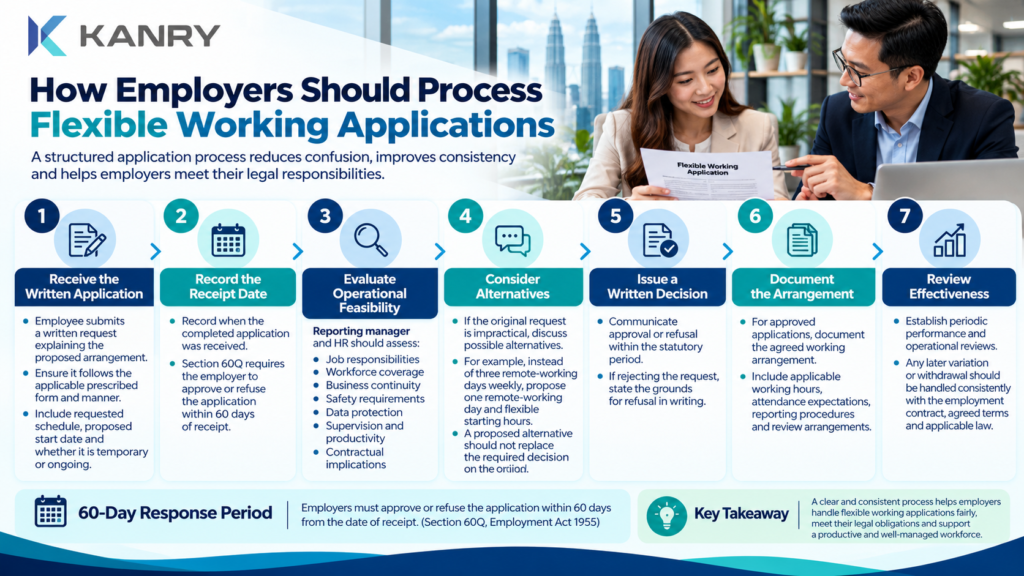
Flexible Working Application Process
A practical employer workflow under Sections 60P and 60Q of the Employment Act 1955.
The 60-Day Rule: What Employers Must Know
One of the most important compliance requirements is the employer’s response deadline.
Under Section 60Q, an employer must approve or refuse a flexible working application within 60 days from the date the application is received.
Illustrative Timeline
| Stage | Example timing | Responsibility |
|---|---|---|
| Application received | Day 1 | HR |
| Initial review | Days 2–7 | HR |
| Operational assessment | Days 8–14 | Reporting manager |
| Discussion with employee | Days 15–21 | HR and manager |
| Internal approval | Days 22–28 | Authorised decision-maker |
| Written decision | By statutory deadline | Employer |
The intermediate stages are recommended internal targets, not statutory deadlines.
Employers should calculate the actual statutory deadline from the receipt date rather than relying solely on a generic timeline.
What Happens if an Employer Does Not Respond?
Failure to respond within the statutory period creates a compliance concern.
However, employers should not assume that silence automatically converts an application into an approved flexible working arrangement.
The prudent approach is to issue a clear written decision before the deadline.
Flexible Working Policies for Different Industries
A single company-wide flexible working policy may not suit every position.
For organisations operating across manufacturing, logistics, retail and professional services, HR should establish consistent assessment principles while allowing role-specific arrangements.
Industry Comparison
| Industry | Potentially suitable arrangements | Key considerations |
|---|---|---|
| Manufacturing | Adjusted shift-start times, selected administrative hybrid roles | Machine coverage, safety, production schedules |
| Logistics and warehousing | Alternative rosters, staggered administrative hours | Dispatch schedules, warehouse coverage |
| Retail | Shift swaps, adjusted rosters | Store operating hours, customer demand |
| Professional services | Hybrid working, flexible starting times | Client availability, deliverables |
| Recruitment | Hybrid working, flexible interviews | Candidate responsiveness, confidentiality |
| Finance and administration | Flexible hours, selected remote-working days | Reporting deadlines, data security |
Manufacturing Example — Johor
A manufacturing company in Pasir Gudang employs production operators, technicians, engineers and administrative employees.
Rather than applying one universal remote-working policy, the employer could assess each position according to its operational requirements.
Production operators may need fixed on-site schedules.
Some engineering roles may allow limited flexibility for documentation or planning activities, while administrative employees may be suitable for hybrid working.
This approach recognises genuine differences in job requirements without automatically excluding entire employee groups from consideration.
Logistics Example — Kuala Lumpur
A logistics company employs warehouse coordinators, transport planners and finance personnel.
Warehouse coordinators may require on-site attendance during receiving and dispatch operations.
Transport planners may need to cover fixed operational windows but could potentially use staggered starting times.
Finance employees may be able to work remotely for certain reporting activities.
The employer should assess coverage requirements, rather than assuming that every employee within the logistics industry needs identical working arrangements.
Does Flexible Working Mean Employees Can Work Fewer Hours?
Not necessarily.
Flexible working arrangements may change when or where employees work without reducing their contractual working hours.
For example:
An employee who normally works 9 AM–6 PM may request an 8 AM–5 PM schedule.
The working hours may remain unchanged, even though the starting and finishing times differ.
A separate request to reduce total working hours may have implications for contractual terms, salary and benefits.
Employers should not automatically reduce salary simply because an employee is approved to work remotely.
Working Hours and Overtime
Malaysia’s Employment Act includes working-hour protections, including the general 45-hour weekly limit under Section 60A, subject to the Act’s applicable provisions and exceptions.
Employers must also consider rest periods, daily limits and overtime rules.
The overtime entitlement analysis may depend on the employee’s statutory coverage and the nature of their work.
Employer advisory: Flexible working approval should not be used to bypass statutory working-hour protections.
Should Employers Introduce a Flexible Working Policy?
Yes, as a recommended HR governance measure.
Although Sections 60P and 60Q establish the statutory application framework, a written internal policy can help employers implement it consistently.
A practical policy should explain the following areas.
Eligibility and Application
Explain how employees can submit requests and where they should send them.
Avoid introducing eligibility restrictions that improperly prevent employees from exercising statutory application rights.
Assessment Criteria
Describe the operational considerations that managers will evaluate.
Approval Authority
Identify the people responsible for reviewing applications and issuing decisions.
Working Hours and Availability
Explain attendance, availability and communication expectations.
Equipment and Data Security
Clarify responsibilities for company equipment, confidential documents and remote access.
Performance Management
Use measurable performance expectations appropriate to the role.
Review and Changes
Explain how agreed arrangements will be reviewed and how proposed changes will be handled.
Employer Flexible Working Checklist
Use this checklist when reviewing flexible working applications and internal HR policies.
This checklist supports internal HR administration. It does not replace statutory requirements or professional legal advice.
Sample Flexible Working Application Assessment
Consider a Malaysian employer receiving the following request.
Employee: HR Executive
Current schedule: Monday–Friday, 9 AM–6 PM
Requested schedule: Monday–Friday, 8 AM–5 PM
Reason: Family transportation arrangements
The employer reviews the employee’s responsibilities and determines that essential HR coverage can be maintained.
A reasonable assessment might look like this:
| Assessment factor | Finding |
|---|---|
| Total working hours | No proposed reduction |
| Customer service | No significant disruption identified |
| Team collaboration | Required meetings can be accommodated |
| Payroll deadlines | No anticipated impact |
| Operational coverage | Adequate |
| Recommendation | Approve, subject to documented terms |
The employer should then issue written approval specifying the agreed arrangement and effective date.
Example of a Rejected Application
A warehouse supervisor requests to work remotely every Monday and Friday.
The employer establishes that the position requires direct supervision of inbound and outbound operations, safety checks and on-site incident management.
A written refusal could explain that the proposed remote-working schedule cannot currently be accommodated because essential on-site supervisory coverage would be insufficient.
The employer may separately invite the employee to discuss alternative arrangements.
Important: A refusal should identify the relevant operational constraints. Generic statements such as “management does not support flexible working” provide less useful justification.
Common Employer Mistakes to Avoid
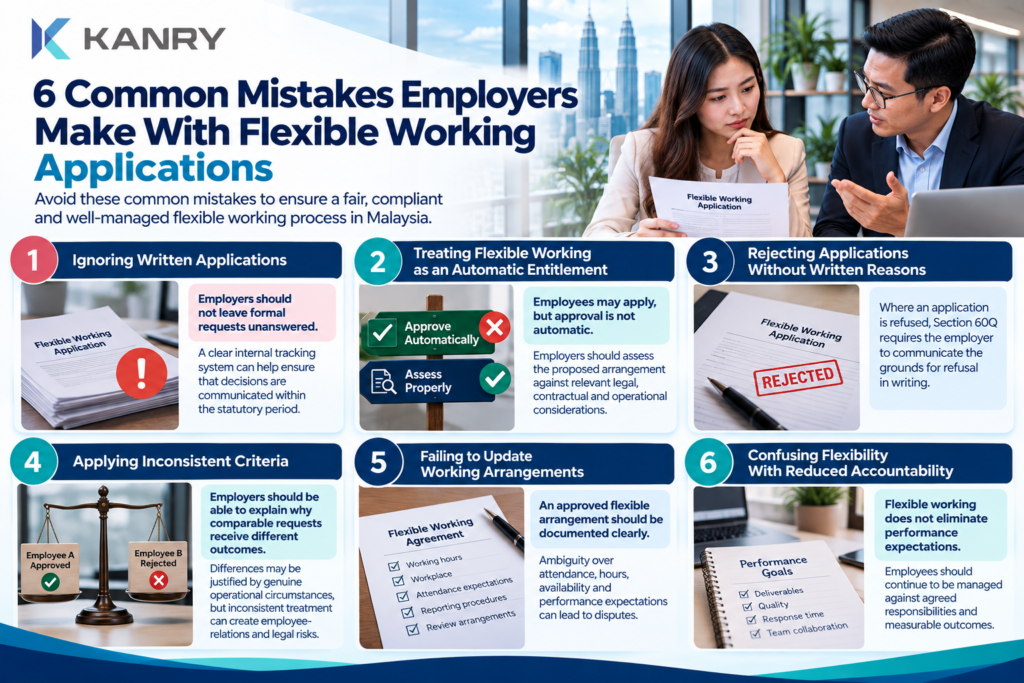
Employers should manage employees according to agreed responsibilities and measurable outcomes.
How Flexible Working Can Support Employee Retention
Flexible working is not simply an HR administrative issue.
It can influence recruitment competitiveness, employee retention and workforce planning.
For example, a company competing for experienced engineers, accountants or recruitment consultants may find that limited scheduling flexibility improves its employment proposition.
However, employers should avoid assuming that flexible working will automatically improve productivity or retention.
The actual results depend on role suitability, management practices, employee preferences and implementation quality.
A Practical Workforce Strategy
Employers can approach flexibility through three questions:
1. Which tasks require physical presence?
Identify duties involving machinery, customer service, inventory handling or direct supervision.
2. Which tasks can be completed independently?
Consider reporting, documentation, analysis and other activities that may not require continuous on-site presence.
3. What measurable outcomes must remain unchanged?
Define service standards, response times, production targets and quality requirements.
This allows employers to assess flexibility as a workforce-design decision rather than a blanket benefit.
How Kanry Search Can Support Employers
Implementing flexible working arrangements requires more than drafting a policy.
Employers must also consider job design, workforce coverage, recruitment requirements and employee expectations.
Kanry Search supports organisations across Malaysia and Singapore through recruitment and HR-related services, including:
- Permanent and executive recruitment
- Temporary and contract recruitment
- Workforce planning support
- HR shared services
- Payroll-related administration
For businesses operating across manufacturing, logistics, engineering, retail and professional services, recruitment decisions should reflect both operational requirements and the flexibility employers can realistically offer.
A well-designed role should communicate its actual working arrangements clearly from the beginning of the hiring process.
Speak With Kanry Search
Looking to strengthen your recruitment strategy, workforce planning or HR operations?
Contact Kanry Search to discuss your organisation’s hiring and workforce requirements.
Frequently Asked Questions
Can employers reject flexible working applications in Malaysia?
Yes. Employers may approve or refuse applications. Under Section 60Q of the Employment Act 1955, a refusal must be communicated in writing and include the grounds for refusal.
How long does an employer have to respond?
An employer must approve or refuse the application within 60 days from the date the application is received.
Is working from home mandatory for Malaysian employers?
No. The statutory framework allows employees to apply for changes to their working arrangements. It does not automatically require employers to approve remote-working requests.
Can employers reduce salary when employees work remotely?
Remote working does not automatically justify a salary reduction. Employers must consider the employment contract, agreed terms and applicable wage protections before making changes to remuneration.
Must employers provide written reasons for rejection?
Yes. Section 60Q requires employers to state the grounds for refusal when rejecting a flexible working application.
Can manufacturing and logistics employees request flexibility?
Employers should consider the applicable legal framework and individual job requirements. Positions requiring physical attendance may present greater operational constraints. Alternative shift arrangements may be feasible even where remote working is unsuitable.
The FAQ component below covers whether employers can reject applications, the 60-day deadline, hybrid working, salary implications and the need for written decisions.
Official References
- JTKSM — Employment Act 1955
- JTKSM — Employment (Amendment) Act 2022
- Kanry Search — Resources
- Kanry Search — Contact Us
Editorial note: This article primarily addresses the Employment Act framework applicable in Peninsular Malaysia and Labuan. Employers operating in Sabah and Sarawak should check the applicable labour ordinances and current amendments rather than automatically applying the same provisions.