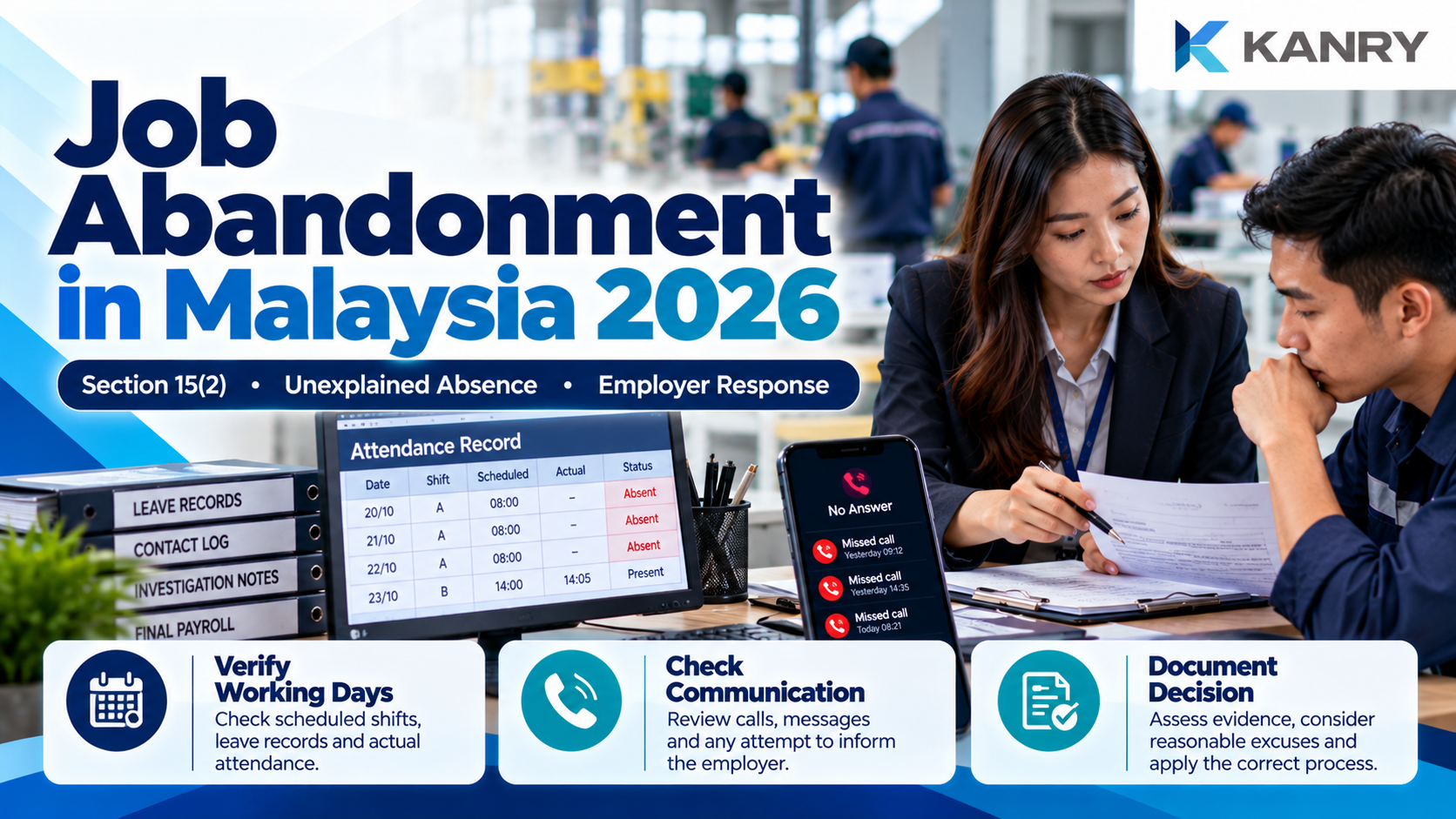

An employee stops reporting for work. Their supervisor cannot reach them. HR checks the attendance system and finds several unexplained absences.
Can the employer treat the employee as having abandoned their job?
For Malaysian employers, the answer depends on more than the number of missed shifts.
Section 15(2) of the Employment Act 1955 provides a framework for determining when an employee is deemed to have broken their contract of service through prolonged unauthorised absence.
However, employers must consider whether the absence exceeded the statutory threshold, whether prior leave was granted, whether there was a reasonable excuse and whether the employee informed or attempted to inform the employer.
A premature decision can lead to disputes involving dismissal, wages, notice arrangements and employment records.
This guide explains how employers in Peninsular Malaysia and Labuan should assess unexplained absences, preserve evidence, communicate with employees and manage the employment and payroll implications.
What Is Job Abandonment in Malaysia?
Job abandonment generally describes a situation where an employee stops attending work without authorisation or an adequate explanation, raising questions about whether they intend to continue their employment.
Employers may also use the terms:
- Abscondment
- Absent without leave (AWOL)
- Unauthorised absence
- Missing in action (MIA)
- Unexplained absenteeism
Although these terms are frequently used in HR practice, they should not be treated as interchangeable legal conclusions.
For example, an employee who misses one shift without contacting their supervisor may have committed a breach of workplace attendance rules.
That does not necessarily mean they have abandoned their employment under Section 15(2).
An employee who has been absent for several scheduled working days may fall within that provision, but the employer must still consider the statutory exceptions and the available evidence.
Absenteeism vs Job Abandonment
| Situation | What it may indicate | Appropriate initial response |
|---|---|---|
| Employee misses one shift | Attendance or leave issue | Contact employee and verify circumstances |
| Employee misses two consecutive working days | Continuing unauthorised absence | Escalate follow-up and preserve records |
| Employee misses more than two consecutive working days | Potential Section 15(2) contract breach | Assess all statutory conditions |
| Employee reports a genuine emergency | Possible reasonable excuse | Assess explanation and notification efforts |
| Employee resigns in writing | Express resignation | Apply resignation and notice procedures |
| Employee cannot be reached | Unresolved absence | Continue reasonable documented contact efforts |
Employer takeaway: An attendance system can establish that an employee was not recorded as present. It cannot, by itself, establish why the employee was absent or whether the employment contract has been broken.
What Does Section 15(2) of the Employment Act 1955 Say?
Section 15(2) addresses circumstances in which an employee is deemed to have broken their contract of service because of absence from work.
The provision concerns an employee who has been continuously absent for more than two consecutive working days without prior leave from the employer.
It also includes an important exception where the employee has a reasonable excuse and has informed or attempted to inform the employer of that excuse before or at the earliest opportunity during the absence.
Four Questions Employers Should Examine
| Legal consideration | Employer assessment |
|---|---|
| Duration | Was the employee absent for more than two consecutive working days? |
| Prior permission | Had leave or another absence arrangement been approved? |
| Reasonable excuse | Is there a reasonable explanation for the absence? |
| Communication | Did the employee inform or attempt to inform the employer as required by the provision? |
These factors should be evaluated together.
The Difference Between Two Days and More Than Two Days
The phrase more than two consecutive working days matters.
If an employee is scheduled to work Monday, Tuesday and Wednesday and is absent without permission throughout all three days, the duration element may be satisfied.
If the employee misses only Monday and Tuesday, the Section 15(2) duration threshold has not yet been exceeded.
That does not mean the employer must ignore the absence. It may still require investigation under the employment contract and workplace policies.
What Counts as a Working Day?
Employers should examine the employee’s actual working schedule.
An office employee working Monday to Friday has a different roster from a production operator on rotating shifts.
A non-working day should not be automatically counted as a scheduled working day simply because it falls between two absences.
Likewise, employees who normally work weekends may have scheduled working days that do not match the standard Monday-to-Friday pattern.
Section 15(2): Employer Decision Matrix
Review all the statutory conditions before deciding whether an employee may be deemed to have broken the employment contract.
Working-Day Threshold
Has the employee been absent for more than two consecutive working days?
Prior Permission
Was the absence covered by approved leave or another authorised arrangement?
Reasonable Excuse
Does the employee have a reasonable explanation supported by the circumstances?
Communication Attempts
Did the employee inform or attempt to inform the employer before or at the earliest opportunity during the absence?
Meeting the duration threshold alone does not resolve the full statutory assessment. Examine the circumstances, relevant exceptions and evidence.
Legal reference: Employment Act 1955, Section 15(2), for the applicable jurisdiction.
Jurisdiction
The Employment Act 1955 provisions discussed here principally concern Peninsular Malaysia and Labuan.
Employers in Sabah and Sarawak must separately assess the applicable labour ordinances and their current amendments.
Official reference: Employment Act 1955 — Department of Labour Peninsular Malaysia
Does Three Days of Absence Automatically Mean the Employee Has Resigned?
No.
An unexplained absence and an express resignation are different situations.
Resignation ordinarily involves an employee communicating their intention to terminate the employment relationship.
Section 15(2), by contrast, addresses circumstances in which the contract is deemed broken because of the employee’s absence, subject to the statutory requirements.
Employers should not automatically record “voluntary resignation” merely because three scheduled working days have been missed.
That approach may create uncertainty about the reason for employment cessation and how the employer reached its decision.
Example: A Missing Production Operator
Illustrative scenario.
A production operator in Pasir Gudang fails to attend three consecutive scheduled shifts.
The supervisor cannot reach the employee by telephone.
HR discovers that the employee sent a message to another authorised supervisor explaining that they were involved in an emergency.
Before recording job abandonment, the employer should assess the message, the timing, the emergency explanation and whether the communication satisfies the relevant requirements.
The fact that the attendance system shows three absences is not enough to resolve the matter.
What If the Employee Does Not Respond?
A complete lack of response may be relevant evidence.
Nevertheless, the employer should examine whether contact attempts reached the employee and whether there may be a reasonable explanation for the lack of communication.
For instance, a communication failure caused by hospitalisation or another serious emergency may materially affect the assessment.
Employers should distinguish between a genuinely uncontactable employee and one who has been deliberately avoiding the employer.
The latter conclusion requires evidence, not assumption.
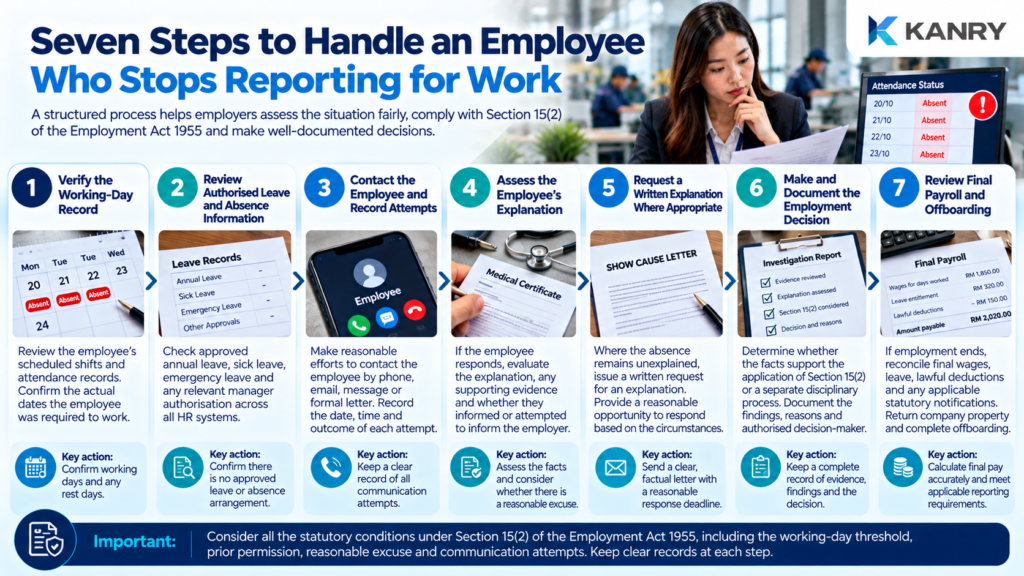
Seven Steps to Handle an Employee Who Stops Reporting for Work
A documented process helps employers avoid premature decisions and supports consistent treatment across departments.
Step 1 — Verify the Working-Day Record
Review the employee’s scheduled shifts and relevant attendance data.
Confirm the actual dates on which the employee was required to work.
Check whether the employee’s shift roster changed, whether a rest day intervened and whether the employee was assigned to another location.
Step 2 — Review Authorised Leave and Absence Information
Check approved annual leave, sick leave, emergency leave under company policy and any relevant manager authorisation.
An incomplete HR system may not immediately reflect leave approved through another channel.
Employers should reconcile those records before deciding that the absence was unauthorised.
Step 3 — Contact the Employee and Record Attempts
Make reasonable efforts to contact the employee using appropriate work-related channels.
These may include telephone calls, email, messages or a formal letter sent to the relevant recorded address.
Record the date, time, communication method and outcome.
The purpose is to establish what the employer knew, when it knew it and whether the employee provided an explanation.
Step 4 — Assess the Employee’s Explanation
If the employee responds, evaluate the facts fairly.
Consider the stated reason, any supporting evidence and whether the employee informed or attempted to inform the employer at the appropriate opportunity.
A medical emergency, communication difficulty or other unexpected event may need individual assessment.
Step 5 — Request a Written Explanation Where Appropriate
Where the absence remains unexplained, the employer may issue a written request for an explanation or a show-cause letter.
The correspondence should identify the relevant dates and allegation without declaring the employee guilty in advance.
Provide a reasonable opportunity to respond based on the circumstances.
Step 6 — Make and Document the Employment Decision
Determine whether the facts support the application of Section 15(2) or whether a separate disciplinary or contractual process is appropriate.
Record the findings, reasons, supporting evidence and authorised decision-maker.
Where misconduct proceedings are contemplated, assess the requirements under Section 14 and other applicable law.
Step 7 — Review Final Payroll and Offboarding
If employment ends, HR and Finance should reconcile wages, leave, lawful recoveries, employee property and any applicable statutory notifications.
A job-abandonment conclusion does not justify automatically withholding all earned wages.
The employer should also determine the appropriate final employment date and documentary basis rather than backdating records without justification.
Should Employers Issue a Show Cause Letter?
A show-cause letter is a practical mechanism for asking an employee to explain an alleged absence or breach.
It can help establish that the employer identified the issue, communicated the concern and considered the employee’s explanation before deciding what to do.
However, Section 15(2) does not prescribe one universal show-cause template or a fixed reply period for every case.
Employers should avoid presenting an internal deadline, such as 48 hours or three working days, as a statutory requirement under that section.
What Should the Letter Contain?
A suitable letter should identify the employee, relevant dates, scheduled working days, attendance issue and applicable workplace rules.
It should invite the employee to provide an explanation, identify a reasonable response deadline and explain how the employee can contact HR.
The wording should remain factual and neutral.
For example, the employer may explain that attendance records show the employee was absent on three identified scheduled working days and that HR has not located an approved leave record.
The letter may then request an explanation and supporting information.
This approach is more defensible than immediately stating that the employee has resigned or committed fraud.
What If the Employee Never Receives the Letter?
Employers should maintain evidence of reasonable delivery and contact attempts.
A returned letter, undelivered email or unanswered phone call may be relevant to the later assessment.
A letter that was never successfully communicated should not be treated as proof that the employee read and deliberately ignored its contents.
Job Abandonment vs Misconduct Dismissal: Why the Distinction Matters
HR teams should distinguish between assessing an employee’s deemed contract breach under Section 15(2) and imposing disciplinary punishment for misconduct under Section 14.
These are related but not identical legal questions.
| Issue | Section 15(2) assessment | Section 14 misconduct action |
|---|---|---|
| Central question | Has the employee’s conduct met the statutory contract-breach conditions? | Has misconduct been established? |
| Relevant facts | Absence, working days, permission, excuse and notification | Alleged conduct, evidence and circumstances |
| Process | Fair factual assessment and documented decision | Applicable due-inquiry requirements |
| Potential outcome | Contract treated as broken where provision applies | Statutory disciplinary outcomes where justified |
| Main risk | Misapplying the threshold or exception | Unfair or unsupported disciplinary action |
The correct route depends on the circumstances.
Where the evidence is disputed or termination may be challenged, employers should obtain qualified employment-law advice before proceeding.
Can an Employee Challenge the Decision?
Yes. A dismissed employee may have recourse under the Industrial Relations Act 1967 where they consider that their dismissal was without just cause or excuse.
An employer’s internal description of a case as “abscondment” does not automatically prevent legal scrutiny.
The underlying facts and applicable legal framework remain important.
What Counts as a Reasonable Excuse for Absence?
There is no single checklist that resolves every possible excuse.
Employers must assess the circumstances of each case.
Potential examples include serious illness, medical emergencies, accidents or other events that genuinely prevented attendance.
An explanation should be assessed for credibility, available supporting information and the employee’s ability to communicate.
Reasonable Excuse Assessment
| Situation | What HR should examine |
|---|---|
| Emergency hospitalisation | Evidence of hospitalisation and communication circumstances |
| Family emergency | Nature of emergency, employee’s responsibilities and notification efforts |
| Transport breakdown | Available facts, duration and attempts to contact employer |
| Phone lost or damaged | Alternative communication opportunities |
| Incorrect work schedule | Approved roster and employee notification |
| Approved leave not entered into system | Supervisor authorisation and leave records |
These examples do not mean every stated emergency automatically excuses all absence.
Equally, employers should not reject an explanation merely because an employee did not follow a preferred communication channel where the statutory requirements may otherwise have been satisfied.
Employer principle: Assess both the explanation and the communication circumstances before reaching a final decision.
Manufacturing Example: Consecutive Shifts and Rest Days
Illustrative example.
A manufacturing employee works on a rotating schedule.
The employee is scheduled for:
| Day | Roster status | Attendance |
|---|---|---|
| Monday | Working day | Absent |
| Tuesday | Working day | Absent |
| Wednesday | Rest day | Not scheduled |
| Thursday | Working day | Absent |
| Friday | Working day | Absent |
The employer should not simply count Monday through Thursday as four consecutive working days.
Wednesday was a rest day, so the assessment must consider the meaning of consecutive working days against the actual roster and legal requirements.
In a potentially disputed case, HR should obtain legal advice on the correct interpretation rather than assume a calendar-day counting method determines the result.
Operational Risk
Manufacturing facilities may face serious production consequences when an operator or technician is unexpectedly absent.
However, operational disruption should not replace a proper legal assessment.
The employer can activate workforce contingency measures while the HR investigation continues.
For example, the supervisor may arrange temporary redeployment or an authorised replacement shift without prematurely recording that the employee’s contract has ended.
Logistics Example: An Employee Returns After Several Days
Illustrative example.
A warehouse assistant fails to attend work for three scheduled working days.
HR sends messages and calls but receives no immediate reply.
On the fourth scheduled working day, the employee returns and explains that a family emergency prevented attendance.
What should the employer do?
The first step is not to accept or reject the explanation automatically.
HR should check the attendance record, the employee’s explanation, any available supporting information and whether the employee attempted to inform the employer.
If the facts support a reasonable excuse and timely communication attempt, that finding may materially affect the Section 15(2) assessment.
If the explanation is unsupported or contradictory, further investigation may be appropriate.
The employer should document the conclusion and ensure any payroll changes are based on the correct facts and applicable wage rules.
What Happens to Final Salary When an Employee Abandons Their Job?
Final salary is one of the most sensitive areas of an abscondment case.
Employers should not automatically assume they may cancel every outstanding wage payment because the employee stopped attending work.
The final-pay assessment should distinguish:
- Wages already earned.
- Days genuinely not worked.
- Accrued contractual or statutory entitlements.
- Lawful deductions.
- Any separately supportable notice-related claim or indemnity.
- Applicable tax-clearance or cessation obligations.
Common Final-Pay Errors
| Employer action | Risk | Better approach |
|---|---|---|
| Withhold all outstanding wages | Potential unlawful non-payment | Calculate amounts properly payable |
| Deduct an arbitrary penalty | May breach wage deduction rules | Establish the lawful basis |
| Assume notice indemnity is always recoverable through payroll | Ignores legal conditions and dispute risks | Review Sections 13 and 24 and obtain advice |
| Record resignation without supporting evidence | Creates inaccurate cessation documentation | Document the correct legal basis |
| Ignore tax-clearance assessment | Possible reporting or payment-control issues | Review CP22A/CP21 obligations where applicable |
Is Notice Pay Automatically Forfeited?
Not necessarily.
Notice issues depend on the governing contract, applicable legal provisions, the factual circumstances and how the employment relationship ended.
Section 13 addresses termination without notice and indemnity in specified circumstances.
Employers should separately examine whether any indemnity is legally due and the lawful mechanism for recovery.
Do not assume that an alleged debt can simply be offset against salary.
Payroll and Tax Notifications
Where employment ends, assess whether the relevant employer notifications apply.
These may include tax-clearance matters, payroll contribution administration and appropriate employee cessation records.
For the tax-clearance framework, refer to Kanry Search’s CP22A Malaysia 2026 Employer Guide.
CP22A is not universally required for every departing employee, and employers must check the applicable conditions and exemptions.
Can Employers Replace an Absconding Employee Immediately?
An employer may need to arrange replacement staffing before the absence case has been fully resolved.
For example, an unfilled warehouse supervisor shift or production technician position may disrupt operations.
The company can assess short-term staffing alternatives while maintaining a separate HR process for the missing employee.
However, a permanent replacement decision should not be taken as conclusive proof that the original employment relationship has lawfully ended.
Workforce Continuity Options
Depending on operational needs, employers may consider:
- Temporary redeployment.
- Additional authorised shifts.
- Short-term contract staffing.
- Cross-training existing employees.
- Temporary agency support.
- Adjusting non-critical work priorities.
The goal is to preserve operations without creating unnecessary employment-law risk.
For manufacturing and logistics organisations, having a contingency staffing plan can reduce pressure on managers to make rushed disciplinary decisions.
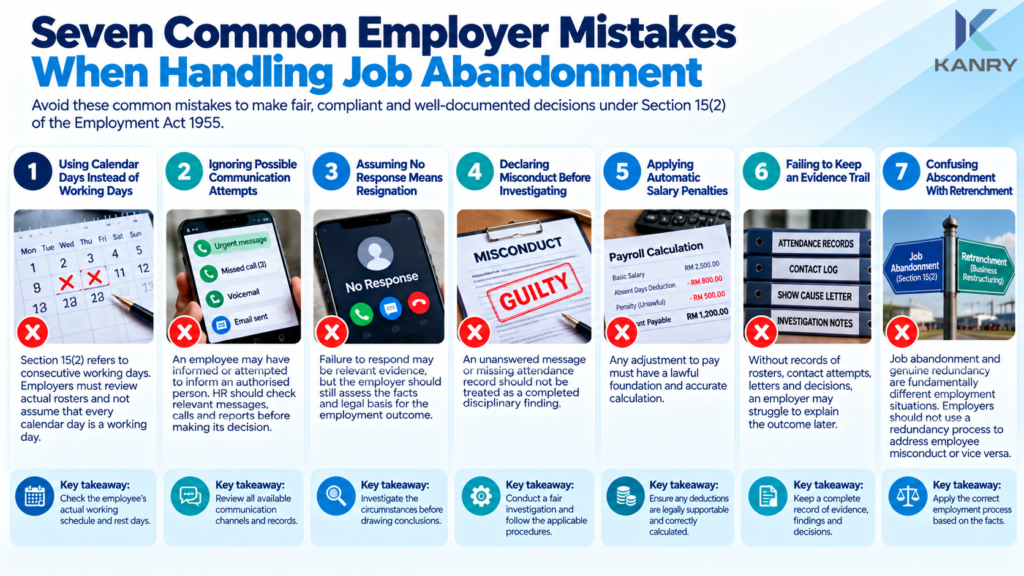
Common Employer Mistakes When Handling Abscondment
Employee Abscondment Checklist for HR
Before closing the case, HR should be able to show that it verified the working schedule, reviewed leave records, assessed the duration of absence, considered the employee’s explanation and communication attempts, and determined the appropriate legal process.
The company should also reconcile the final employment records and payroll calculations.
Employee Abscondment Compliance Checklist
Use this internal checklist before finalising an unexplained-absence case.
This is a recommended employer administration tool. It does not replace legal analysis or establish that an employee’s contract has automatically ended.
A standardised checklist can improve consistency across multiple sites, especially where supervisors and HR teams do not operate from the same location.
How to Prevent Job Abandonment Problems
An abscondment policy should do more than threaten disciplinary consequences.
Employers should also make it easy for employees to report unexpected absences and understand their responsibilities.
Recommended HR Practices
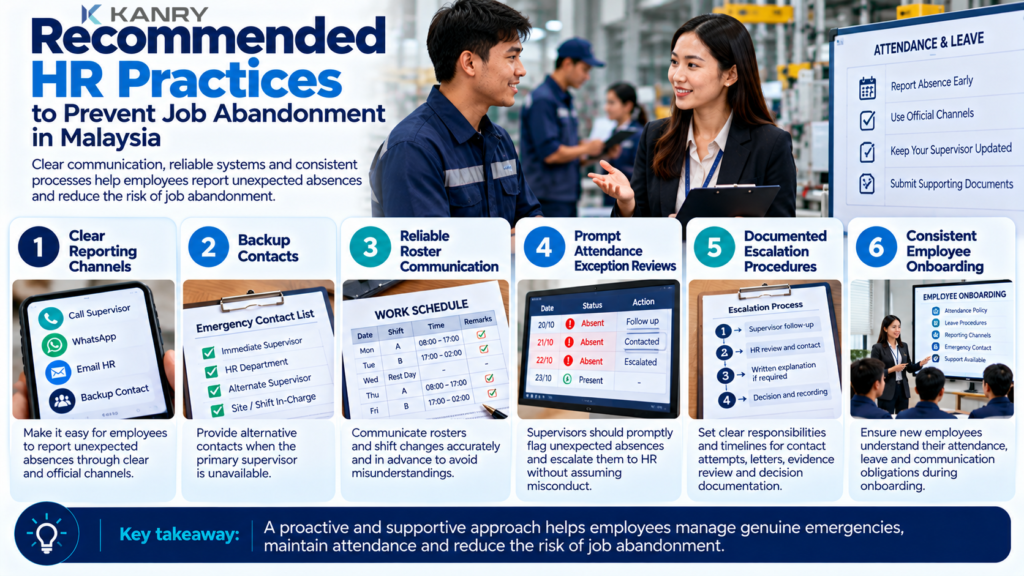
These are recommended management measures, not additional statutory requirements imposed by Section 15(2).
How Kanry Search Can Support Employers
Unexpected employee absences can be especially disruptive to manufacturing, logistics and service operations where workforce coverage directly affects productivity.
Employers need reliable recruitment processes, realistic manpower contingency plans and consistent HR administration.
Kanry Search supports organisations across Malaysia and Singapore through permanent recruitment, temporary and contract staffing, executive search and HR shared services.
For companies managing high-volume hiring or shift-based teams, workforce continuity planning can help reduce the operational disruption caused by unexpected employee departures.
Strengthen Your Recruitment and Workforce Continuity
If your organisation needs support with replacement hiring, contract staffing or HR administration, Kanry Search can discuss suitable workforce solutions for your business.
Contact Kanry Search to speak with our team.
Frequently Asked Questions
Job Abandonment Malaysia — Frequently Asked Questions
How many days of absence constitute job abandonment in Malaysia?
Section 15(2) of the Employment Act 1955 refers to more than two consecutive working days without prior leave, subject to its reasonable-excuse and communication exception. Employers must examine all the conditions before concluding that the contract has been broken.
Does an employee automatically resign after three days of absence?
No. An express resignation and a deemed contract breach under Section 15(2) are different matters. Employers should establish the relevant facts and legal basis rather than automatically recording a voluntary resignation.
Do weekends and rest days count towards the two-day threshold?
The provision refers to working days, not simply calendar days. Employers should review the employee’s actual roster, approved schedule and any relevant legal interpretation, particularly where rotating shifts are involved.
Is a show-cause letter compulsory in every abscondment case?
Section 15(2) does not prescribe a universal show-cause template or response period. A written request for explanation is a useful safeguard, but employers must consider the applicable contractual, legal and procedural requirements in the individual case.
What if the employee had a medical emergency?
The employer should assess the medical circumstances, the explanation and whether the employee informed or attempted to inform the employer at the earliest opportunity. A genuine emergency may be relevant to the statutory exception.
Can an employer withhold final salary when an employee absconds?
Employers should calculate wages and other amounts properly payable and review any proposed deduction or indemnity against the applicable law. Job abandonment is not a blanket authorisation to withhold all earned wages.
Can an employer hire a temporary replacement before resolving the case?
Employers may assess operational contingency options while the HR process continues. Temporary workforce coverage should be distinguished from the legal determination of the absent employee’s employment status.
Official References
- Employment Act 1955 — JTKSM — Sections 13, 14, 15 and 24.
- JTKSM — Department of Labour Peninsular Malaysia — official labour guidance.
- Department of Industrial Relations Malaysia — dismissal representation framework.
- HASiL / LHDN — employer tax and cessation obligations.
This article is intended as general employer information. The correct response to a particular absence depends on the facts, employment terms, applicable jurisdiction and current law. Serious or contested employment termination matters should be reviewed with qualified legal advisers.