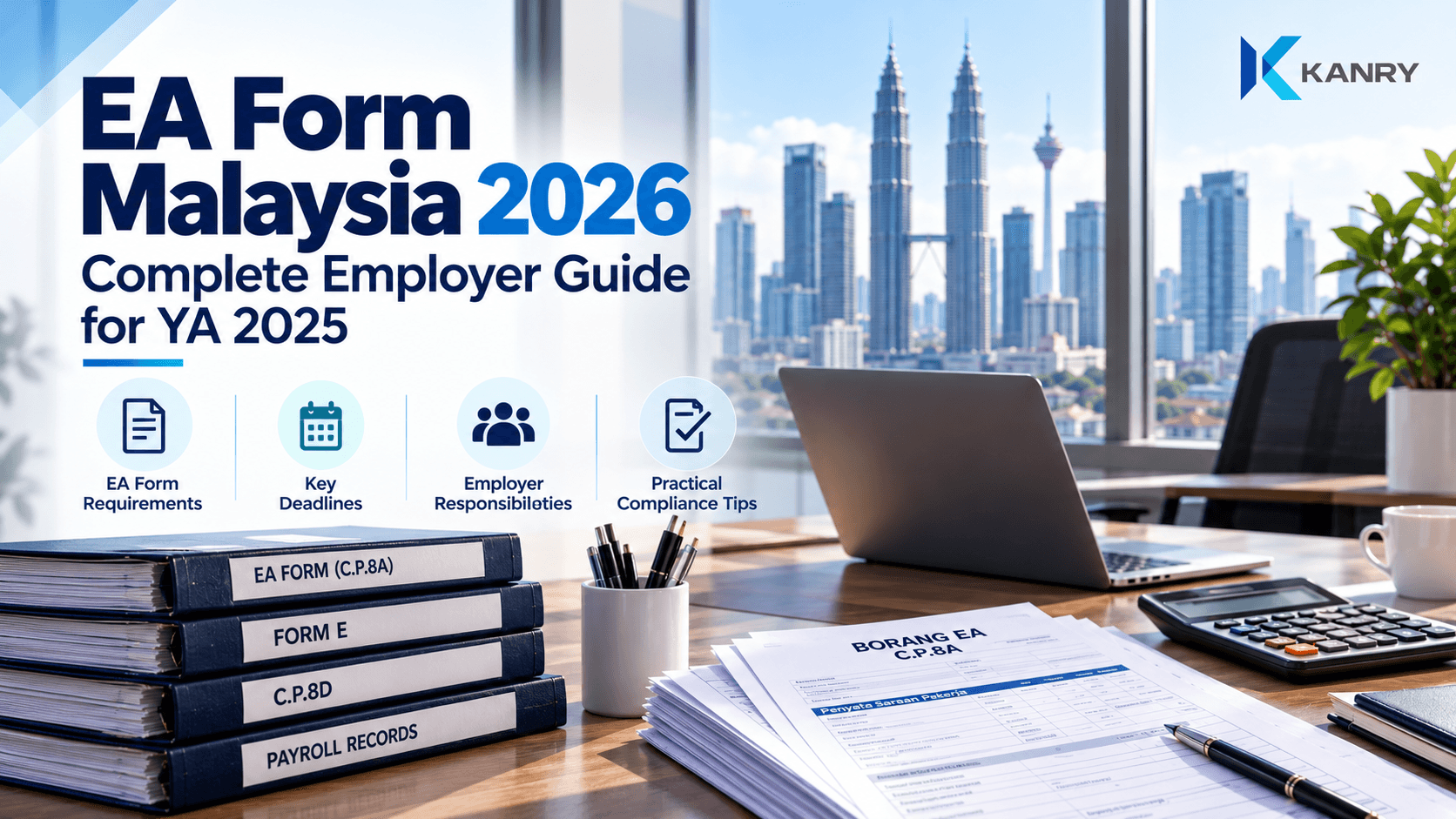

Preparing the EA Form in Malaysia is an annual employer responsibility. It gives employees the remuneration information they need to prepare their personal income tax returns.
For Year of Assessment (YA) 2025, employers were required to provide EA Forms to employees by 28 February 2026. That deadline has passed, but employers may still need to issue missing forms, correct errors and reconcile remuneration records.
For HR, payroll and finance teams, the challenge is ensuring that annual statements agree with the underlying payroll records and related employer tax reporting.
This guide explains the EA Form requirements, the distinction between EA Form and Form E, the preparation process, common mistakes and how to correct discrepancies.
EA Form Malaysia 2026: Key Facts
| Requirement | Employer guidance |
|---|---|
| Reporting period | 1 January–31 December 2025 |
| Form | EA Form / Borang EA (C.P.8A) |
| EA Form deadline | 28 February 2026 |
| Form E deadline | 31 March 2026, subject to applicable filing arrangements |
| Main authority | Lembaga Hasil Dalam Negeri Malaysia (HASiL/LHDN) |
| Governing legislation | Income Tax Act 1967 |
| Employer record retention | Seven years under HASiL guidance |
If your business missed the deadline: Identify missing or inaccurate statements, reconcile the records, issue outstanding or corrected forms, and assess whether any employer filing also needs correction.
What Is an EA Form in Malaysia?
The EA Form, also known as Borang EA or Form C.P.8A, is an annual statement of employment remuneration prepared by an employer for an employee.
It summarises relevant employment income, benefits and deductions for the calendar year. Employees use the information when preparing their personal income tax returns.
What information does the EA Form contain?
Depending on the employee’s circumstances, relevant information can include:
- Salary and wages.
- Bonuses and commissions.
- Overtime and allowances.
- Taxable perquisites and benefits-in-kind.
- Value of living accommodation, where applicable.
- Relevant tax-exempt allowances and benefits.
- Employee EPF contributions and other prescribed deductions.
- Monthly Tax Deductions (PCB/MTD).
The correct classification depends on the nature of each payment and the applicable tax rules. Employers should refer to the prescribed EA Form and current HASiL guidance rather than treating every payroll component identically.
EA Form vs payslip
| Payslip | EA Form |
|---|---|
| Covers a particular payroll period | Consolidates the relevant calendar year |
| Shows period earnings and deductions | Reports annual remuneration and relevant deductions |
| Supports monthly payroll administration | Supports annual employee tax reporting |
Providing monthly payslips does not replace the obligation to provide the required EA Form.
Official reference: HASiL — Employer’s Responsibilities
EA Form vs Form E vs C.P.8D
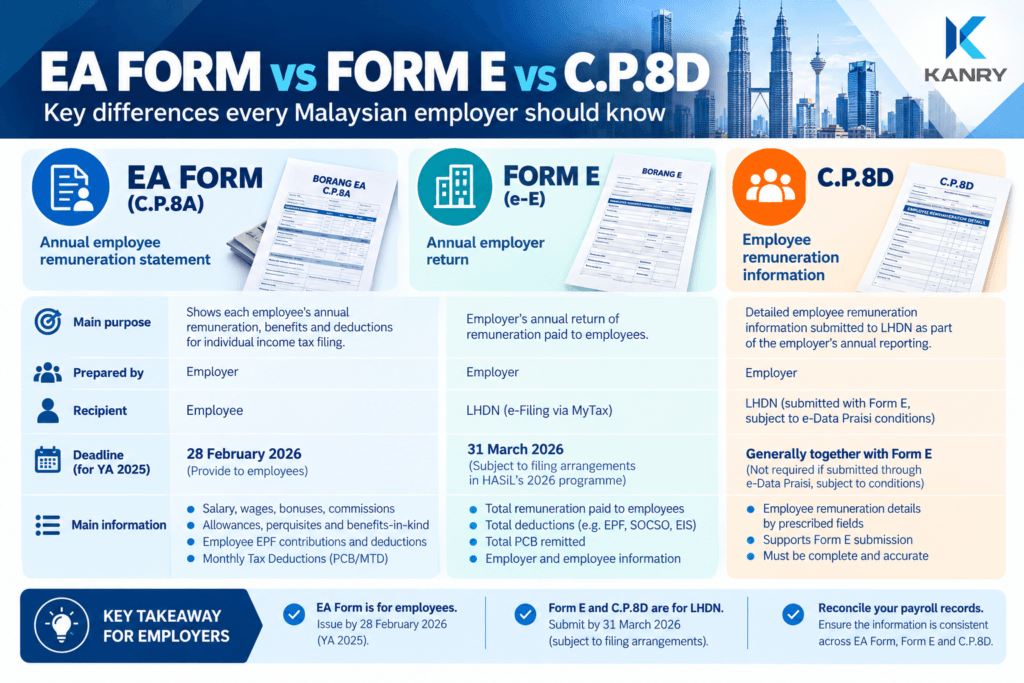
These documents are related, but they serve different purposes. Confusing them can lead to missing submissions or inconsistent employee remuneration information.
| Document | Purpose | Who receives it? |
|---|---|---|
| EA Form (C.P.8A) | Annual employee remuneration statement | Employee |
| Form E (e-E) | Annual employer return | HASiL |
| C.P.8D | Employee remuneration information for employer reporting | HASiL |
Why must employers reconcile them?
The underlying payroll data should be consistent across the relevant records, but the forms do not necessarily have identical totals because their reporting scope differs.
Common discrepancies include:
- Bonuses recorded in payroll but omitted from annual remuneration reporting.
- Resigned employees missing from the annual employee listing.
- PCB amounts that differ from monthly remittance records.
- Benefits-in-kind that were not classified correctly.
- Payroll adjustments that were not reflected in the final statements.
HASiL states that Form E is considered complete only when the required C.P.8D information is furnished within the specified period. Employers who have submitted the information through e-Data Praisi do not need to submit C.P.8D again, subject to the applicable conditions.
Official reference: HASiL — Employer’s Responsibilities
What Are the EA Form and Employer Filing Deadlines?
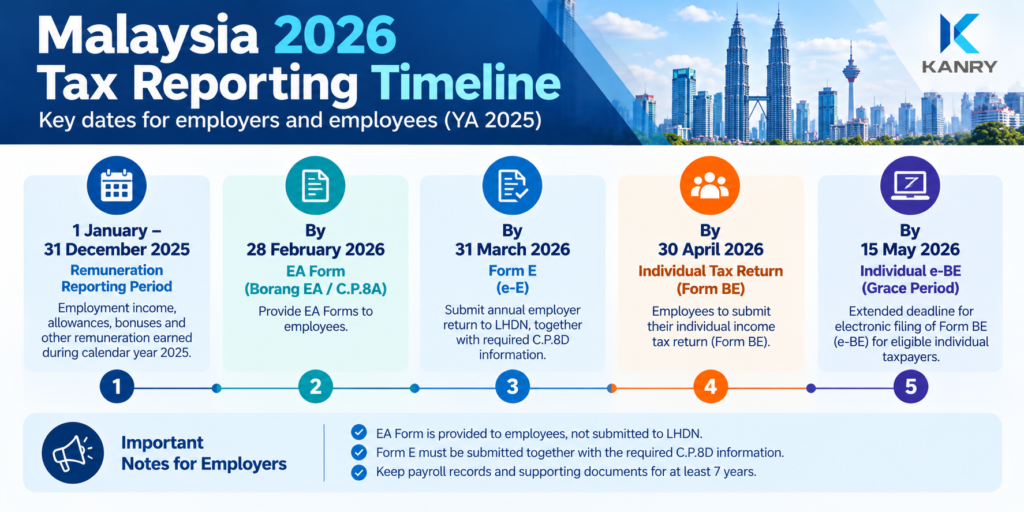
For remuneration earned during 2025, the EA Form deadline was 28 February 2026.
The employer’s Form E deadline was 31 March 2026, with applicable filing programme arrangements to be checked against HASiL’s official guidance.
| Obligation | Date or period |
|---|---|
| Remuneration reporting period | Calendar year 2025 |
| EA Form provided to employees | By 28 February 2026 |
| Form E statutory deadline | 31 March 2026 |
| Individual e-BE statutory deadline | 30 April 2026 |
| Individual e-BE administrative grace period | 15 May 2026 |
The e-BE grace period is an administrative filing concession for eligible individual taxpayers. It is not an extension of the employer’s EA Form deadline.
Official source: HASiL — Return Form Filing Programme 2026
What if the EA Form deadline has passed?
Employers should not ignore missing or inaccurate forms simply because the deadline has passed.
- Identify employees who have not received their statements.
- Reconcile remuneration and deduction records.
- Prepare and issue the outstanding or corrected EA Forms.
- Keep evidence of issuance and corrections.
- Review whether Form E or C.P.8D information also requires correction.
- Seek professional advice where material non-compliance or enforcement risk exists.
Late issuance does not retrospectively make the original deadline timely.
Which Employees Should Employers Review?
Employers should review the relevant employees who received remuneration during the reporting year, including people who left the business before the forms were prepared.
| Employee category | What HR should check |
|---|---|
| Permanent employees | Full-year remuneration and deductions |
| Part-time employees | Applicable reporting requirements and pay records |
| Fixed-term employees | Employment status and remuneration |
| Employees who resigned | Relevant earnings during their employment |
| Terminated employees | Outstanding pay and annual reporting records |
| Foreign employees | Malaysian employment income and applicable tax treatment |
| Directors receiving remuneration | Correct classification of salary, fees and other payments |
Example: An employee who resigned during 2025
An employee worked from January to August 2025 and resigned in September. The employer should not exclude that person simply because they were no longer employed in February 2026.
The relevant remuneration during 2025 still needs to be assessed for annual reporting.
The treatment of freelancers and independent contractors depends on the actual working relationship and payment arrangement. Employers should not assume that every person paid by the business is an employee—or that a contractual label alone determines the correct status.
Which Payroll Components Need Review?
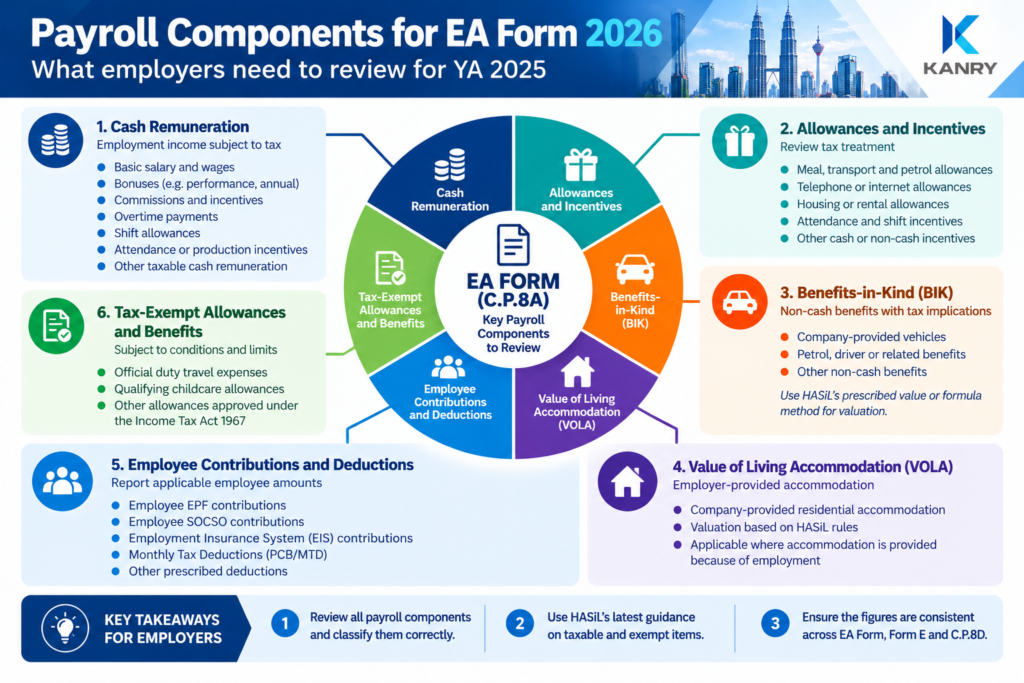
The most difficult part of EA Form preparation is often classifying remuneration correctly, not generating the form.
Cash remuneration
Review relevant items such as:
- Basic salary.
- Bonuses and commissions.
- Overtime.
- Shift and attendance allowances.
- Other remuneration and incentives.
Benefits-in-kind and accommodation
Non-cash benefits may also have tax implications. Depending on the arrangement, these can include employer-provided vehicles, other benefits-in-kind and living accommodation.
Use the applicable HASiL valuation rules. Do not assign arbitrary values or assume that a benefit is exempt because it was not paid in cash.
Tax-exempt allowances and benefits
Some allowances or benefits may qualify for exemption subject to conditions and limits. Their tax treatment depends on their actual purpose, supporting evidence and the applicable provisions.
For example, an allowance described as a travel allowance is not automatically tax-exempt.
Official references:
How to Reconcile PCB, EPF and Other Payroll Records
Annual remuneration statements should be supported by accurate monthly payroll information.
| Reconciliation item | Payroll record | Reporting record | Action |
|---|---|---|---|
| Annual salary | RM36,000 | RM36,000 | Matched |
| Annual bonus | RM3,000 | RM3,000 | Matched |
| PCB deducted | RM1,200 | RM1,100 | Investigate RM100 difference |
| Employee EPF contribution | RM4,290 | RM4,290 | Matched |
Illustrative example only. Figures are not a statutory calculation.
In this example, payroll should investigate the RM100 PCB difference before finalising the relevant records. It should not simply change one figure to match another without establishing which amount is correct.
Review the employee contribution amounts and other prescribed fields separately. Do not combine employer and employee contributions indiscriminately.
For broader statutory payroll guidance, see Kanry Search’s Malaysia Payroll Contribution Guide 2026.
Eight-Step EA Form Preparation Workflow
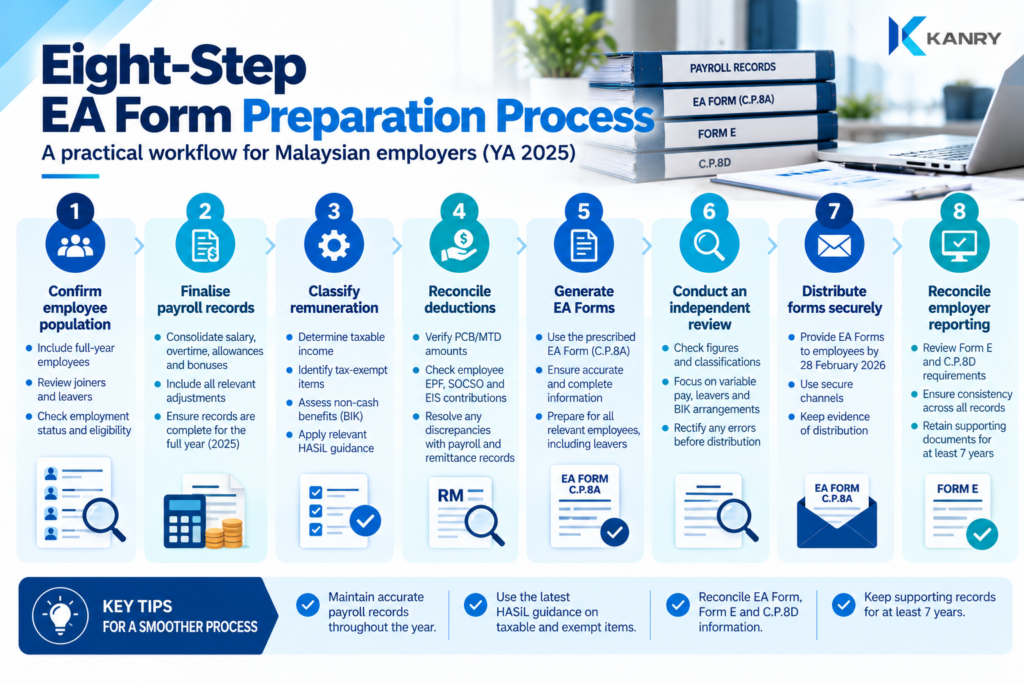
Use this workflow to make annual reporting more consistent and easier to audit.
- Confirm the employee population. Include relevant joiners, leavers and employees who worked during the year.
- Finalise payroll records. Consolidate salary, overtime, allowances, bonuses and adjustments.
- Classify remuneration. Review taxable income, exempt items and non-cash benefits.
- Reconcile deductions. Check PCB and relevant employee statutory contributions.
- Generate EA Forms. Use the applicable prescribed form and guidance.
- Conduct an independent review. Prioritise variable-pay employees, leavers and unusual benefit arrangements.
- Distribute forms securely. Protect personal and remuneration information.
- Reconcile employer reporting. Review Form E and C.P.8D requirements and retain supporting records.
Year-end checklist
EA Form Preparation Checklist
YA 2025 | Employer self-assessment
0% completed
Tick the tasks as you complete them.
This checklist is a practical planning tool and does not replace official HASiL requirements. Progress is not saved after refreshing the page.
Practical tip: A reliable process should produce evidence that the data was reviewed, not merely evidence that the system generated a PDF.
Common EA Form Mistakes
| Common mistake | Recommended control |
|---|---|
| Omitting resigned employees | Extract the full-year employee population |
| Missing bonuses or commissions | Reconcile payroll with approved incentive records |
| Misclassifying allowances | Maintain a documented payroll component register |
| Ignoring non-cash benefits | Obtain an annual benefits register |
| PCB discrepancies | Reconcile against monthly payroll and remittance records |
| Wrong reporting year | Label annual reports by remuneration year |
| Insecure distribution | Use controlled access and secure delivery |
| Assuming outsourcing transfers all responsibility | Document preparation, review, approval and distribution duties |
For manufacturing employers, shift allowances and overtime deserve particular attention. Retail businesses should review commissions and staff turnover. Logistics businesses should check the classification of operational allowances.
What if an EA Form Contains an Error?
The correct response depends on the error and whether related employer reporting has already been submitted.
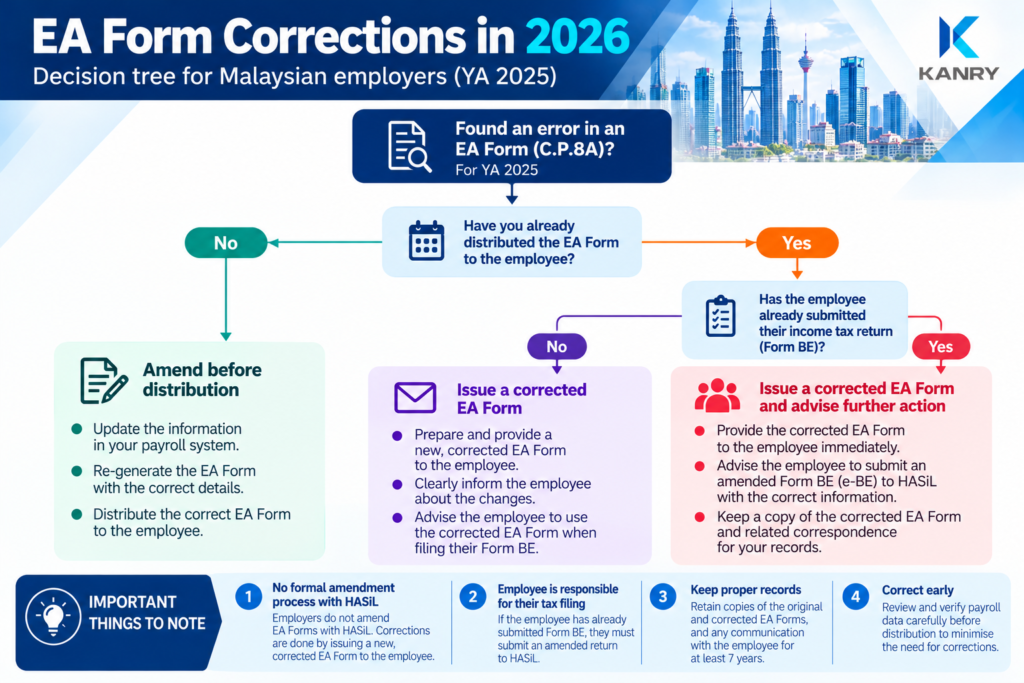
Correction process
- Identify the discrepancy. Determine whether it concerns employee details, remuneration, benefits, PCB or contributions.
- Check original records. Use payroll registers, approved adjustments and supporting payment records.
- Prepare the corrected statement. Record what changed and why.
- Inform the employee securely. Provide the corrected statement and explain the correction.
- Review employer submissions. Determine whether Form E or C.P.8D information also requires amendment.
- Retain the evidence. Keep the original records, correction history and relevant correspondence.
If the employee has already filed a tax return, advise them to check the appropriate amendment procedure with HASiL or a qualified tax adviser.
Replacing an EA Form does not automatically correct information already submitted to the tax authority.
For employer return amendments, refer to HASiL’s official support and amendment guidance.
What Are the Penalties for Failing to Issue EA Forms?
The employer obligation to prepare and provide the remuneration statement arises under the Income Tax Act 1967.
HASiL’s employer guidance and prescribed forms identify failure to comply with the relevant statutory obligation as an offence under paragraph 120(1)(b).
The statutory penalty identified for this offence is a fine of RM200 to RM20,000, imprisonment for up to six months, or both.
These are statutory penalty limits, not automatic penalties for every late or inaccurate statement. The outcome depends on the offence, circumstances and enforcement process.
How long should employers retain records?
HASiL instructs employers to maintain and keep records for seven years and ensure they can be accessed when required.
Employers should establish appropriate controls for payroll registers, EA Forms, supporting calculations and relevant correspondence.
Official source: HASiL — Employer’s Responsibilities
Onboarding and Offboarding: Where EA Form Accuracy Begins
Year-end accuracy depends on employee records created and maintained throughout the year.
Onboarding
Check employee identification and payroll information. Employers should also assess separate tax notification requirements, including CP22 where applicable. HASiL specifies submission within 30 days of employment commencement, through e-CP22 on MyTax.
During employment
Maintain accurate records of remuneration changes, bonuses, benefits and deductions.
Offboarding
Review final remuneration and relevant cessation obligations. Depending on the circumstances, CP22A or CP21 may apply. These obligations are separate from annual EA Form preparation.
Official source: HASiL — Employer’s Responsibilities
Should Employers Outsource Payroll and EA Form Administration?
Outsourcing may help employers manage payroll complexity, but it should not eliminate internal oversight.
| Service consideration | Why it matters |
|---|---|
| Payroll classification | Supports accurate remuneration reporting |
| PCB administration | Helps maintain consistent monthly records |
| Statutory contribution reconciliation | Supports payroll accuracy |
| EA Form preparation | Supports annual employee reporting |
| Form E and C.P.8D coordination | Helps reconcile employer reporting |
| Joiner and leaver records | Reduces missing employee information |
| Data protection | Protects confidential payroll information |
| Correction procedures | Helps resolve discrepancies efficiently |
A practical responsibility structure assigns clear owners for preparation, HR verification, finance reconciliation, approval and secure distribution.
Document these responsibilities in internal procedures or the payroll service agreement.
How Kanry Search Supports Employers
Recruitment, HR administration and payroll processes are closely connected. Every new hire introduces employee records, salary arrangements and ongoing administrative requirements.
Kanry Search supports employers in Malaysia and Singapore through:
- Permanent and executive recruitment — sourcing professionals, managers and operational talent.
- Contract and temporary staffing — supporting flexible workforce requirements.
- Payroll and HR administration — supporting agreed payroll-related administrative processes.
- Employer-of-Record solutions — helping businesses explore eligible local employment arrangements.
If your company is expanding, reviewing payroll processes or managing a multi-location workforce, a coordinated approach can help reduce avoidable administrative issues.
Contact Kanry Search to discuss recruitment, staffing and HR support for your business.
Kanry Search’s services do not replace qualified tax or legal advice or decisions made by HASiL.
Frequently Asked Questions
What is the EA Form deadline for 2026?
For remuneration earned during calendar year 2025, employers were required to provide EA Forms by 28 February 2026.
Is EA Form the same as Form E?
No. The EA Form is an individual employee remuneration statement. Form E is the employer’s annual return submitted to HASiL.
Must employers submit EA Forms directly to HASiL?
The EA Form is generally provided to employees. Employers separately submit the required annual employer return and employee remuneration information through the applicable reporting channels.
Must resigned employees receive an EA Form?
Employers should assess the relevant reporting obligations for employees who received remuneration during the year, including those who left before the forms were prepared.
Are all allowances tax-free?
No. Tax treatment depends on the nature of the payment, applicable exemptions, conditions and supporting evidence.
What if PCB on the EA Form is incorrect?
Investigate the discrepancy, reconcile the supporting records and correct the statement where necessary. Related employer reporting may also require amendment.
Can an employer correct an EA Form after issuing it?
Yes, inaccurate information should be corrected and the updated statement provided to the employee. If employer information has already been submitted, follow the applicable HASiL correction procedure.
What should employers do if they missed the deadline?
Prepare and issue outstanding statements promptly, reconcile the supporting records and review related reporting. Seek professional advice where non-compliance is material.
How long should employers keep payroll records?
HASiL’s employer guidance specifies a seven-year record-retention period.
Conclusion: Make EA Form Compliance Part of Your Payroll Process
EA Form compliance should not be treated as an isolated February task. Accurate annual reporting depends on reliable employee records, consistent payroll classification and regular reconciliation throughout the year.
For employers, the priorities are straightforward:
- Maintain complete employee and payroll records.
- Classify remuneration and benefits correctly.
- Reconcile PCB and relevant statutory deductions.
- Issue accurate statements and correct errors promptly.
- Coordinate EA Forms with Form E and C.P.8D reporting.
The best year-end reporting process begins with accurate payroll administration every month.
Kanry Search supports employers with recruitment, staffing and HR administration solutions across Malaysia and Singapore.
Official Government References
- HASiL — Employer’s Responsibilities — EA/EC, Form E, C.P.8D, PCB, record retention and employee notifications.
- HASiL — Return Form Filing Programme 2026 — employer and individual filing dates.
- HASiL — Notes for Part F of Form EA — guidance on specified allowances and benefits.
- HASiL — Public Ruling on Benefits-in-Kind — guidance on benefits-in-kind.
- HASiL — Help Desk — official support, including employer return amendments.
Disclaimer: This article provides general employer compliance information based on official Malaysian tax guidance reviewed in October 2026. It is not legal or tax advice. Verify current requirements with HASiL and qualified tax professionals for specific reporting obligations, corrections or disputes.