
Have you ever noticed an employee’s Potongan Cukai Bulanan (PCB) increasing even though their basic salary has not changed?
For Malaysian HR and payroll teams, this is a common question, especially during bonus months, salary adjustments, new employee on-boarding and year-end payroll processing.
PCB, also known as Monthly Tax Deduction (MTD), is not always a fixed amount. Under LHDN’s computerised calculation method, the deduction can change when an employee’s taxable remuneration, accumulated income, applicable deductions, rebates or other relevant payroll information changes.
Understanding these movements helps employers explain payslips, identify payroll errors and process deductions accurately.
This guide covers the main reasons PCB changes, practical examples, payroll checks and official LHDN resources for 2026.
What Is PCB in Malaysia?
PCB is the monthly income tax deduction made by an employer from an employee’s remuneration and remitted to Lembaga Hasil Dalam Negeri Malaysia (LHDN/HASiL).
It is a mechanism for collecting income tax throughout the year rather than requiring employees to pay their entire tax liability in one lump sum.
The amount deducted depends on the applicable tax rules and information used in the calculation.
These may include the employee’s taxable remuneration, accumulated income, eligible deductions and rebates, and previous PCB payments.
Employers must apply the prescribed PCB calculation and payment requirements.
Official reference: LHDN — PCB Tables and Data Specifications.
Is PCB Supposed to Be the Same Every Month?
Not necessarily.
An employee with consistent monthly remuneration and unchanged tax information may have relatively stable deductions.
However, PCB can change when relevant inputs change.
For example, an employee may receive a bonus in June, submit an eligible TP1 claim in August or join a new company in October after receiving remuneration from another employer earlier in the year.
Each situation may affect the calculation.
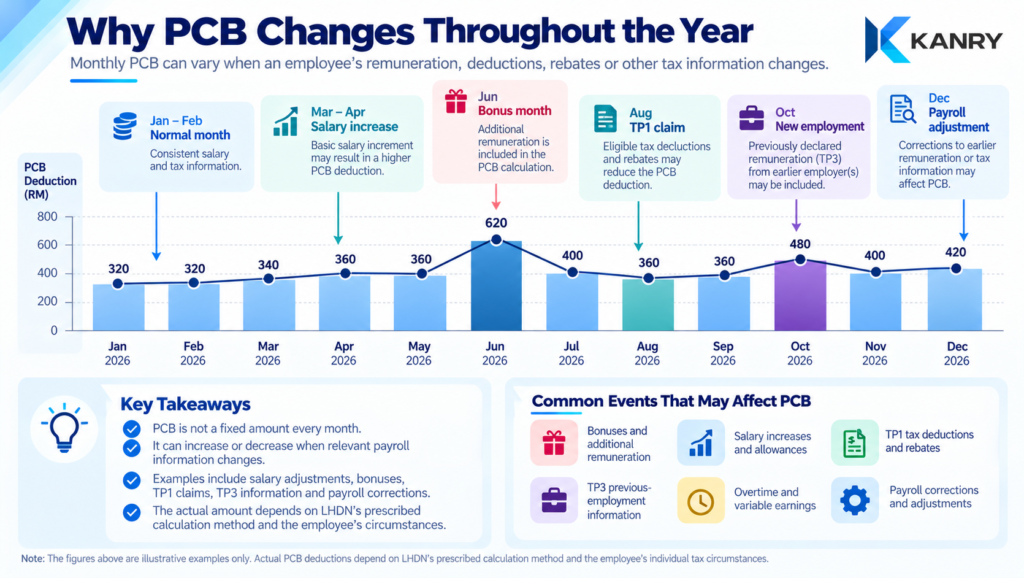
The chart is illustrative. It shows how PCB may vary across different payroll events rather than predicting a particular employee’s actual deduction.
Seven Common Reasons PCB Changes Every Month
7 Reasons Your Monthly PCB May Change
Explore the common payroll events that affect monthly tax deductions.
A higher salary may change estimated taxable income.
Additional remuneration is considered in PCB calculations.
Taxable variable earnings may differ by month.
Eligible deductions and rebates may affect PCB.
Previous-employment income and PCB may be relevant.
Relevant status and relief information can change.
Payroll adjustments may affect later deductions.
1. Salary Increases
A salary increment may increase an employee’s annual taxable remuneration.
Depending on the employee’s overall tax circumstances, this can lead to a higher monthly PCB deduction.
2. Bonuses and Additional Remuneration
Bonuses, commissions, certain incentives, arrears and other taxable additional remuneration may affect PCB.
LHDN’s computerised method includes treatment for additional remuneration.
Payroll should calculate the applicable deduction using the prescribed method rather than applying an arbitrary percentage to the bonus.
3. Overtime and Variable Earnings
Where overtime or other variable payments are taxable, changes in the amounts paid can affect the calculation.
This is particularly relevant for manufacturing, logistics, retail and other industries with variable monthly earnings.
4. Changes in Eligible Tax Deductions or Rebates
An employee may submit Borang TP1 to claim eligible deductions or rebates for PCB purposes.
Where applicable, these claims may affect the calculation.
Employers must account for the relevant limits, conditions and previously declared amounts.
5. Previous Employment Information
When an employee joins a new company during the calendar year, Borang TP3 helps the employer obtain relevant accumulated remuneration and tax deduction information from previous employment.
If the new employer initially has incomplete information, subsequent corrections may affect the payroll calculation.
6. Employee Tax Information Changes
Changes to relevant tax details—such as applicable marital status, child relief information or residency status—may affect the calculation, depending on the circumstances and prescribed rules.
HR and payroll should update records only after obtaining the necessary information.
7. Payroll Adjustments and Corrections
A correction to earlier remuneration, deduction or payroll information may change the PCB calculated for a subsequent month.
This is why payroll reconciliation is important even when the employee’s basic salary remains unchanged.
How Does LHDN Calculate Monthly PCB in 2026?
LHDN provides a computerised PCB calculation specification for 2026.
The calculation considers relevant current-month and accumulated information, with prescribed treatment for normal remuneration and additional remuneration.
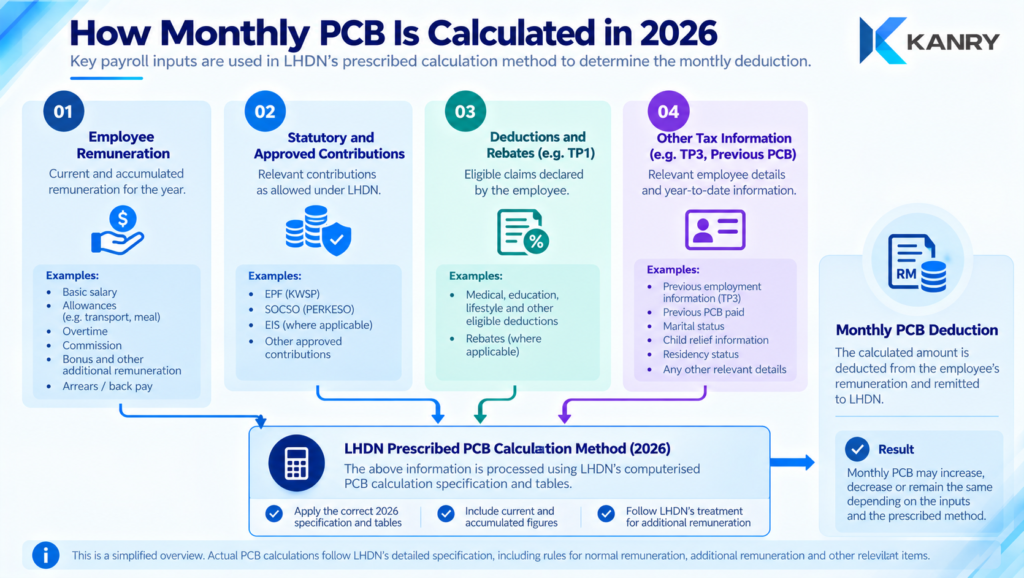
The key inputs may include current remuneration, accumulated remuneration, approved contributions, applicable deductions and rebates, previous PCB paid, and other relevant tax information.
The exact calculation is more detailed than a simple fixed percentage of gross salary.
Employers should therefore use an appropriate payroll system configured to the current specification or an applicable official LHDN calculation facility.
Official reference: 2026 PCB Calculation Specification and Forms.
Practical Example: Why PCB May Increase During a Bonus Month
Consider an employee with the following illustrative remuneration:
| Item | Ordinary month | Bonus month |
|---|---|---|
| Basic salary | RM5,000 | RM5,000 |
| Bonus | RM0 | RM10,000 |
| Total gross remuneration | RM5,000 | RM15,000 |
| PCB | Calculated under LHDN rules | Recalculated including additional remuneration |
The employee’s basic salary has not changed, but the bonus increases the remuneration considered for the relevant payroll calculation.
Same Basic Salary. Different Payroll.
Illustrative example — not an actual PCB calculation.
RM5,000
Basic salary: RM5,000
Bonus: RM0
PCB: Apply normal calculation
RM15,000
Basic salary: RM5,000
Bonus: RM10,000
PCB: Apply additional-remuneration method
This does not mean the employee’s entire bonus is taxed at one fixed rate.
The payroll calculation must apply the prescribed treatment of additional remuneration, considering the employee’s relevant tax circumstances.
The exact PCB cannot be determined from salary and bonus figures alone.
Can PCB Decrease Even When Salary Stays the Same?
Yes, it can.
An employee’s PCB may decrease when the applicable calculation changes because of qualifying deductions, rebates, corrected payroll information or other relevant factors.
For example, an employee who submits an eligible TP1 claim may see a change in PCB after the claim is correctly processed.
However, a RM1,000 tax deduction does not mean PCB decreases by RM1,000.
A tax deduction reduces the relevant amount of income subject to tax; its actual effect depends on the prescribed calculation.
For further information, refer to Blog #7 — Borang TP1 Malaysia 2026: Employer Guide to PCB Tax Relief Claims.
Why Does PCB Change When an Employee Switches Jobs?
When an employee changes employers during the same calendar year, the new employer needs relevant previous-employment information for PCB calculation.
Borang TP3 is used to obtain this information.
How a Job Change Affects PCB
Example: Employee joins a new employer in October 2026.
Employee receives remuneration and PCB deductions from the previous employer.
HR obtains current-year previous-employment information using TP3.
Payroll checks accumulated remuneration, relevant contributions and previous PCB.
Apply the prescribed LHDN method using the applicable information.
For example, an employee who joins in October 2026 may have received salaries, bonuses and PCB deductions from January to September at a previous company.
The new employer should account for the applicable accumulated information rather than treating the employee as though they had no employment income earlier in 2026.
See Blog #6 — Borang TP3 Malaysia 2026 for the on-boarding process and required information.
What Should Payroll Check When PCB Changes Unexpectedly?
Before concluding that a deduction is incorrect, payroll should review the underlying information.
PCB Changed Unexpectedly? Check These First.
A practical checklist for HR and payroll review.
Checklist selections are temporary and are not saved.
The review should include current and previous remuneration, bonuses, accumulated tax information, relevant employee details, TP1 or TP3 declarations, and payroll system configuration.
The payroll team should also check whether any previous-month corrections were processed.
Where a discrepancy is identified, the employer should determine the appropriate correction under LHDN’s rules rather than making an unsupported manual adjustment.
PCB vs EPF vs SOCSO: Why Employees Should Not Confuse Them
PCB, EPF and SOCSO may all appear as payroll deductions, but they have different purposes and calculation rules.
| Deduction | Main purpose | Administered by |
|---|---|---|
| PCB | Monthly income tax deduction | LHDN/HASiL |
| EPF / KWSP | Retirement savings contributions | KWSP |
| SOCSO / PERKESO | Social security protection | PERKESO |
An increase in PCB does not necessarily mean EPF or SOCSO contributions have increased.
Likewise, an employee’s take-home pay may change because of several deductions at the same time.
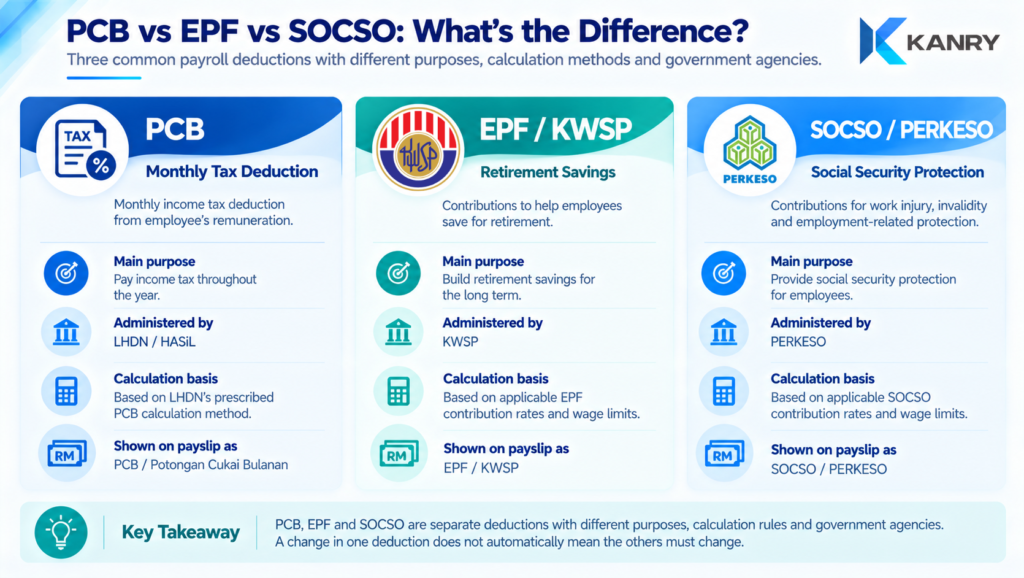
For a broader overview, read Kanry Search’s Malaysia Payroll Contribution Guide 2026.
How Should HR Explain PCB Changes to Employees?
A good payroll explanation should be accurate, understandable and respectful of employee privacy.
Rather than telling employees that the system automatically calculated a different amount, HR should identify the relevant cause.
For example, a bonus payment may have increased the taxable remuneration considered in that month’s PCB calculation.
Alternatively, a new TP1 declaration may have changed the employee’s eligible deduction information.
HR should avoid promising a particular PCB reduction before the calculation has been verified.
How HR Should Respond to a PCB Query
A simple, professional response process.
Confirm the month and payslip being queried.
Check payroll inputs and relevant declarations.
Describe the verified reason in plain language.
Escalate discrepancies and document corrections.
“Your PCB was recalculated this month because your payroll included additional taxable remuneration. We can review the calculation breakdown with you if you would like more details.”
Where appropriate, payroll can provide a calculation breakdown or refer the employee to the official LHDN calculation facility.
Common PCB Payroll Mistakes Employers Should Avoid
Common mistakes include treating PCB as a fixed percentage, omitting taxable additional remuneration, entering incorrect accumulated figures, ignoring relevant TP1 or TP3 information, and applying unsupported manual adjustments.
Employers should also avoid using outdated payroll calculation specifications.
Common PCB Mistakes and How to Prevent Them
Practical payroll controls for Malaysian employers.
PCB is not a universal percentage of salary.
Better: Use LHDN’s prescribed calculation.Taxable additional remuneration may be omitted.
Better: Reconcile all taxable payroll items.Year-to-date calculations may be inaccurate.
Better: Verify cumulative records.Relevant declarations may not be reflected.
Better: Review employee tax forms.Changes may not follow the prescribed method.
Better: Investigate and document corrections.An older specification may produce incorrect results.
Better: Validate 2026 payroll configuration.A consistent review process helps improve payroll accuracy and reduces employee queries.
Frequently Asked Questions About PCB Malaysia 2026
PCB Malaysia 2026 — Frequently Asked Questions
Select a question to expand the answer.
Why did my PCB increase even though my salary stayed the same?
A change in bonus payments, accumulated payroll information, eligible deductions or other relevant tax inputs may affect PCB even if basic salary is unchanged.
Is PCB a fixed percentage of salary?
No. PCB is calculated under LHDN’s prescribed rules using relevant employee and payroll information.
Does a bonus increase PCB?
A taxable bonus may increase the deduction because it is additional remuneration. The exact result depends on the prescribed calculation and employee circumstances.
Can PCB decrease during the year?
Yes. Eligible deductions, rebates, corrections and other relevant changes may result in a lower calculated deduction.
What is the difference between PCB and EPF?
PCB is an income tax deduction administered by LHDN. EPF contributions are retirement savings administered by KWSP.
Why does PCB change when I start a new job?
The new employer may need to include relevant current-year remuneration and PCB information from your previous employment, usually obtained through Borang TP3.
Can TP1 claims affect PCB?
Yes. Eligible TP1 deductions and rebates may affect PCB when processed under the prescribed calculation method. A tax deduction does not reduce PCB by the same ringgit amount.
Where can employers verify PCB calculations for 2026?
Refer to LHDN’s PCB Tables and Data Specifications for the official 2026 computerised calculation specification and related resources.
How Kanry Search Supports Malaysian Employers
Accurate payroll administration requires coordination between HR, payroll and finance, particularly where employees receive variable remuneration or join and leave throughout the year.
Employers must maintain reliable employee information, apply statutory calculations and retain appropriate records.
Kanry Search supports Malaysian employers through recruitment, contract staffing, payroll administration and workforce-related HR services.
Whether your organisation is expanding its workforce or reviewing payroll administration processes, Kanry Search can help support your hiring and workforce requirements.
Need Recruitment or Payroll Administration Support?
Contact Kanry Search to discuss recruitment, staffing and payroll administration support for your Malaysian operations.
Official References
- LHDN — PCB Tables and Data Specifications
- LHDN — Employer Responsibilities
- LHDN — PCB Payment
- LHDN — Borang TP1 2026
- LHDN — Borang TP3 2026
Disclaimer: This article provides general information as of October 2026. Actual PCB calculations depend on the applicable LHDN specification and employee-specific circumstances. Employers should consult LHDN or a qualified tax professional when necessary.