
Malaysia Employer Advisory | Updated October 2026
Attendance records are a fundamental part of workforce management. Employers use them to monitor working hours, arrange shift coverage, calculate overtime and prepare payroll.
But what happens when an employee’s attendance record does not match the actual working arrangements?
A production operator may forget to clock out. A warehouse employee may dispute a recorded late arrival. A supervisor may discover that one employee appears to have clocked in on behalf of another.
These situations require different responses.
An incomplete clock-in record is not automatically misconduct. Equally, a deliberately falsified attendance record should not be treated as an ordinary administrative correction.
For Malaysian employers, the real challenge is determining what happened, preserving reliable evidence, correcting payroll lawfully and taking proportionate action where misconduct is established.
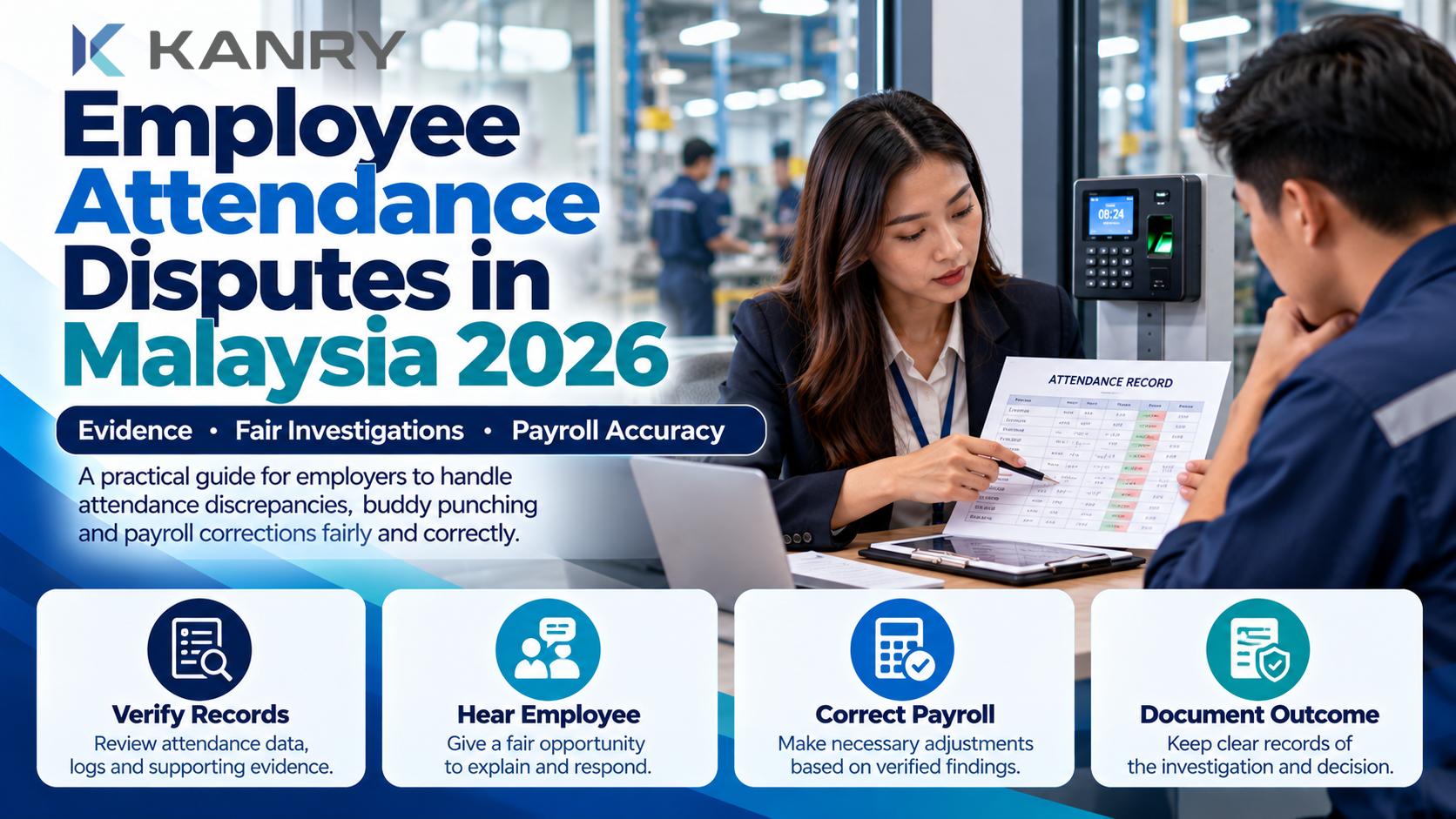
This guide explains how HR, Finance and operations managers can handle attendance discrepancies, suspected buddy punching, timesheet disputes and disciplinary investigations in 2026.
What Are Employee Attendance Disputes?
An attendance dispute arises when an employee and employer disagree about working time, attendance status or the accuracy of an attendance-related record.
Common examples include:
- An employee disputes being marked absent.
- A clock-in system records an incorrect arrival time.
- An employee forgets to clock out after completing a shift.
- A manager questions whether recorded overtime was actually worked.
- An employee is suspected of clocking in for a colleague.
- A manual timesheet is amended without clear authorisation.
The most important distinction is between a record discrepancy and proven dishonesty.
Common Attendance Problems
| Attendance issue | Possible explanation | Initial HR response |
|---|---|---|
| Missing clock-in | Forgotten punch, device failure or absence | Reconcile against other evidence |
| Late arrival | Actual lateness, queue at clock-in terminal or inaccurate device time | Verify the timeline |
| Missing clock-out | Employee omission or system error | Check completed work and shift records |
| Unexpected overtime | Approved work, unapproved work or incorrect entry | Establish what work was performed |
| Duplicate punch pattern | Shared device, administrator intervention or deliberate misuse | Review access and audit logs |
| Buddy punching allegation | Another person may have recorded attendance | Preserve evidence and investigate |
| Roster mismatch | Incorrect roster, approved shift swap or unauthorised change | Check approved scheduling records |
Employer takeaway: The attendance system provides evidence, but it should not be treated as infallible.
What Is Buddy Punching?
Buddy punching occurs when one employee records another employee’s attendance, commonly by using an attendance card, PIN or another person’s credentials.
For example, Employee A may clock in at 8:00 AM on behalf of Employee B, who does not arrive until 8:30 AM.
If the record is then used to calculate paid working time, the employer may have an inaccurate attendance and payroll record.
However, an apparent duplicate attendance event does not automatically establish deliberate fraud.
Employers should first consider whether the issue could involve an authorised administrative correction, mistaken credentials, a malfunctioning device or another reasonable explanation.
Buddy Punching vs Ordinary Attendance Error
| Factor | Ordinary error | Suspected deliberate buddy punching |
|---|---|---|
| Intent | Often accidental or unknown | Possible intentional misrepresentation |
| Evidence | Missing or incorrect entry | Possible credential sharing or impersonation |
| Employee explanation | May involve system failure or oversight | Requires careful verification |
| Payroll effect | May cause underpayment or overpayment | May produce inaccurate paid-time records |
| Appropriate response | Verify and correct | Investigate before deciding |
The employer should avoid using terms such as “fraud” or “theft” in a final disciplinary finding unless the available evidence supports that conclusion.
What Does Malaysian Employment Law Say About Attendance Misconduct?
Malaysia does not have a single statutory provision that defines every clock-in error or instance of buddy punching.
The relevant legal considerations arise from employment terms, workplace rules, wage obligations, misconduct procedures and industrial relations law.
Section 14 — Employment Act 1955
Section 14 provides a framework for disciplinary action where an employee engages in misconduct inconsistent with the fulfilment of the express or implied conditions of employment.
Following due inquiry, the provision allows an employer, where appropriate, to dismiss the employee without notice, downgrade the employee or impose a lesser punishment.
This does not mean every attendance irregularity justifies dismissal.
The employer must consider the evidence, seriousness of the conduct, surrounding circumstances and applicable legal requirements.
Section 20 — Industrial Relations Act 1967
An employee who considers that a dismissal was without just cause or excuse may make a representation for reinstatement under Section 20.
The statutory period for making the representation is generally 60 days from dismissal, subject to the applicable statutory provisions.
This reinforces the importance of having a supportable basis for disciplinary termination rather than relying solely on the employer’s suspicions.
Attendance Records and Payroll
The Employment Regulations 1957 prescribe wage-register particulars and recordkeeping requirements.
Employers should ensure that attendance discrepancies are investigated and any relevant wage records accurately reflect what is properly payable.
Statutory obligations and recommended practices are different. The law supplies the applicable employment and disciplinary framework; the investigation checklist and internal review timelines in this article are recommended management procedures.
Which Malaysian Jurisdictions Are Covered?
The Employment Act 1955 framework discussed here primarily applies to Peninsular Malaysia and Labuan.
Sabah and Sarawak have their own labour ordinances. Employers in those jurisdictions must check the relevant provisions rather than automatically applying every Employment Act rule.
Industrial relations issues may also involve separate legislation and case law.
Seven Steps to Investigate an Attendance Discrepancy
A consistent process protects the employer’s interests while giving the employee a fair opportunity to explain.
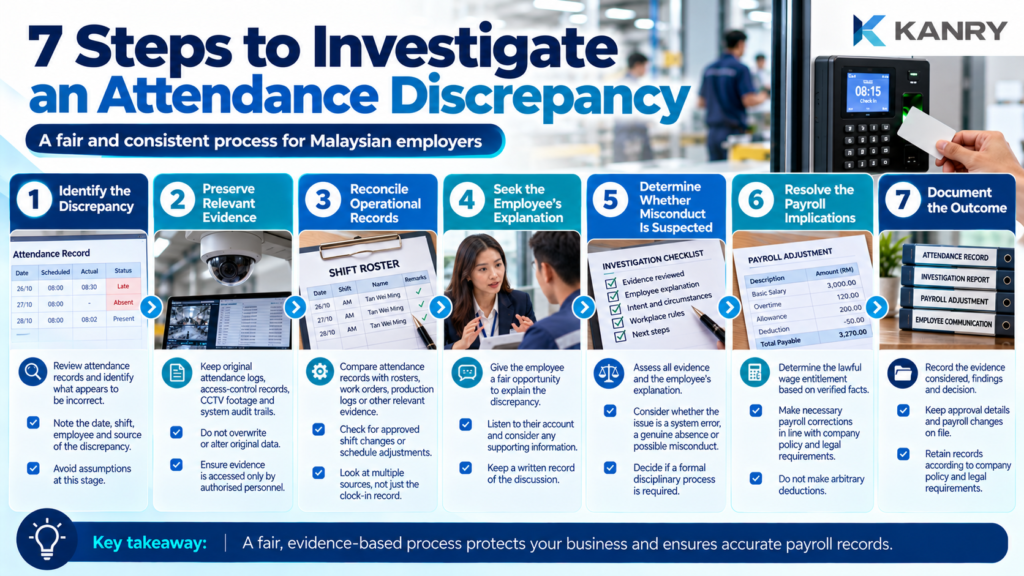
Step 1 — Identify the Discrepancy
Determine precisely what appears to be incorrect.
For example, the system may show an 8:00 AM clock-in while the supervisor reports that the employee arrived at 8:30 AM.
Record the date, employee, shift and source of the discrepancy.
Step 2 — Preserve Relevant Evidence
Preserve the original attendance records before making changes.
Relevant information may include clock-in logs, roster records, authorised adjustments, system audit trails, shift handovers and legally obtained access-control information.
Access to CCTV or biometric-related records should comply with applicable data-protection requirements and internal access controls.
Step 3 — Reconcile Operational Records
Compare the recorded time against other evidence.
A manufacturing employee may appear in production handover records or equipment logs. A logistics employee may have relevant dispatch or loading records.
No single source should automatically be treated as conclusive.
Step 4 — Seek the Employee’s Explanation
Give the employee a reasonable opportunity to clarify the discrepancy.
The explanation may reveal a technical issue, approved roster change or administrative omission.
Do not frame the discussion as a finding of guilt before the facts have been established.
Step 5 — Determine Whether Misconduct Is Suspected
Where the evidence indicates a deliberate breach of workplace rules, HR should assess whether a formal disciplinary process is warranted.
The investigation and disciplinary decision should be handled impartially, with appropriate separation of responsibilities where practical.
Step 6 — Resolve the Payroll Implications
Determine whether payroll records or wage calculations require correction.
Any proposed change must respect the employee’s actual entitlement and lawful deduction requirements.
An attendance discrepancy is not, by itself, permission to deduct an arbitrary amount from salary.
Step 7 — Document the Outcome
Record the evidence considered, employee explanation, findings, approved payroll corrections and any appropriate follow-up.
Where formal disciplinary action is considered, follow the applicable legal procedures and employment policies.
[INSERT IMAGE: Seven-Step Attendance Investigation Workflow]
Attendance Investigation Checklist
Use this checklist to document a fair, evidence-based review of an attendance discrepancy.
Recommended internal workflow. Any formal disciplinary action must comply with applicable law and employment terms.
What Evidence Should HR Review?
A fair attendance investigation should use evidence relevant to the particular allegation.
| Evidence source | What it may establish | Main limitation |
|---|---|---|
| Clock-in and clock-out logs | Recorded attendance events | May contain errors or shared-credential issues |
| Approved roster | Scheduled working time | Does not prove actual attendance |
| Access-control logs | Entry or access event | Entry does not necessarily prove work |
| Supervisor’s report | Observations about shift activity | May be incomplete or subjective |
| Production records | Work or equipment activity | May not identify the responsible employee conclusively |
| Work-order records | Assigned or completed tasks | May not show exact working hours |
| CCTV | Relevant observable events | Privacy, reliability and retention considerations |
| Employee explanation | Context and alternative account | Should be assessed with other evidence |
The objective is to reconstruct a reliable timeline rather than simply accumulate documents supporting one conclusion.
Recommended Evidence Record
For each material discrepancy, HR should record the event date, time, source, original file reference, who accessed the evidence and any subsequent amendment.
Only authorised personnel should be able to change the official attendance record.
Employers should retain both the original entry and the approved correction where the system allows.
Can Employers Deduct Salary for Missing Attendance Records?
A missing punch does not automatically prove that the employee failed to work.
For example, an employee may have completed a full shift but forgotten to clock out.
If the employer deducts wages solely because the system contains no clock-out entry, the employee may dispute the payment.
Three Different Payroll Situations
Situation A — Work was performed but the clock-in failed
The employer should assess the evidence and ensure wages are calculated correctly.
Situation B — The employee did not work during a disputed period
The employer should determine the lawful amount payable, taking account of the contract, applicable wage rules and facts.
Situation C — An overpayment or deliberate falsification is suspected
The employer must separately determine the lawful basis for any correction or recovery. An established overpayment does not authorise unlimited deductions from future wages.
Section 24 of the Employment Act regulates deductions from wages, including specific conditions and limitations.
Payroll Correction Decision Table
| Finding | Payroll treatment to consider | HR action |
|---|---|---|
| System error confirmed | Correct inaccurate records and pay | Close documented exception |
| Employee worked but forgot to punch | Reflect verified working time | Correct records |
| Genuine absence established | Apply applicable contractual and statutory rules | Record finding |
| Hours remain disputed | Review additional evidence | Escalate for resolution |
| Suspected intentional falsification | Separate payroll determination from disciplinary findings | Consider formal investigation |
Critical principle: A disciplinary penalty and a wage correction are not interchangeable. An employer should not manufacture a payroll deduction to punish suspected misconduct.
Manufacturing Example: Disputed Shift Attendance in Johor
Illustrative scenario.
A manufacturer in Pasir Gudang operates a shift beginning at 7:00 AM.
An employee’s attendance system shows a clock-in at 6:58 AM. However, the supervisor reports that the employee did not arrive at the production area until approximately 7:25 AM.
The supervisor suspects buddy punching.
A poor response would be to immediately label the employee dishonest and deduct a fixed amount from salary.
A more reliable investigation would examine the original attendance event, relevant access-control records, equipment or production logs, approved shift changes and the employee’s explanation.
The employer may discover that the employee was present on-site but working in an alternative authorised area.
Alternatively, evidence may support the allegation that another individual recorded the employee’s attendance.
The appropriate decision depends on the established facts.
What HR Should Learn
Where employees must pass through security, attend shift handovers or collect protective equipment before beginning productive work, employers should define how those activities relate to recorded working time.
Ambiguous timekeeping policies can create disputes even when no employee has acted dishonestly.
Logistics Example: Timesheet and Overtime Discrepancies
Illustrative scenario.
A warehouse employee in Klang Valley submits overtime for work continuing until 9:00 PM.
The warehouse management system shows the last recorded transaction at 8:15 PM.
Does that mean the remaining time was not worked?
Not necessarily.
The employee may have performed inventory checks, cleanup, handover activities or other assigned duties that were not recorded as warehouse transactions.
HR should check the supervisor’s instructions, approved overtime arrangements, any relevant operational records and the employee’s explanation.
Approved vs Actual Overtime
Employers should distinguish between whether overtime was authorised under company policy and whether compensable work was actually performed.
A missing approval form does not necessarily establish that no work occurred.
Likewise, an overtime claim should not be accepted without verifying the facts where there is a genuine discrepancy.
The applicable overtime payment obligations depend on the Employment Act, contractual arrangements and employee eligibility.
When Should Employers Start a Formal Disciplinary Inquiry?
Not every attendance discrepancy requires a disciplinary inquiry.
Minor isolated recording mistakes may be resolved administratively.
A formal misconduct process may be appropriate where credible evidence indicates deliberate falsification, repeated unauthorised credential sharing, dishonest timesheet amendments or another serious breach.
Administrative Correction vs Disciplinary Review
| Circumstance | Initial handling |
|---|---|
| One forgotten punch with corroborating evidence | Administrative correction |
| Repeated recording errors without evidence of dishonesty | Investigate system and training weaknesses |
| Disputed roster with an authorised shift change | Correct scheduling and attendance records |
| Credible evidence of another employee clocking in | Formal fact-finding |
| Evidence suggesting deliberate repeated falsification | Consider disciplinary proceedings |
| Conflicting evidence and unresolved allegations | Further investigation before a decision |
Employers should communicate the allegations clearly, allow a meaningful opportunity to respond and ensure decisions are based on relevant evidence.
Where Section 14 applies, its requirements concerning due inquiry and disciplinary action must be observed.
There is no automatic rule that every case of suspected buddy punching results in dismissal.
Can Employers Suspend an Employee During an Attendance Investigation?
Section 14(2) of the Employment Act provides for suspension during an inquiry for a period not exceeding two weeks, with payment of not less than half the employee’s wages during that period.
Where the inquiry does not disclose misconduct, wages withheld under that provision must be restored.
These requirements should not be confused with other forms of paid administrative leave or suspension arrangements, which require a separate legal and contractual assessment.
Employers should not assume they may impose indefinite unpaid suspension while investigating an allegation.
For complex disciplinary matters, obtain qualified employment-law advice before deciding on suspension or termination.
Attendance Systems, CCTV and Employee Privacy
Electronic attendance systems can improve accuracy, but employers must also manage the personal information they collect.
Potential information sources include fingerprints, facial recognition, access-control records, location data and CCTV footage.
The use of technology should be appropriate to the purpose and subject to applicable data-protection and employment requirements.
Recommended Privacy Controls
Employers should define why information is collected, restrict access to authorised staff, protect records from unauthorised alteration and establish a retention policy.
Where CCTV or biometric information is used, employers should review the applicable Personal Data Protection Act 2010 framework and guidance from Malaysia’s Personal Data Protection Commissioner.
The use of a biometric system does not eliminate the need to investigate conflicting evidence.
Evidence and Privacy Control Checklist
Before using attendance records, CCTV or access logs in an investigation, check the following controls.
Privacy requirements depend on the information, processing purpose and applicable Malaysian law. Consult current guidance from the Personal Data Protection Commissioner.
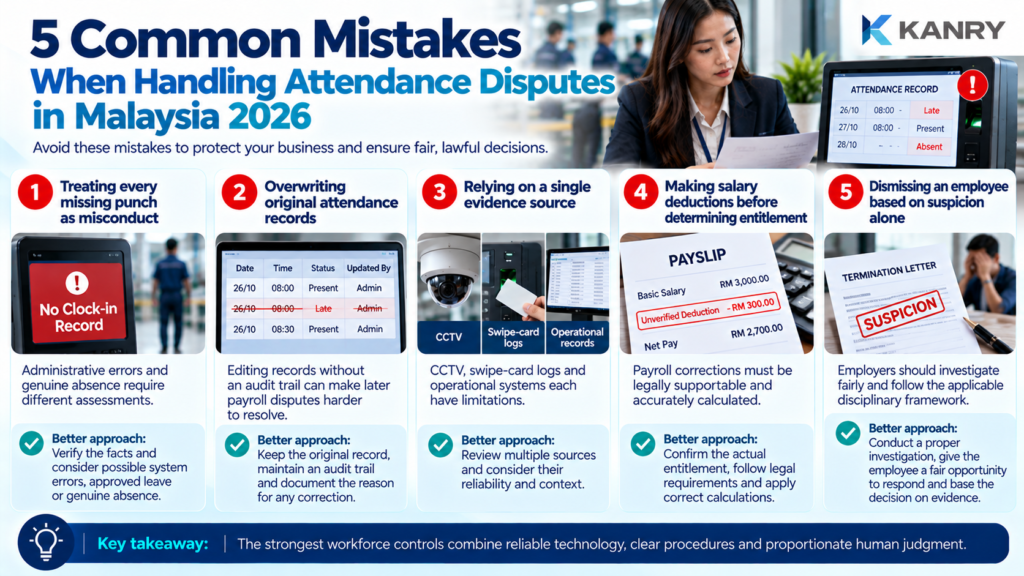
Five Common Employer Mistakes
How Employers Can Prevent Attendance Disputes
An effective prevention programme should address how work is scheduled, recorded, verified and paid.
Recommended measures include documented clock-in rules, an employee attendance-correction procedure, supervisor review of exceptions, controlled access to attendance adjustments and regular reconciliation before payroll is finalised.
HR should also ensure employees know how to report device failures, late attendance corrections and approved shift changes.
Recommended Monthly Attendance Audit
| Audit question | Why it matters |
|---|---|
| Are there repeated missing punches? | May indicate training or system problems |
| Are manual adjustments properly authorised? | Reduces alteration risk |
| Do recorded hours match approved rosters? | Identifies scheduling discrepancies |
| Are overtime differences explained? | Supports accurate pay |
| Are disputes closed with documented reasons? | Improves accountability |
| Are original records preserved? | Supports audit and investigation |
| Are privacy and access controls reviewed? | Protects employee information |
The audit should distinguish system weaknesses, process errors and genuine misconduct rather than assuming all irregularities are deliberate.
How Kanry Search Can Support Employers
Growing manufacturing, logistics and service businesses often manage complex workforce arrangements involving shift employees, temporary workers, contract personnel and multiple operational sites.
As headcount increases, accurate attendance administration becomes closely connected with payroll, workforce planning and employee relations.
Kanry Search supports Malaysian and Singaporean employers through permanent recruitment, temporary and contract staffing, employer-of-record arrangements and HR shared services.
For employers reviewing staffing structures or workforce administration processes, it is important to establish clear responsibilities for scheduling, reporting and payroll coordination.
Strengthen Your Workforce Operations
Whether your organisation is expanding its production workforce, hiring warehouse teams or reviewing HR administration support, Kanry Search can discuss suitable recruitment and workforce solutions.
Contact Kanry Search to discuss your business requirements.
Frequently Asked Questions
Employee Attendance Disputes Malaysia — FAQs
Is buddy punching automatically grounds for dismissal?
No. The employer should establish the facts, assess the seriousness of the conduct and follow the applicable disciplinary requirements. The outcome depends on the evidence and circumstances.
Can an employer deduct salary for a missed clock-in?
A missing clock-in does not automatically establish that the employee failed to work. The employer should verify actual attendance and determine the lawful wage entitlement before making corrections.
Must an employer conduct a domestic inquiry?
Section 14 of the Employment Act 1955 refers to disciplinary action following due inquiry. The appropriate procedure depends on the allegation, applicable law and circumstances. Employers should obtain advice on contested or serious disciplinary cases.
Can CCTV be used to investigate an attendance dispute?
Relevant, lawfully obtained footage may assist an investigation. Employers should assess applicable privacy obligations, authorised access, evidential reliability and retention.
What if the attendance system is incorrect?
HR should preserve the original entry, examine supporting records, document the reason for correction and ensure the employee receives the wages properly payable.
Can employers suspend employees during an inquiry?
Section 14(2) of the Employment Act allows suspension for inquiry purposes subject to specified wage and duration protections. Other suspension arrangements require separate legal and contractual consideration.
What should an employer retain after an investigation?
Useful records include original logs, relevant evidence, the employee’s explanation, approved corrections and the final decision. The retention period should follow applicable legal and company requirements.
Official References
- Employment Act 1955 — JTKSM
- Employment Regulations 1957 — JTKSM
- Industrial Relations Department — Section 20 Dismissal Guidance
- Personal Data Protection Commissioner
This article provides general employer guidance, not legal advice for a specific disciplinary case. Employment, industrial relations and privacy requirements should be assessed according to the circumstances and applicable jurisdiction.