
Tanaka’s planned precious-metal refinery in Batu Kawan adds an often-overlooked question to Penang’s semiconductor workforce discussion. Who can establish what is in the manufacturing material a plant sends for recovery, and how confidently can that result be linked back to the original shipment?
Tanaka’s 21 October 2026 announcement confirms a joint venture with Malaysia’s MEP Enviro Technology and says the site broke ground on 8 October. It plans to analyse recovered material, refine precious metals to 99.99% purity and make precious-metal products. MIDA’s announcement puts the investment at RM70 million and identifies high-purity gold and potassium gold cyanide as the initial products. Tanaka lists April 2029 as the planned operating start. The earlier MIDA release indicated the first quarter of 2029. Both refer to plans for a site under development.
The value of a lot starts before refining
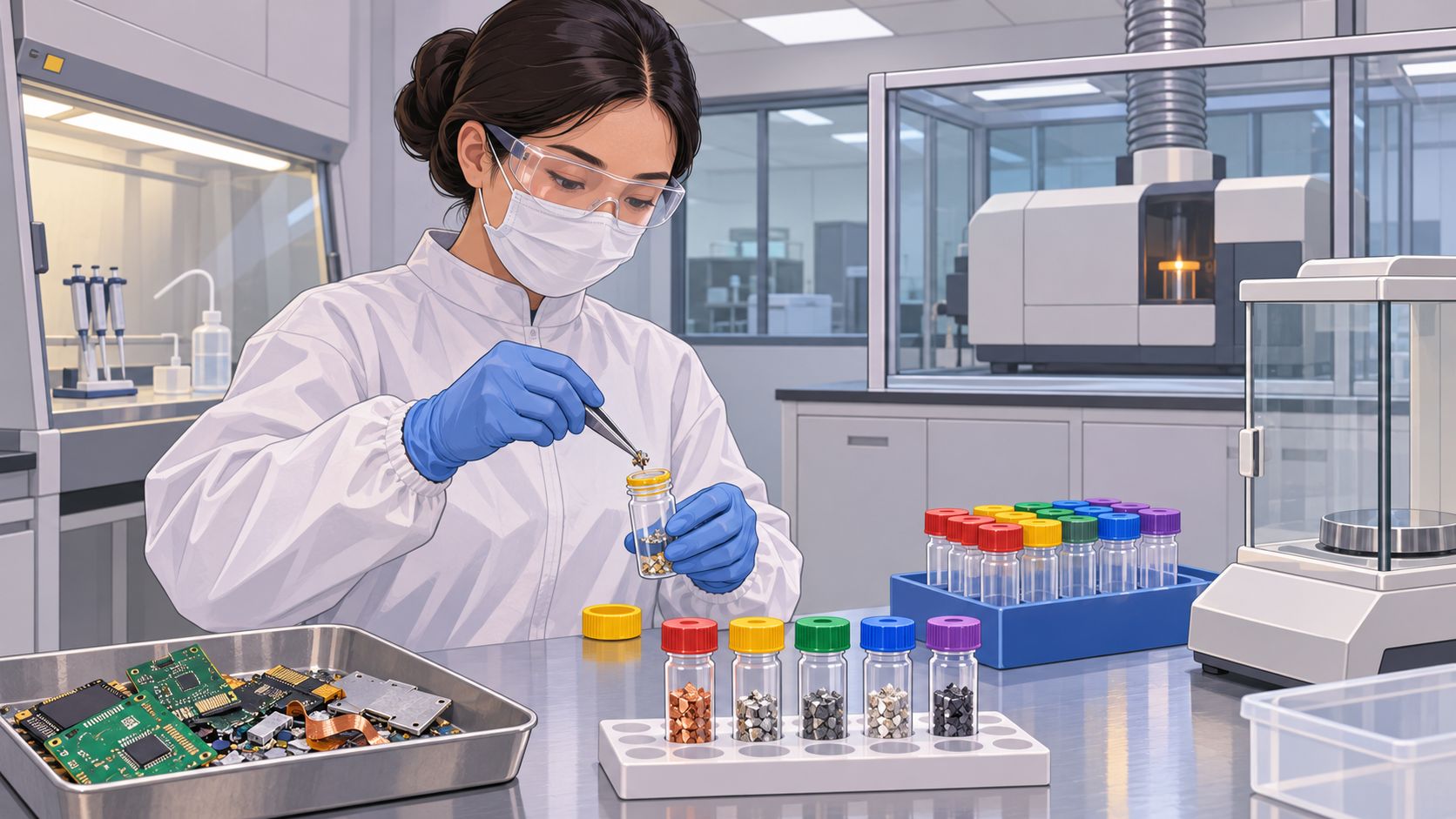
An electronics manufacturer’s recovered material can arrive from different production steps and differ in composition. An assay measures the concentration of the metal of interest in a sample. For the assay to support a commercial decision, the sample needs to represent the lot from which it came. A precise laboratory result is of limited use when the underlying sample does not represent the shipment.
This creates two distinct workforce needs. One sits at the manufacturer, where operations teams segregate and record material before it leaves. Another sits at the receiving and laboratory stages, where staff preserve the identity of the lot, select and prepare samples, and interpret results. If lot records become inconsistent at the first handover, the laboratory cannot reconstruct them from the assay alone.
For a procurement or operations leader, recovery is therefore a supplier relationship with a measurable data component. The people negotiating the service need to understand what the plant can document about its outgoing material. Plant teams need to know what records the receiving company needs and how the parties will handle a result that differs from expectations.
What Penang employers can plan for
A useful hiring question is whether an organisation needs an additional laboratory specialist or a process owner who can connect production records, material segregation and downstream acceptance. Those roles solve different problems. A stronger lab may shorten the time needed to test a sample. A stronger handover can reduce the number of shipments that require resampling or an investigation. Teams can distinguish the two by tracking why lots are held, repeated or disputed.
There is a second boundary on the output side. A customer using refined materials in electronics production may need to qualify the material against its own specifications and processes. Tanaka’s purity target describes a planned capability. It does not establish which manufacturers will buy the output or when any individual customer qualification will be complete.
For Penang’s electronics employers, the project makes an overlooked part of the local supply chain visible. Recovering high-value material brings together production discipline, laboratory work and customer qualification. The workforce opportunity sits at the points where those groups need to agree on what a lot contains, where it came from and whether it is ready for the next use.
Hiring for materials recovery, laboratory or process operations? Contact Us to discuss the technical roles your team needs.