
Unpaid Employees Provident Fund (EPF/KWSP) contributions can create far more than a payroll discrepancy. For Malaysian employers, failing to remit contributions may result in late payment charges, legal proceedings, criminal penalties and restrictions on company directors leaving Malaysia.
The consequences are not hypothetical.
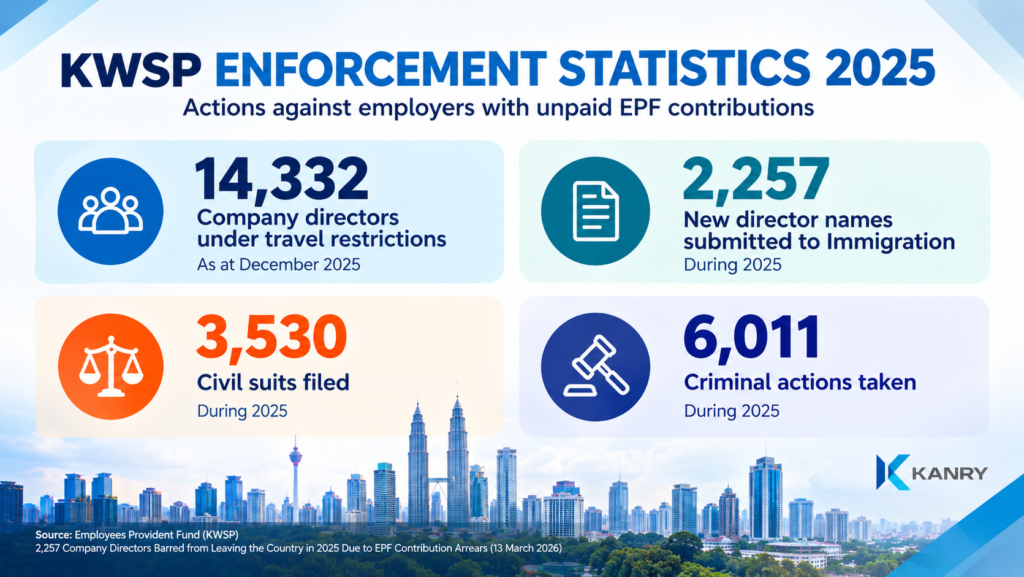
On 13 March 2026, the Employees Provident Fund (KWSP) announced that 14,332 company directors were subject to travel restrictions as at December 2025 because of outstanding employee EPF contributions.
For employers, the more important question is not simply how many directors have been affected. It is whether the business has adequate controls to prevent statutory contribution arrears, identify discrepancies and resolve them before enforcement escalates.
This guide explains Malaysia’s EPF compliance requirements, the potential consequences of unpaid contributions and the practical steps HR, payroll, finance and company directors should take.
At a Glance: What Malaysian Employers Need to Know
- EPF contributions are ordinarily due by the 15th of the following month.
- Failing to remit contributions can lead to statutory penalties and recovery proceedings.
- Deducting employee EPF contributions without remitting them is a particularly serious offence.
- Company directors may face personal liability and travel restrictions under applicable legal provisions.
- Employers should reconcile contributions, verify payments and escalate arrears promptly.
1. What Happens When Employers Fail to Pay EPF in Malaysia?
Under the Employees Provident Fund Act 1991, employers must remit mandatory EPF contributions for employees who fall within the statutory requirements.
Employers are responsible for paying both the employer’s contribution and the employee’s contribution to KWSP. The employee’s share may be deducted from wages, but the employer remains responsible for remitting the required amounts.
The standard deadline is the 15th day of the month following the wage month.
Example: September 2026 Payroll
| Payroll item | Details |
|---|---|
| Wage month | September 2026 |
| Ordinary EPF payment deadline | 15 October 2026 |
| Employer responsibility | Calculate, submit and complete the required EPF payment |
Completing the payroll calculation is not enough. The required contribution payment must also be successfully completed.
Where employers fail to comply, KWSP may take enforcement action depending on the circumstances.
Common EPF Compliance Failures and Consequences
| Compliance failure | Potential consequence |
|---|---|
| Late EPF contribution | Late payment charges and applicable dividend-related amounts |
| Failure to remit mandatory contributions | Criminal penalties and recovery proceedings |
| Deducting employees’ EPF contributions without remitting them | More serious criminal penalties |
| Outstanding company EPF liabilities | Potential legal action involving responsible directors |
| Unresolved contribution arrears | Possible travel restrictions under Section 39 |
| Incorrect employee contribution records | Employee disputes, investigations and corrective payments |
These consequences are not automatically imposed in every case. The applicable legal provisions, facts and enforcement decisions determine the outcome.
Official reference: KWSP — Employer Compliance and Enforcement
2. Why Were 14,332 Company Directors Barred from Leaving Malaysia?
KWSP’s announcement on 13 March 2026 highlighted the scale of enforcement against employers with unpaid EPF contributions.
Official EPF Enforcement Figures
| Enforcement indicator | Figures reported by KWSP |
|---|---|
| Company directors under travel restrictions as at December 2025 | 14,332 |
| New director names submitted to Immigration during 2025 | 2,257 |
| Civil suits filed during 2025 | 3,530 |
| Criminal actions taken during 2025 | 6,011 |
These figures come from KWSP’s official media announcement.
The 14,332 figure represents the reported total as at December 2025, rather than the number of new restrictions imposed during that year.
The civil and criminal action figures represent enforcement activity, not necessarily final court convictions.
Official source: KWSP — 2,257 Company Directors Barred from Leaving the Country in 2025 Due to EPF Contribution Arrears
Why Does This Matter to Business Owners?
An EPF contribution default is not necessarily confined to the company’s payroll department.
When contribution arrears remain unresolved, directors may face personal legal and operational consequences under the relevant statutory provisions.
For a company whose directors regularly travel overseas to meet customers, suppliers, investors or regional management teams, a travel restriction can disrupt important business activities.
For businesses operating across Malaysia and Singapore, this makes EPF compliance particularly relevant to directors who frequently cross borders.
Important distinction: Travel restrictions arise from applicable statutory enforcement procedures, not automatically from a single late payment.
3. Can Company Directors Be Personally Liable for Unpaid EPF?
Yes. Malaysian EPF legislation provides mechanisms through which company directors may be held responsible for outstanding contributions.
Two important provisions are Sections 39 and 46 of the EPF Act 1991.
Section 39: Restrictions on Leaving Malaysia
Section 39 provides for restrictions on leaving Malaysia in connection with unpaid EPF contributions.
According to KWSP’s official guidance, company directors, partners and sole proprietors with outstanding contributions, including applicable late payment charges and dividends, may be prevented from leaving the country.
A director should not assume that an upcoming business trip, existing flight booking or urgent overseas meeting automatically exempts them from an imposed restriction.
Section 46: Liability Relating to Outstanding Contributions
Section 46 addresses liability involving company directors and other persons in relation to outstanding EPF contributions.
KWSP identifies potential enforcement measures including recovery proceedings, bankruptcy action, seizure and sale of assets, and passport-related restrictions, subject to the applicable legal requirements.
The precise liability of a director depends on the statutory provisions and facts of the case. Employers should obtain legal advice where director liability or enforcement proceedings are involved.
Does Appointing a Payroll Manager Remove a Director’s Responsibility?
No. Delegating payroll administration does not, by itself, remove statutory obligations.
A payroll manager may process the contribution file, but senior management should ensure the company has sufficient funding, approval procedures and payment verification controls.
For directors, an effective governance approach is to require regular reporting on outstanding statutory contributions rather than relying solely on verbal confirmation that payroll has been completed.
Official references:
4. What Are the Penalties for Not Paying EPF Contributions?
Different EPF offences carry different penalties.
The table below summarises several statutory offences identified in KWSP’s official employer compliance guidance.
| EPF Act provision | Offence | Maximum stated penalty |
|---|---|---|
| Section 41(1) | Failure to register as an EPF employer within the required period | Up to 3 years’ imprisonment, RM10,000 fine, or both |
| Section 43(2) | Failure to pay EPF contributions by the statutory deadline | Up to 3 years’ imprisonment, RM10,000 fine, or both |
| Section 48(3) | Deducting employees’ EPF contributions but failing to remit them | Up to 6 years’ imprisonment, RM20,000 fine, or both |
| Sections 47(1) and 47(2) | Unlawfully deducting the employer’s contribution from employee wages | Up to 6 years’ imprisonment, RM20,000 fine, or both |
These are maximum statutory penalties identified by KWSP, not automatic fines for every instance of non-compliance.
Employers may also face recovery proceedings and applicable late payment charges.
Official source: KWSP — Employer Compliance and Penalties
What Is the Difference Between Late Payment and Deducting EPF Without Remitting It?
Situation A: Late EPF Payment
A company calculates its EPF contributions but misses the statutory payment deadline.
This may expose the employer to late payment charges and enforcement for failing to remit contributions on time.
Situation B: Employee EPF Deductions Not Remitted
A company deducts EPF contributions from employee wages but does not transfer the money to KWSP.
This involves money deducted from employee wages that has not been remitted to the statutory fund. Section 48(3) provides for more severe penalties.
Employer takeaway: Not all EPF arrears represent the same offence. The cause and nature of the failure matter when determining the applicable legal consequences.
5. When Must Employers Pay EPF Contributions?
The general payment deadline is the 15th day of the following month.
| Wage month | Ordinary EPF contribution deadline |
|---|---|
| August 2026 | 15 September 2026 |
| September 2026 | 15 October 2026 |
| October 2026 | 15 November 2026* |
| November 2026 | 15 December 2026 |
KWSP states that where the 15th falls on a weekend or public holiday, payment on the next working day does not attract a late payment charge. Employers should verify the applicable calendar and payment arrangements.
A Payroll Deadline Is Not the Same as a Payment Confirmation
One recurring operational risk is assuming that completing a payroll file means the statutory payment has been made.
Monthly EPF Payment Verification Checklist
- Calculate the applicable EPF contributions.
- Review and approve the contribution schedule.
- Submit the required information through the relevant KWSP channel.
- Complete the payment.
- Verify the payment result and retain evidence.
- Reconcile the payment against the payroll register and employee contribution records.
A file that has been prepared but not successfully paid does not demonstrate that the employer has fulfilled the payment obligation.
Official source: KWSP — Contribution Payment Channels
6. Common Causes of EPF Arrears in Malaysian Businesses
Unpaid contributions can result from deliberate non-payment, but operational weaknesses may also contribute to arrears.
Employers should examine the underlying cause rather than simply correcting the latest outstanding payment.
Incorrect Treatment of Wages and Allowances
Manufacturing, logistics, retail and service employers frequently operate payroll structures containing basic salary, incentives, commissions, shift allowances, bonuses and overtime.
Different payment categories may receive different statutory treatment.
An incorrect wage classification can cause an employer to understate contributions even when payments are made before the deadline.
For a broader discussion of wage classification, see Kanry Search’s Malaysia Payroll Contribution Guide 2026.
Failure to Update Employee Records
Incorrect identification numbers, incomplete employee registration or inaccurate employment details can create contribution-processing and reconciliation problems.
This risk increases when employers recruit large numbers of workers within a short period.
Insufficient Cash-Flow Planning
A company may have enough cash to pay net salaries but insufficient funds set aside for statutory contributions.
This creates a dangerous situation where employees have received wages, but the related statutory liabilities remain unpaid.
EPF contributions should be included in workforce cost planning from the beginning, rather than treated as an expense to address after payroll.
Weak Approval and Payment Controls
If one person prepares, approves and submits payroll without independent verification, errors or missed payments may remain undetected.
Similarly, where the finance team assumes HR has paid EPF and HR assumes finance has completed the transfer, neither department may recognise the outstanding liability promptly.
Inadequate Oversight of Outsourced Payroll
Outsourcing payroll processing can improve operational efficiency, but employers still need clarity over responsibility for contribution calculations, approvals, payment execution and record retention.
A service agreement should specify who performs each task and how the employer receives evidence of completion.
Employer Takeaway: Five Common Risk Areas
- Wage classification errors.
- Inaccurate employee records.
- Insufficient statutory payment funding.
- Weak approval and verification controls.
- Unclear outsourced payroll responsibilities.
Correcting arrears is necessary, but fixing the control weakness that caused them is what reduces repeat exposure.
7. Practical Example: How EPF Arrears Can Accumulate
Consider a hypothetical Malaysian manufacturing business employing 80 workers.
Assume its monthly EPF contribution liability, including both employer and employee shares, is RM45,000.
The finance department experiences a cash-flow shortage and delays contributions for three months.
Employer Scenario: Manufacturing Company
| Item | Illustrative amount |
|---|---|
| Number of employees | 80 |
| Monthly EPF contribution liability | RM45,000 |
| Number of unpaid months | 3 |
| Outstanding contributions | RM135,000 |
| Late payment charges and dividend-related amounts | Additional; subject to KWSP assessment |
| Total requiring settlement | At least RM135,000 before additional applicable charges |
Illustrative calculation:
RM45,000 × 3 months = RM135,000 in unpaid contributions, before any additional applicable charges.
This example is illustrative and does not represent a specific company’s circumstances or an official KWSP calculation.
The main lesson is that statutory contribution liabilities can accumulate rapidly, particularly in labour-intensive businesses.
A director reviewing only monthly salary expenditure may fail to appreciate the extent of the outstanding liability unless statutory contributions are reported separately.
What Should Management Have Done Differently?
The company should have maintained a monthly statutory liability register, established a payment approval deadline ahead of the statutory due date, and escalated any funding shortfall immediately.
A contribution arrears report should be visible to senior management, not buried within routine payroll administration.
Practical employer takeaway: Include outstanding statutory contributions in monthly management reporting alongside payroll costs, cash-flow forecasts and other financial liabilities.
8. What Should an Employer Do If EPF Contributions Are Already Overdue?
Where contributions have not been paid, employers should prioritise correcting the position and communicating with KWSP.
The following process provides a practical starting point.
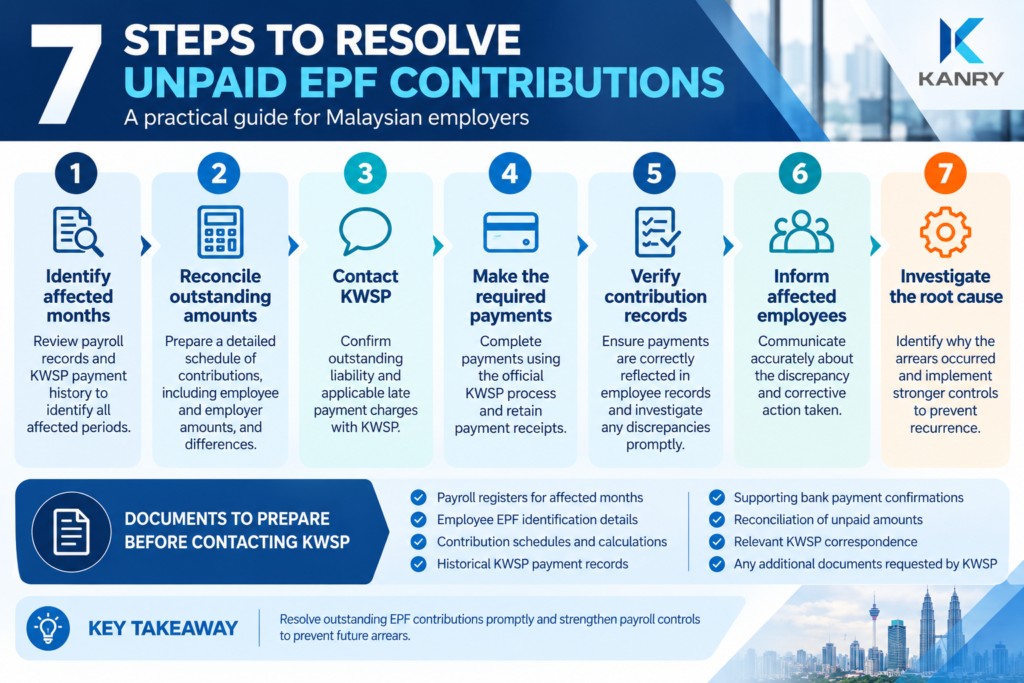
Step 1: Identify Every Affected Contribution Month
Review payroll registers, payslips, contribution schedules and KWSP payment records.
Determine whether the problem involves:
- Complete non-payment.
- Partial payment.
- Incorrect contribution calculations.
- Missing or inaccurate employee records.
Step 2: Reconcile the Outstanding Amounts
Prepare a schedule identifying the following information.
| Required information | Purpose |
|---|---|
| Wage month | Identifies the affected period |
| Employee identification and EPF number | Matches contributions to the correct member |
| EPF-liable wages | Supports the contribution calculation |
| Employee contribution | Identifies the employee share |
| Employer contribution | Identifies the employer share |
| Amount previously remitted | Avoids double-counting |
| Outstanding difference | Establishes the arrears requiring correction |
Do not estimate the final amount payable using only a flat percentage where the official contribution schedule or employee category requires a different calculation.
Step 3: Contact KWSP
Employers should approach KWSP to confirm the outstanding liability, applicable charges and correct payment or rectification procedure.
Do not assume that an informal payment arrangement, partial settlement or pending discussion automatically suspends enforcement action.
Step 4: Make the Required Payments
Complete the payments using the official process confirmed by KWSP.
Retain payment receipts and supporting documents.
Step 5: Verify the Contribution Records
Confirm that the remitted amounts are correctly reflected against the relevant employee records.
Where discrepancies remain, investigate them promptly.
Step 6: Inform Affected Employees Appropriately
Employees may already have noticed missing contributions through their KWSP accounts.
HR should provide accurate information about the discrepancy and the corrective action taken, without promising an unconfirmed settlement date.
Step 7: Investigate the Root Cause
Determine why the problem occurred and what must change to prevent recurrence.
For example, if the cause was insufficient payment authorisation, introduce a backup approver and an escalation process before the next statutory deadline.
Where enforcement proceedings, director liability or significant arrears are involved, obtain appropriate legal and professional advice.
Documents to Prepare Before Contacting KWSP
- Payroll registers for affected months.
- Employee EPF identification details.
- Contribution schedules and calculations.
- Historical KWSP payment records.
- Supporting bank payment confirmations.
- Reconciliation of unpaid amounts.
- Relevant KWSP correspondence.
This is a recommended preparation checklist, not a complete statutory document requirement for every case.
9. How Can a Director Check or Resolve an EPF Travel Restriction?
A director who is already subject to a travel restriction should follow KWSP’s official procedure rather than assuming that making a payment will immediately remove the restriction.
KWSP states that affected persons may contact its Unit Larangan Keluar Negara to obtain details of outstanding contributions.
According to KWSP’s published guidance, an application to lift a restriction should be submitted at least five working days before the intended travel date.
Information Required for a Travel Restriction Application
The application requires information including:
- The affected person’s identity.
- Employer number, where applicable.
- Purpose of travel.
- Travel destination.
- Intended travel period.
KWSP will communicate the outstanding amount and the payment and supporting-document requirements.
The official guidance states that the release process will not be initiated without proof of payment.
The applicant must await confirmation of the restriction’s release.
Important: The five-working-day requirement is an application lead time, not a guarantee that the restriction will be lifted within five working days.
For the current procedure and contact details, refer directly to KWSP’s Employer Travel Restriction guidance.
10. EPF Compliance Checklist for HR, Finance and Company Directors
EPF compliance is most reliable when responsibilities are clearly divided and independently checked.
The following framework can be adapted for SMEs, manufacturing plants, retail chains and multi-location businesses.
Recommended EPF Compliance Responsibility Matrix
| Control | Suggested owner | Recommended frequency |
|---|---|---|
| Verify new employee EPF registration | HR | Upon onboarding |
| Review employee status and contribution eligibility | HR / Payroll | Upon onboarding and when status changes |
| Validate EPF-liable wage components | Payroll | Every payroll cycle |
| Reconcile employer and employee contribution amounts | Payroll / Finance | Monthly |
| Approve statutory payment funding | Finance | Before payment deadline |
| Verify payment completion | Finance | Monthly |
| Reconcile KWSP payment records | Payroll / Finance | Monthly |
| Review outstanding statutory liabilities | Finance Manager | Monthly |
| Escalate unresolved arrears | CFO / Managing Director | Immediately |
| Review recurring payroll control failures | Management | Quarterly |
The frequencies and ownership assignments above are Kanry’s recommended management practices, not separate statutory deadlines.
Five Questions Directors Should Ask Every Month
- Have all EPF contributions for the previous wage month been successfully paid?
- Do the contribution amounts reconcile with the payroll register?
- Are there any unresolved contribution arrears or employee complaints?
- Have new joiners, foreign employees and departing employees been handled correctly?
- Can the finance team produce documentary evidence of completed payments?
These questions provide directors with a practical basis for overseeing statutory payroll compliance without requiring them to process payroll personally.
11. Special EPF Considerations for Employers Hiring Foreign Workers
Employers operating in manufacturing, logistics, construction and other labour-intensive industries should also review their obligations for non-Malaysian employees.
From wages for October 2025, mandatory EPF contributions generally apply to eligible non-Malaysian citizen employees under the applicable framework.
KWSP states that the contribution rate for this category is generally:
| Contribution component | Rate |
|---|---|
| Employer share | 2% |
| Employee share | 2% |
Employers must check the applicable eligibility conditions, exclusions and contribution requirements rather than assuming every foreign worker has identical treatment.
Why This Matters for Recruitment and Workforce Planning
When calculating the total cost of hiring a foreign employee, employers should account for applicable statutory contributions in addition to wages, allowances, recruitment costs and other employment expenses.
A workforce budget based solely on take-home pay may understate the employer’s actual cost.
HR should also verify employee registration and identification details before the first required contribution.
Official source: KWSP — Contributions for Non-Malaysian Citizen Employees
For additional context, see Kanry Search’s EPF Contributions for Non-Malaysian Employees.
12. Should Employers Outsource Payroll to Reduce EPF Compliance Risk?
Payroll outsourcing may help businesses improve consistency, administration and reporting, particularly where they have complex salary structures or limited internal HR resources.
However, outsourcing should not be treated as a transfer of all legal responsibility.
What Employers Should Evaluate in a Payroll Provider
- Applying current statutory contribution requirements.
- Processing different wage components accurately.
- Managing employee onboarding and offboarding.
- Maintaining contribution and payment records.
- Handling corrections and outstanding amounts.
- Reporting exceptions before statutory deadlines.
- Protecting confidential employee and payroll information.
The most important consideration is accountability.
A reliable payroll arrangement should make it clear who calculates, who approves, who pays and who verifies each statutory obligation.
Recommended Accountability Structure
| Stage | Suggested responsibility |
|---|---|
| 1. Calculate | Payroll team or service provider |
| 2. Approve | Authorised employer representative |
| 3. Pay | Designated payment owner |
| 4. Verify | Finance or independent reviewer |
This is an illustrative division of duties. Actual responsibility should be documented in the employer’s payroll procedures and service agreement.
13. How Kanry Search Supports Employers with Workforce and Payroll Administration
For growing businesses, recruitment and payroll compliance are closely connected.
Every new hire introduces employment documentation, salary arrangements, statutory registration and ongoing payroll administration.
Kanry Search supports employers in Malaysia and Singapore through recruitment and HR solutions designed to reduce operational pressure as workforces expand.
Permanent and Executive Recruitment
Helping employers identify and hire suitable professionals, managers and operational talent across multiple industries.
Contract and Temporary Staffing
Supporting businesses that require flexible workforce arrangements for ongoing operations, projects or seasonal demand.
Payroll and HR Shared Services
Assisting with payroll administration, employee records and relevant statutory processes within agreed service arrangements.
Employer-of-Record Solutions
Supporting eligible workforce arrangements where businesses require local employment administration and operational support.
For employers reviewing their payroll processes, Kanry can help assess the operational requirements of recruitment, staffing and payroll administration.
Strengthen Your Workforce and Payroll Operations
Whether you’re expanding your workforce, managing contract employees or reviewing payroll administration, Kanry Search can help you explore practical recruitment and HR support solutions for your Malaysian operations.
Contact Kanry Search to discuss recruitment, contract staffing, payroll administration or HR support.
Kanry’s services support HR and payroll administration; they do not replace legal representation or statutory decisions made by KWSP.
Frequently Asked Questions About Unpaid EPF in Malaysia
Can an Employer Pay EPF Contributions After the 15th?
An employer can make overdue payments, but payment after the applicable statutory deadline may attract late payment charges and other consequences. Late payment does not remove the original compliance failure.
Can a Company Director Be Stopped at Immigration Because of Unpaid EPF?
Yes. Section 39 of the EPF Act provides for travel restrictions in relevant cases. A director must follow the official procedure to resolve an imposed restriction.
Is Unpaid EPF a Criminal Offence in Malaysia?
Failure to remit mandatory EPF contributions can constitute an offence under the EPF Act 1991. The applicable penalty depends on the statutory provision and circumstances.
What Happens if an Employer Deducts EPF From Salary but Does Not Pay KWSP?
This can fall under Section 48(3), which carries a maximum penalty of six years’ imprisonment, a RM20,000 fine, or both, according to KWSP’s official enforcement guidance.
Can a Company Use Cash-Flow Problems as a Reason for Not Paying EPF?
Cash-flow difficulties do not automatically exempt an employer from statutory contribution obligations. Employers experiencing arrears should contact KWSP promptly and obtain professional advice where necessary.
Can a Director Avoid EPF Liability by Assigning Payroll to an HR Manager?
Delegating payroll administration does not automatically remove the director’s statutory exposure. Liability depends on the applicable provisions and circumstances.
How Can Employees Check Whether Their EPF Contributions Have Been Paid?
Employees can review their contribution records using KWSP’s i-Akaun services. They should compare the records with their payslips and raise discrepancies with the employer or KWSP.
Does EPF Apply to Foreign Employees in Malaysia?
Mandatory contributions generally apply to eligible non-Malaysian citizen employees from October 2025 wages, subject to the applicable requirements and exclusions. Employers should consult KWSP’s official guidance.
What Should an Employer Do After Discovering Several Months of Unpaid EPF?
Identify the affected periods, calculate the outstanding amounts, contact KWSP, arrange the required payments, verify employee records and implement controls to prevent recurrence.
Can an EPF Travel Restriction Be Lifted Immediately After Payment?
Employers and directors should not assume immediate release. KWSP has a formal application and confirmation process. Affected individuals should obtain official confirmation before travelling.
Conclusion: Treat EPF Compliance as a Management Responsibility
The 2026 KWSP enforcement announcement demonstrates that unpaid EPF contributions can have consequences beyond payroll administration.
For employers, the essential responsibilities are to calculate contributions accurately, pay them on time, maintain reliable records and address discrepancies promptly.
For company directors, the responsibility extends to ensuring that the business has appropriate oversight of its statutory liabilities.
Key takeaway: A monthly payroll process should not end when salaries are transferred. It should end when statutory payments have been completed, verified and properly documented.
For businesses expanding their workforce, the most sustainable approach is to build payroll compliance into recruitment planning, financial controls and ongoing HR operations.
Kanry Search supports employers with recruitment, staffing, payroll administration and HR solutions across Malaysia and Singapore.
Explore Kanry Search’s services.
Official Government References
- Employees Provident Fund (KWSP) — 2,257 Company Directors Barred from Leaving the Country in 2025 Due to EPF Contribution Arrears, 13 March 2026.
- KWSP — Employer Compliance and Enforcement. Statutory offences, penalties and enforcement provisions.
- KWSP — Employer Travel Restrictions. Section 39 and travel restriction procedures.
- KWSP — Contribution Payment Channels. Contribution obligations, deadlines and payment information.
- KWSP — EPF Act 1991 Third Schedule. Applicable statutory contribution schedules.
- KWSP — Employer Record-Keeping. Employee records and wage statement requirements.
- KWSP — Contributions for Non-Malaysian Citizen Employees. Mandatory contribution requirements for eligible foreign employees.
Disclaimer: This article provides general information based on official sources reviewed as at 12 October 2026. It is not legal advice. Statutory requirements and enforcement procedures may change. Employers should verify current requirements with KWSP and seek qualified professional advice for specific disputes, arrears or enforcement matters.