
The Employees Provident Fund (EPF), also known as KWSP, is a core statutory payroll obligation for employers in Malaysia. Yet calculating EPF contributions correctly involves more than applying 11%, 12% or 13% to an employee’s salary.
Employers must identify the employee’s contribution category, determine which earnings are subject to EPF, use the applicable Third Schedule and remit both employer and employee contributions on time.
This guide explains EPF contribution rates in Malaysia for 2026, including Malaysian and non-Malaysian employees, practical calculations, payment deadlines, payroll controls and common mistakes.
It complements Kanry Search’s existing Malaysia Payroll Contribution Guide 2026 by focusing specifically on EPF calculations and payroll reconciliation.
What Are the EPF Contribution Rates in Malaysia for 2026?
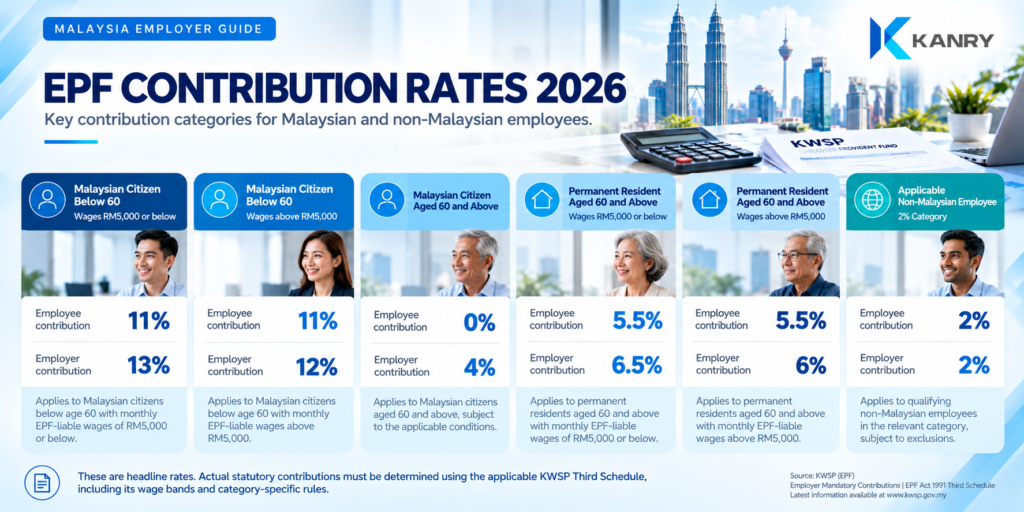
For most Malaysian employees below age 60, the standard employee contribution rate is 11%. The employer generally contributes 13% when monthly EPF-liable wages are RM5,000 or below, or 12% when wages exceed RM5,000.
However, different rules apply to employees aged 60 and above, permanent residents and certain non-Malaysian employees.
EPF Contribution Rate Comparison
| Employee category | Employee share | Employer share |
|---|---|---|
| Malaysian citizen below 60, wages RM5,000 or below | 11% | 13% |
| Malaysian citizen below 60, wages above RM5,000 | 11% | 12% |
| Malaysian citizen aged 60 and above | 0% | 4% |
| Permanent resident aged 60+, wages RM5,000 or below | 5.5% | 6.5% |
| Permanent resident aged 60+, wages above RM5,000 | 5.5% | 6% |
| Applicable non-Malaysian employee in the 2% category | 2% | 2% |
These are headline rates. Actual statutory contributions must be determined using the applicable KWSP Third Schedule, including its wage bands and category-specific rules.
Why the RM5,000 Threshold Matters
For the standard under-60 contribution category, RM5,000 is the dividing point between the employer’s 13% and 12% rates.
An employee earning RM5,000 and an employee earning RM5,001 can therefore fall into different employer contribution categories.
Employers should also assess bonuses and other EPF-liable payments correctly. The Third Schedule contains specific rules for contribution calculations where bonuses affect the month’s wages.
How to Calculate EPF Contributions Correctly
One of the most common payroll mistakes is multiplying an employee’s salary directly by the headline contribution percentage.
Although this may produce the correct amount in some cases, it is not always the statutory amount.
KWSP requires employers to follow the official Third Schedule for wages up to RM20,000. Exact-percentage calculations are permitted for wages exceeding RM20,000, subject to the applicable rules and rounding requirements.
Practical Example: RM3,250 Monthly Wages
For a Malaysian employee below 60 with RM3,250 in EPF-liable monthly wages, KWSP publishes the following example:
| Contribution component | Amount |
|---|---|
| Monthly EPF-liable wages | RM3,250 |
| Employee contribution | RM359 |
| Employer contribution | RM424 |
| Total monthly EPF contribution | RM783 |
Simply multiplying RM3,250 by 11% and 13% would produce RM781, which is RM2 less than the statutory schedule amount.
This demonstrates why employers should rely on the official contribution schedule rather than percentage calculations alone.
What About an Employee Earning RM5,000?
For a Malaysian employee below 60 with exactly RM5,000 in EPF-liable wages, the Third Schedule lists:
| Contribution | Amount |
|---|---|
| Employee share | RM550 |
| Employer share | RM650 |
| Total | RM1,200 |
These figures apply to the specified wage amount and contribution category. They should not be used as a universal calculation method for other salaries.
For official calculation guidance, refer to KWSP — Mandatory Contributions.
Which Salary Components Are Subject to EPF?
Before calculating contributions, employers must establish the correct EPF-liable wage amount.
Not every item shown on a payslip receives identical treatment. Payroll teams should assess the substance of each payment rather than relying on how an allowance or reimbursement is labelled.
| Payroll component | Employer action |
|---|---|
| Basic salary | Generally included in EPF wages |
| Commission | Assess and include where EPF-liable |
| Bonuses and incentives | Apply the relevant contribution treatment |
| Allowances | Review the specific type of allowance |
| Overtime payments | Check the applicable statutory exclusion |
| Genuine expense reimbursements | Verify whether they fall outside EPF wages |
| Salary arrears | Identify the correct contribution period |
For example, a payment described as a transport allowance should not automatically be treated in the same way as reimbursement of actual business travel expenses.
Employers should refer to KWSP’s official mandatory contribution guidance when determining whether specific payments form part of EPF-liable wages.
EPF Contributions for Non-Malaysian Employees in 2026
An important payroll consideration in 2026 is the expanded mandatory EPF coverage for qualifying non-Malaysian employees.
This requirement began with October 2025 wages, corresponding to the November 2025 contribution month. It is therefore an existing requirement in 2026, not a newly introduced 2026 law.
Under the expanded coverage, the general contribution rate for qualifying non-Malaysian employees in the relevant category is:
| Contribution category | Rate |
|---|---|
| Employee contribution | 2% |
| Employer contribution | 2% |
| Combined headline rate | 4% |
This is subject to the applicable coverage conditions and exclusions. Permanent residents and certain longstanding EPF members remain subject to different contribution categories.
Employers should verify employees’ membership status, work authorisation, residency classification and applicable exemptions.
For a more detailed explanation, read Kanry Search’s EPF Contributions for Non-Malaysian Employees.
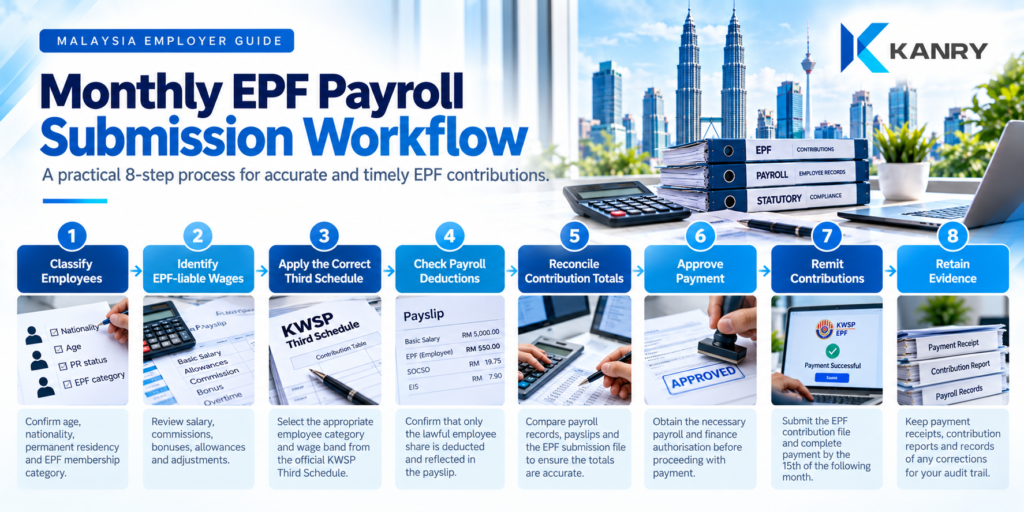
Monthly EPF Payroll Submission Workflow
A reliable payroll process should begin before the contribution file is submitted.
The process can be divided into eight practical steps:
EPF Payment Deadline in Malaysia
EPF contributions for a wage month are generally payable by the 15th day of the following month.
For example:
| Wage month | General payment deadline |
|---|---|
| September 2026 | 15 October 2026 |
| October 2026 | 15 November 2026 |
| November 2026 | 15 December 2026 |
Employers should verify applicable payment arrangements when a deadline falls on a weekend or public holiday rather than assuming an automatic extension.
Recommended Internal Payroll Timeline
| Internal activity | Suggested timing |
|---|---|
| Finalise employee payroll changes | Early in the following month |
| Reconcile EPF-liable wages | Before submission approval |
| Check employee and employer shares | Before payment |
| Obtain finance authorisation | Several working days before the 15th |
| Submit and retain payment evidence | By the statutory deadline |
This internal timetable is a recommended operational control, not an additional legal deadline.
Practical Employer Example: Reconciling EPF for 55 Employees
Consider a Malaysian company employing 55 people:
- 40 Malaysian employees
- 15 qualifying non-Malaysian employees
The payroll team should not apply a single contribution rate to everyone.
Instead, it should classify employees individually, identify the correct wage base and reconcile contribution amounts against the applicable statutory schedules.
EPF Payroll Responsibility Matrix
| Control area | Responsible team | Evidence to review |
|---|---|---|
| Employee identity and membership | HR | Identity and EPF records |
| Age and nationality classification | HR | Employee master data |
| EPF-liable wages | Payroll | Payroll component report |
| Statutory contribution amounts | Payroll | Third Schedule and contribution file |
| Payroll reconciliation | Payroll / Finance | Payslips and contribution totals |
| Payment approval | Finance | Authorisation records |
| Submission and payment | Authorised payroll/finance personnel | KWSP acknowledgment and receipt |
| Compliance oversight | Management | Exceptions and outstanding issues |
This separation of responsibilities helps prevent a single data-entry error from becoming a recurring payroll compliance problem.
Employer EPF Payroll Audit Checklist
Before submitting EPF contributions, employers should conduct a short but consistent monthly audit.
Monthly EPF Compliance Checklist
Tick each item before submitting your EPF contributions.
For guidance only. Checklist selections are not saved. Confirm all statutory requirements with KWSP.
The checklist should form part of a documented payroll approval process. Any discrepancies should be investigated before the contribution file is submitted.
Common EPF Payroll Mistakes Employers Should Avoid
| Common mistake | Why it matters | Recommended action |
|---|---|---|
| Applying 13% to every employee | Different wage thresholds and categories apply | Check the applicable contribution category |
| Using direct percentage multiplication | Can produce incorrect statutory amounts | Refer to the Third Schedule |
| Missing qualifying foreign employees | Mandatory coverage expanded in October 2025 | Review employee coverage and exclusions |
| Misclassifying allowances | Can cause incorrect EPF-liable wages | Audit payroll component definitions |
| Deducting the employer share from salary | Employer contributions are the employer’s obligation | Separate employee and employer costs |
| Paying contributions late | Can create arrears and enforcement exposure | Set earlier internal payment controls |
| Failing to retain payment records | Makes reconciliation and investigations harder | Maintain organised monthly evidence |
Who Is Responsible for EPF Compliance?
EPF compliance should not depend entirely on one payroll administrator.
HR, payroll, finance and management each have distinct responsibilities.
Who Manages EPF Compliance?
A practical division of responsibilities for Malaysian employers.
Management
Compliance oversight, accountability, approval controls and issue escalation.
Human Resources
Maintain employee identity, age, nationality, residency and EPF membership records.
Payroll
Identify EPF-liable wages, apply the correct Third Schedule, calculate contributions and prepare submissions.
Finance
Reconcile contribution totals, authorise payments, monitor deadlines and retain payment evidence.
Illustrative internal responsibility structure. The employer remains responsible for meeting applicable statutory EPF obligations.
For growing businesses, a written responsibility matrix is particularly useful when payroll activities are shared between internal teams and external service providers.
Frequently Asked Questions About EPF in Malaysia
EPF Malaysia 2026 — Frequently Asked Questions
Click any question below to view the answer.
What is the standard EPF employee contribution rate in 2026?
For most Malaysian employees below age 60, the standard employee contribution rate is 11%. Actual contributions must follow the applicable KWSP Third Schedule.
When does the employer contribute 13% instead of 12%?
For the standard under-60 category, the employer generally contributes 13% when monthly EPF-liable wages are RM5,000 or below and 12% when they exceed RM5,000.
Do employers contribute EPF for foreign workers in 2026?
Yes. Qualifying non-Malaysian employees are covered by the expanded mandatory EPF requirements introduced for October 2025 wages. The general rate for the relevant category is 2% from the employee and 2% from the employer, subject to exclusions and different membership categories.
Are Malaysian employees aged 60 and above required to contribute 11%?
No. The standard contribution category for Malaysian citizens aged 60 and above provides for a 0% employee share and a 4% employer share.
Can employers deduct their own EPF contributions from employees’ salaries?
No. Employers must bear their statutory employer contribution. Only the lawful employee share may be recovered through payroll deductions.
When must EPF contributions be paid?
EPF contributions are generally payable by the 15th day of the month following the wage month.
Can employers calculate EPF using an online percentage calculator?
A calculator may be useful for estimates, but actual payroll contributions must comply with the official KWSP Third Schedule and applicable rounding rules.
For the latest contribution requirements, refer to the official KWSP website .
How Kanry Search Supports Malaysian Employers
Accurate EPF administration begins with accurate employee information, organised payroll records and clear responsibilities between HR and finance.
As companies expand their workforce, these processes become increasingly important—particularly when hiring employees across different age groups, employment arrangements and nationality categories.
Kanry Search supports businesses in Malaysia through recruitment, contract staffing, payroll administration and HR-related services.
Our team can help employers strengthen workforce administration while they continue to meet their statutory obligations.
Need Recruitment or Payroll Administration Support?
Whether your business is expanding its workforce, managing contract employees or reviewing payroll administration processes, Kanry Search can support your HR and recruitment needs.
Contact Kanry Search to discuss your workforce and payroll requirements.
Official References
For the latest statutory guidance, employers should consult:
- KWSP — Employer Mandatory Contributions
- KWSP — EPF Act 1991 Third Schedule
- KWSP — Non-Malaysian Citizen Employees
- KWSP — Mandatory Contribution and Wage Guidance
Disclaimer: This article provides general employer information as of 12 October 2026. Employers should verify employee-specific requirements, current contribution schedules and applicable payment rules with KWSP before processing payroll.