
An employee’s probation period is coming to an end, but the reporting manager is not ready to confirm their appointment.
Perhaps the employee meets basic productivity expectations but continues to make quality errors. A newly hired engineer may need more time to demonstrate independent troubleshooting ability. A warehouse supervisor may understand operational processes but has not yet shown consistent leadership.
Should the employer extend probation, confirm the employee or consider non-confirmation?
For Malaysian employers, the decision requires more than a manager’s general impression.
Although probation is commonly used to assess employee suitability, employers should establish clear expectations, review actual performance, provide reasonable feedback and follow the applicable employment terms.
Importantly, an employee on probation is not an employee without legal protection.
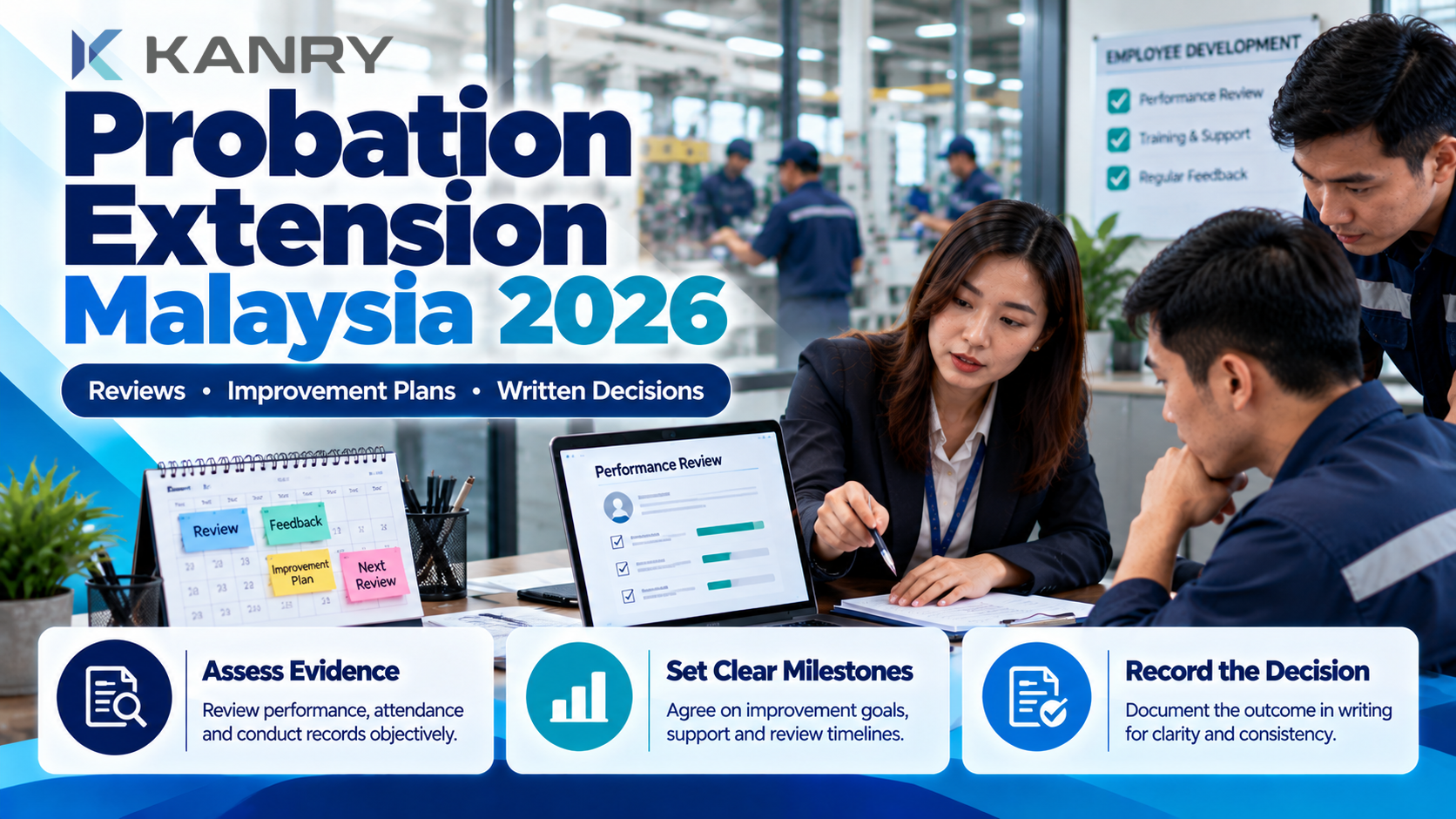
This guide explains how Malaysian employers can manage probation reviews, decide whether an extension is justified, prepare an improvement plan and document confirmation or non-confirmation decisions.
What Is a Probation Period in Malaysia?
Probation is an initial employment period during which the employer evaluates an employee’s suitability for the appointed position.
The assessment may cover technical competence, productivity, work quality, reliability, communication, teamwork and ability to perform assigned responsibilities.
The employee also has an opportunity to evaluate whether the role and organisation match their expectations.
Is Probation Mandatory Under Malaysian Law?
No general provision in the Employment Act 1955 requires every private-sector employer to impose a probation period.
The Act also does not establish a universal three-month or six-month probation period for all employees.
The existence, duration and extension arrangements of probation are ordinarily determined through the employment contract and applicable terms.
Common Probation Arrangements
| Arrangement | Typical employer practice | Legal consideration |
|---|---|---|
| Three-month probation | Often used for roles with readily measurable duties | Not a universal statutory duration |
| Six-month probation | Common for roles requiring more time to assess performance | Subject to employment terms |
| Probation extension | Additional assessment period with defined objectives | Review contractual basis and fairness |
| Early confirmation | Confirmation before the initial period ends | Apply applicable contract and policy |
| Non-confirmation | Employer decides not to confirm appointment | Must have a legally supportable basis |
These arrangements are examples of employer practice, not mandatory statutory categories.
Employer advisory: The fact that a company labels an employee as a probationer does not eliminate ordinary employment obligations concerning wages, statutory contributions, applicable leave and other protections.
Can Employers Extend an Employee’s Probation in Malaysia?
A probation extension may be possible, but employers should not assume they have an unrestricted right to extend probation indefinitely.
The employer should examine the employment contract, applicable company policy, any collective agreement and the circumstances surrounding the proposed extension.
For example, an employment contract may expressly allow a probation extension subject to specified conditions.
The employer should act consistently with those conditions and communicate any extension clearly.
Where the contract does not expressly address extensions, the employer should not assume it can unilaterally impose new terms without legal risk.
When Might an Extension Be Appropriate?
An extension may be appropriate where:
- The employee has shown genuine improvement but needs additional assessment.
- Specific performance gaps remain unresolved.
- The employee has not had sufficient opportunity to demonstrate certain competencies.
- Additional structured coaching could realistically address the gaps.
- The employer has identified a reasonable, measurable assessment period.
However, an extension should not be used simply because the manager has failed to conduct a probation review.
Example: Production Technician
Illustrative scenario.
A manufacturing company in Johor hires a production technician on a six-month probation arrangement.
The technician demonstrates acceptable attendance, safety awareness and compliance with work instructions.
However, independent machine troubleshooting remains below the agreed expectations.
The reporting manager considers extending probation for a further period to assess whether targeted training can close the competency gap.
A defensible approach would involve documenting specific performance evidence, reviewing contractual authority, discussing the concerns with the employee and establishing measurable improvement targets.
The employer should not merely issue a letter stating, “Probation extended due to unsatisfactory performance,” without explaining what needs to improve.
What Does Malaysian Employment Law Say About Probationers?
The distinction between probationary status and employment protection is particularly important.
Employment Act 1955
The Employment Act establishes statutory employment protections within its jurisdiction.
Those protections are not generally postponed until the employee receives a confirmation letter.
For employees in Peninsular Malaysia and Labuan, employers should apply the relevant provisions to probationers according to statutory coverage and eligibility.
Industrial Relations Act 1967
Section 20 of the Industrial Relations Act 1967 provides a mechanism for employees who consider that they have been dismissed without just cause or excuse to make representations.
Malaysian industrial relations principles recognise that probationers may also challenge dismissals.
An employer should therefore avoid assuming that a probation clause permitting termination on notice automatically establishes sufficient justification for dismissal.
Does an Employer Have to Confirm a Probationer?
Not automatically.
Employers may assess whether the employee meets the standards reasonably required for confirmation.
However, confirmation or non-confirmation decisions should be made genuinely, consistently and in accordance with the applicable legal and contractual framework.
The Malaysian Employers Federation’s publication Probationers and the Law discusses the protection of probationers against dismissal without just cause or excuse.
Statutory Requirements vs HR Best Practices
| Issue | Legal consideration | Recommended HR practice |
|---|---|---|
| Probation duration | Governed principally by applicable employment terms | Define start and review dates |
| Performance expectations | Relevant to a supportable employment decision | Communicate measurable criteria |
| Probation extension | Requires a sound contractual and legal basis | Issue written extension with clear goals |
| Dismissal | Subject to applicable industrial relations protections | Preserve performance evidence |
| Confirmation | Assess relevant terms and conduct | Issue a clear written decision |
| Feedback | Circumstances and fairness may matter | Conduct scheduled reviews |
A structured appraisal template is a recommended management tool, not a statutory form prescribed for all probationers.
Seven Steps Before Extending an Employee’s Probation
Employers can use the following process to improve consistency and reduce unnecessary disputes.
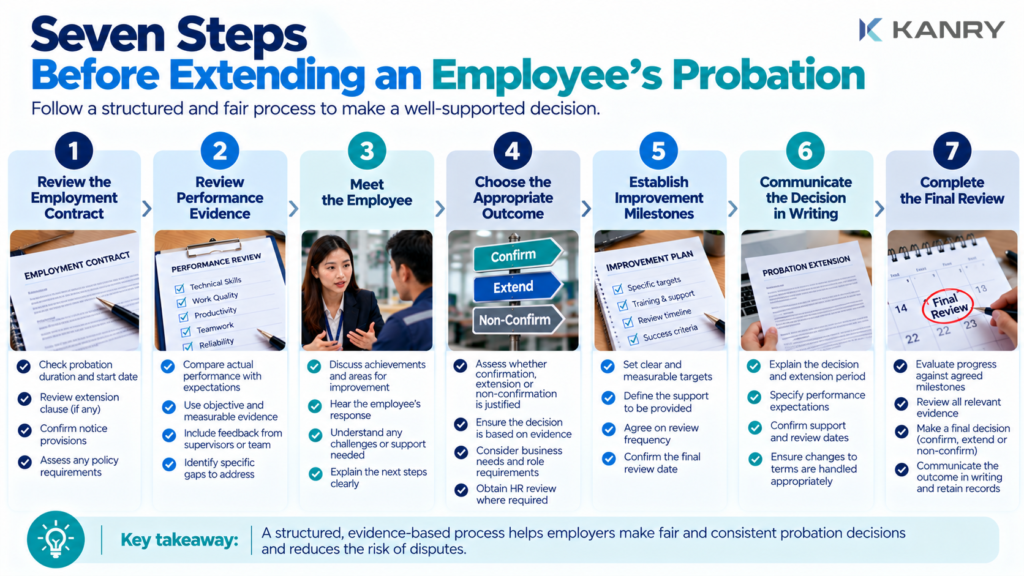
Step 1 — Review the Employment Contract
Confirm the probation commencement date, initial duration, applicable extension clause, notice provisions and confirmation requirements.
HR should identify whether any variation to the probation arrangement requires agreement or additional legal review.
Step 2 — Review Performance Evidence
Compare actual performance against expectations communicated to the employee.
Relevant evidence may include quality results, completed work, competency assessments, operational KPIs, customer feedback and documented coaching.
Avoid relying solely on subjective statements such as “not proactive enough”.
Step 3 — Meet the Employee
Discuss the employee’s performance, achievements and areas requiring improvement.
Allow the employee to respond to concerns and identify possible obstacles.
A lack of training, unclear job responsibilities or insufficient access to equipment may materially affect the assessment.
Step 4 — Choose the Appropriate Outcome
Consider whether the evidence supports confirmation, an appropriately structured extension or possible non-confirmation.
An extension should have a meaningful purpose.
If the employer has already concluded that the employee cannot meet the role’s essential requirements, extending probation without a credible development rationale may create unnecessary uncertainty.
Step 5 — Establish Improvement Milestones
Where an extension is appropriate, identify measurable performance targets, support measures and review dates.
For example, a technician could be required to complete specified troubleshooting tasks to the agreed safety and quality standards.
Step 6 — Communicate the Decision in Writing
Explain the decision, applicable dates, expected improvements and next review arrangements.
Confirm any contractual changes appropriately.
The employee should understand what needs to improve and how progress will be assessed.
Step 7 — Complete the Final Review
At the agreed review point, assess the evidence against the stated criteria and communicate the next employment decision.
Do not allow the extension to continue indefinitely through administrative inaction.
How Should Employers Decide Whether to Extend Probation?
Not every performance concern justifies the same response.
A useful starting point is to distinguish four situations.
Probation Decision Matrix
| Employee situation | Recommended consideration | Possible decision |
|---|---|---|
| Consistently meets essential expectations | Evidence supports suitability | Confirm |
| Some gaps but meaningful improvement | More assessment may be useful | Consider structured extension |
| Significant gaps with little progress | Review support, evidence and suitability | Consider legally supportable non-confirmation |
| Inadequate evidence due to employer’s poor assessment process | Address missing evaluation and procedural issues | Conduct proper review before deciding |
These are decision aids, not automatic legal outcomes.
Questions Managers Should Answer
Before proposing an extension, the manager should be able to explain:
- Which essential job requirements are not being met?
- What evidence demonstrates the gaps?
- Has the employee been told about them?
- What training, supervision or support has been provided?
- Can improvement realistically be demonstrated during the proposed extension?
- What objective measure will determine the next decision?
If the manager cannot answer these questions, HR should assess whether there is sufficient justification for the proposed extension.
Employer Probation Extension Checklist
Complete these checks before approving or communicating a probation extension.
Recommended HR controls only. A completed checklist does not establish that a probation extension or termination is legally valid.
How Long Should a Probation Extension Be?
Malaysia does not prescribe one universal extension duration for all private-sector employees.
The appropriate period depends on the contractual framework, the job responsibilities and the specific assessment needs.
A company might consider a short extension where only a limited competency requires further assessment.
A more complex managerial or technical role may require different arrangements.
However, an employer should not assume that extensions can be repeated without limit.
Illustrative Extension Plan
| Review item | Example |
|---|---|
| Role | Production Technician |
| Original probation | Six months |
| Proposed extension | Two months, subject to lawful contractual basis |
| Development area | Independent troubleshooting |
| Target | Complete agreed troubleshooting assessments to required standards |
| Employer support | Technical mentoring and supervised practice |
| Review frequency | Fortnightly progress meetings |
| Final decision date | Specified in extension letter |
The two-month duration in this example is a hypothetical management decision, not a statutory extension period.
The employer should set a period long enough to evaluate genuine improvement without creating unnecessary uncertainty.
What Should a Probation Extension Letter Include?
A written extension letter should provide employees with a clear understanding of the decision.
Useful particulars include:
- Employee name, designation and employing entity.
- Original probation end date.
- Proposed extension period and revised review date.
- Specific performance gaps.
- Expected improvement standards.
- Training, guidance or resources to be provided.
- Scheduled feedback and review meetings.
- Applicable employment terms and decision authority.
- Appropriate acknowledgement or agreement where required.
An extension letter should not imply that the employee has forfeited statutory protections.
Example of a Clear Improvement Requirement
Vague expectation: “Employee must improve job knowledge and attitude.”
Better expectation: “Demonstrate independent completion of the agreed equipment inspection and troubleshooting tasks in accordance with work instructions, safety requirements and defined quality standards by the final review.”
The second expectation is easier to assess fairly because it identifies observable work requirements.
The employer should still ensure that the targets are realistic for the position and the training made available.
Probation Extension vs Performance Improvement Plan (PIP)
A probation extension and a Performance Improvement Plan are not identical.
A probation extension changes or continues an initial assessment period according to the applicable contractual framework.
A PIP is a management process that identifies performance gaps, required improvements, support arrangements and evaluation dates.
A PIP can be used within probation, during an extension or in other employment circumstances.
Comparison
| Area | Probation extension | Performance Improvement Plan |
|---|---|---|
| Main purpose | Continue assessment before confirmation decision | Address defined performance gaps |
| Primary basis | Employment terms and applicable law | Employer performance-management process |
| Typical documentation | Extension decision and revised review arrangements | Goals, evidence, support and progress reviews |
| Possible outcomes | Confirmation, further lawful action or non-confirmation | Improvement achieved or further employment action |
| Legal consideration | Contractual status and fairness | Fair process and applicable employment law |
Employer advisory: Neither document automatically authorises dismissal. Any termination decision must still be assessed under the applicable legal framework.
Practical Manufacturing Example — Technician Probation Review
Illustrative scenario.
A manufacturing employer in Pasir Gudang hires an assembly technician.
The role requires the employee to:
- Read engineering drawings and work instructions.
- Assemble mechanical and electrical components.
- Follow equipment safety and ESD requirements.
- Conduct basic inspections.
- Maintain accurate production records.
At the end of probation, the employee performs routine assembly competently but continues to require close supervision when interpreting unfamiliar drawings.
A Structured Review
| Assessment area | Evidence | Proposed action |
|---|---|---|
| Assembly quality | Generally meets standards | Maintain |
| Work instruction compliance | Consistent | Maintain |
| Engineering drawing interpretation | Repeated assistance required | Targeted training |
| Safety compliance | Meets requirements | Maintain |
| Productivity | Acceptable for current tasks | Monitor |
| Independent capability | Not yet demonstrated consistently | Assess during agreed review period |
If extension is contractually and legally appropriate, the manager can set a structured competency plan.
The final assessment should then focus on whether the employee actually meets the communicated requirements.
This is more defensible than relying on a general impression that the employee is “not ready”.
Practical Logistics Example — Warehouse Supervisor
Illustrative scenario.
A logistics business in Johor hires a warehouse supervisor to manage receiving, storage, picking and dispatch activities.
The employee has strong technical warehouse knowledge but struggles to delegate tasks and coordinate a team of 15 employees.
The reporting manager proposes a probation extension.
What HR Should Check
First, HR should determine whether team leadership was an established requirement of the role.
Second, it should review actual evidence of supervisory performance, rather than relying only on complaints.
Third, the manager should explain the deficiencies and provide reasonable improvement opportunities.
A structured plan might assess shift briefing quality, task allocation, escalation of stock discrepancies, attendance management and achievement of operational targets.
If the employer offers coaching, the plan should specify who provides it and how progress will be measured.
The final decision should consider both employee performance and the support actually provided.
Does Probation Automatically End When the Original Period Expires?
Employers should not assume that every expired probation period produces the same outcome.
The employee’s legal and contractual status can depend on the wording of the appointment letter, employer communications, company practice and conduct.
For example, a contract may require written confirmation.
However, prolonged inaction or conduct inconsistent with continued probation may create disputes about the employee’s status.
Employers should not rely on silence as an effective probation management strategy.
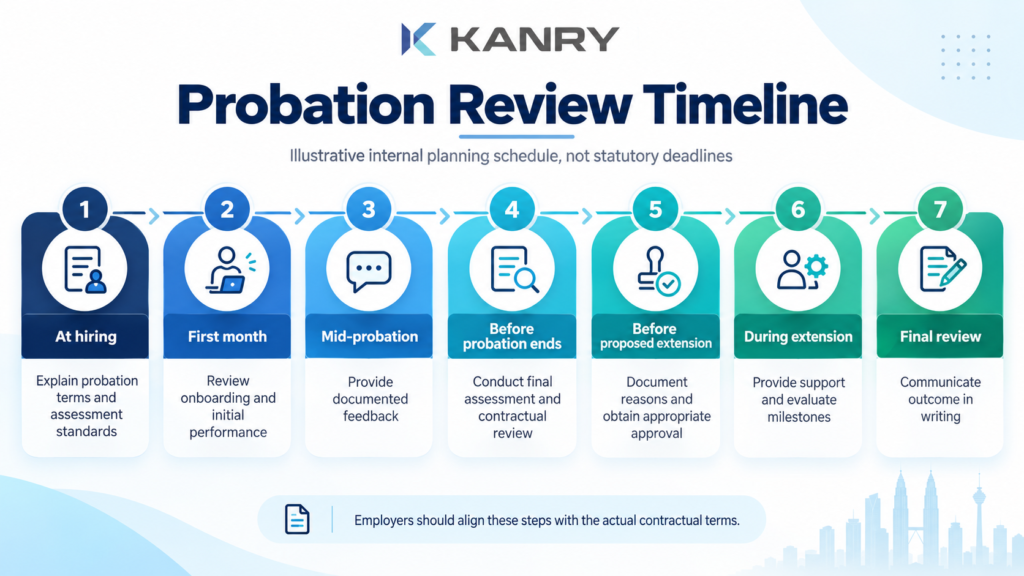
Recommended HR Timeline
Illustrative internal planning schedule, not statutory deadlines.
Can an Employer Terminate an Employee During Probation?
Probationary status does not create an unrestricted right to dismiss.
Where an employer considers termination or non-confirmation due to poor performance, it should examine the evidence, applicable employment terms and relevant industrial relations principles.
The Malaysian Employers Federation explains that probationers enjoy protection against dismissal without just cause or excuse.
An employee who considers a dismissal unjustified may seek the applicable industrial relations remedy.
The Department of Industrial Relations states that a Section 20 representation generally must be filed within 60 days of dismissal, and it may also be filed during the notice period.
Notice Is Not the Same as Justification
An employment contract may specify a notice period during probation.
Complying with notice provisions is important, but the ability to give notice does not automatically answer whether a dismissal has just cause or excuse.
Employers should also distinguish inadequate performance from misconduct.
Where serious misconduct is alleged, a separate disciplinary assessment may be appropriate.
When Legal Advice Is Especially Important
Obtain case-specific advice where:
- The employee disputes the performance assessment.
- The contract is silent or ambiguous about extension.
- Several extensions have already occurred.
- The employee may have been treated as confirmed.
- The employee alleges discriminatory treatment.
- The employer is considering termination without substantial documented performance evidence.
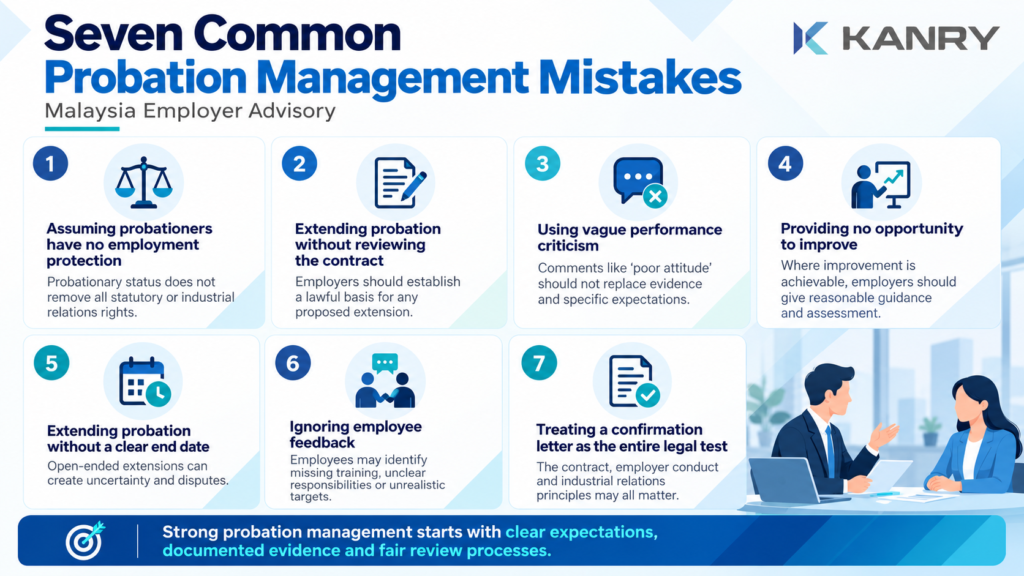
Seven Common Probation Management Mistakes
How to Improve Probation Decisions Across the Organisation
A company with multiple departments should avoid leaving probation decisions entirely to individual manager preferences.
HR should establish a consistent review framework while allowing job-specific competency requirements.
Recommended Governance Controls
| Control | Purpose |
|---|---|
| Standard review template | Consistent evaluation |
| Job-specific competencies | Relevant assessment criteria |
| Mid-probation feedback | Earlier identification of problems |
| HR review of extension proposals | Contractual and procedural oversight |
| Written development plans | Clear improvement expectations |
| Final review date tracking | Avoid delayed decisions |
| Central recordkeeping | Preserve evidence and decisions |
For organisations with several manufacturing or logistics sites, these controls can help reduce inconsistent treatment.
At the same time, employers should avoid turning performance reviews into a box-ticking exercise.
The quality of evidence and the fairness of the decision remain more important than the number of completed forms.
How Kanry Search Can Support Employers
Probation decisions are closely connected with recruitment quality, realistic job design and workforce planning.
An employer who repeatedly extends probation across a department may need to examine whether the problem begins earlier in the hiring process.
Possible underlying causes include unclear job descriptions, inconsistent candidate assessment, insufficient onboarding or unrealistic performance expectations.
Kanry Search supports organisations in Malaysia and Singapore through permanent recruitment, executive search, temporary and contract staffing and HR shared services.
For manufacturing, engineering, logistics and professional-services employers, effective recruitment should identify the competencies required for successful performance, not simply match candidates to job titles.
Strengthen Recruitment and Employee Performance Outcomes
Whether your organisation is reviewing its hiring requirements, expanding its workforce or improving HR administration, Kanry Search can discuss suitable recruitment and workforce-support arrangements.
Contact Kanry Search to speak with our team.
Probation Extension Malaysia — Frequently Asked Questions
Can an employer extend probation in Malaysia?
A probation extension may be possible depending on the employment contract, applicable policies and circumstances. Employers should review the contractual basis, communicate the decision appropriately and avoid arbitrary or indefinite extensions.
Is probation legally limited to three or six months?
There is no single general three-month or six-month probation limit prescribed by the Employment Act 1955 for all private-sector employees. The applicable employment terms and legal framework must be reviewed.
Can an employee be terminated during probation?
Probationary status does not eliminate protection against dismissal without just cause or excuse. Employers should establish a supportable reason and follow applicable contractual and legal requirements.
Does an employee automatically become confirmed when probation expires?
Not necessarily. The position depends on the contract and relevant employer conduct and circumstances. Employers should not assume that continued silence resolves the employee’s confirmation status.
Must employers use a Performance Improvement Plan?
There is no universal statutory PIP template for every probationer. A documented improvement plan is a recommended HR tool where specific performance gaps need to be addressed and evaluated.
What should a probation extension letter include?
A useful letter identifies the contractual basis, proposed extension dates, performance areas requiring improvement, measurable targets, available support and final review arrangements. Changes to employment terms should be handled appropriately.
Can an employee challenge non-confirmation?
An employee who considers that non-confirmation amounted to dismissal without just cause or excuse may have recourse under Section 20 of the Industrial Relations Act 1967. The correct legal outcome depends on the facts and circumstances.
Official References
- Employment Act 1955 — JTKSM
- JTKSM — Acts and Guidelines
- Department of Industrial Relations — Section 20 Dismissal Representations
- Malaysian Employers Federation — Probationers and the Law
This article provides general employer guidance. The legal position in individual cases depends on the contract, relevant case law, applicable jurisdiction and circumstances. Employers should obtain professional advice before a contested non-confirmation or termination.